
By Dr. Anthony O. Kellum, Contributing Columnist
For generations, the national conversation about Black economic progress has followed a familiar script. We debate educational attainment, workforce participation, entrepreneurship and voting rights as though each representsthe next frontier of equality. These conversations matter. They have reshaped public policy, dismantled legal barriers and expanded opportunity in ways that would have seemed unimaginable to previous generations. Yet they often overlook a quieter question, one that has shaped American prosperity for centuries who owns the assets that appreciate while everyone else is working?
The question is not merely academic. It goes to the heart of how wealth is created in the United States. Income provides security, but ownership creates permanence. A paycheck pays today’s expenses; appreciating assets finance tomorrow’s opportunities. That distinction has always mattered, but it carries particular significance for Black Americans because our history is not simply one of exclusion from opportunity. It is also a history of exclusion from ownership.
For much of American history, Black Americans were denied meaningful access to the country’s most powerful engine of wealth creation property. Redlining restricted where Black families could purchase homes. Federal housing policies helped millions of white families build equity while routinely excluding Black households from the same opportunities. Restrictive covenants, discriminatory lending practices and unequal access to mortgage credit did more than separate neighborhoods. They separated generations of Black families from decades of appreciation that quietly transformed homeownership into the foundation of middle-class wealth.
Those laws have largely disappeared. Their consequences have not.
Today, the Black homeownership rate remains well below that of white households, and the racial wealth gap remains one of the most persistent features of the American economy. It is tempting to explain these disparities through the language of personal responsibility or changing market conditions. Certainly, individual decisions matter. But those explanations alone cannot account for gaps that have persisted across generations. A more convincing explanation is that ownership compounds, and exclusion compounds with it.
That observation can feel uncomfortable in a culture that rightly celebrates education, professional achievement and hard work. Those remain essential ingredients of economic mobility. Yet they are not, by themselves, the principal engines of wealth creation in America. The American economy has always rewarded ownership more generously than labor. Wages are earned once, assets appreciate repeatedly, one produces income the other produces leverage.
This is why the story of American wealth is, at its core, a story about property.
For most middle-class families, a home is far more than shelter. It is the largest asset they will ever own and, in many cases, the first opportunity to convert monthly payments into long-term equity. Over time, appreciation expands a family’s financial capacity in ways that wages alone rarely can. Equity finances college education, provides collateral to launch businesses, creates a cushion during economic downturns and becomes an inheritance that allows the next generation to begin life with advantages their parents never had.
Viewed through that lens, some of the most consequential public policies in American history were not simply about separating Black Americans from white Americans. They were about separating Black Americans from ownership. Redlining did not merely determine where Black families could live; it determined where they could accumulate equity.
Restrictive covenants did not simply organize neighborhoods; they influenced which communities would appreciate and which would remain undervalued. Discriminatory lending practices did not merely deny mortgages; they denied participation in one of the greatest periods of wealth creation in modern American history.
The laws changed. The mathematics did not.
Much of today’s public conversation about racial inequality still focuses on income, educational attainment and employment. Those discussions are necessary, but they sometimes obscure a more fundamental divide: the difference between earning and owning.
A physician earning a substantial salary while renting for thirty years may ultimately accumulate less wealth than a family with a more modest income that purchased a home decades earlier in a neighborhood that steadily appreciated. The comparison is not intended to diminish education or professional success. It illustrates a larger truth about how wealth actually accumulates. Ownership changes the equation because ownership allows time to work on behalf of the owner.
That reality should shape how we think about the future of Black economic progress.
The Black middle class has never been more educated or professionally accomplished than it is today. Black Americans lead Fortune 500 companies, serve on federal courts, teach at the nation’s leading universities, build innovative businesses and occupy positions that previous generations could scarcely imagine. These achievements deserve recognition. They represent extraordinary progress against barriers that once seemed immovable.
Yet professional advancement has not translated into proportional gains in household wealth. One reason is that income grows incrementally while assets compound exponentially. Families that purchased homes decades ago often experienced appreciation that exceeded what they could have accumulated through wages alone.
Those gains became down payments for larger homes, capital for businesses, financial protection during recessions and inheritances for children and grandchildren. Families excluded from those same opportunities lost more than property. They lost time. And in investing, time is often the most valuable asset because compounding rewards patience over generations.
This is why the conversation about Black advancement should evolve beyond access. Access remains essential. Equal opportunity remains non-negotiable. Strong civil rights protections, fair lending laws, quality education and equitable public investment continue to matter profoundly. But history suggests that access, by itself, does not guarantee wealth. Ownership does.
That may be the defining economic challenge of the twenty-first century. The twentieth century was rightly devoted to securing equal rights under the law. The next chapter must be equally committed to expanding participation in wealth creation.
That means encouraging sustainable homeownership, strengthening financial literacy around equity and leverage, supporting Black developers and Black-owned financial institutions, and teaching young professionals that the first appreciating asset they acquire may shape their family’s future more profoundly than the first prestigious title they earn.
Ownership is not simply a private financial decision it is a civic one. Communities with higher rates of ownership tend to exercise greater influence over their schools, their neighborhoods and their local economies because owners possess both a financial stake and a generational stake in the future of the places they call home. They are not simply residents; they are investors in the long-term success of their communities.
Governments will change. Presidents will come and go. Tax codes will be rewritten. Markets will expand and contract. Interest rates will rise and fall. Those cycles are inevitable. But families who own appreciating assets possess something that is less vulnerable to political change. The family that purchased a home twenty-five years ago benefited from decades of appreciation regardless of which party controlled Washington. Public policy mattered. Economic cycles mattered. Yet ownership created something more durable than political certainty. It created equity, leverage and the capacity to transfer opportunity from one generation to the next.
For generations, Black Americans fought courageously for access to the American promise. That struggle transformed the nation and remains unfinished. But perhaps the next chapter requires asking a different question. Not simply whether Black Americans have access to opportunity, but whether they are building ownership in the assets that shape the nation’s wealth.
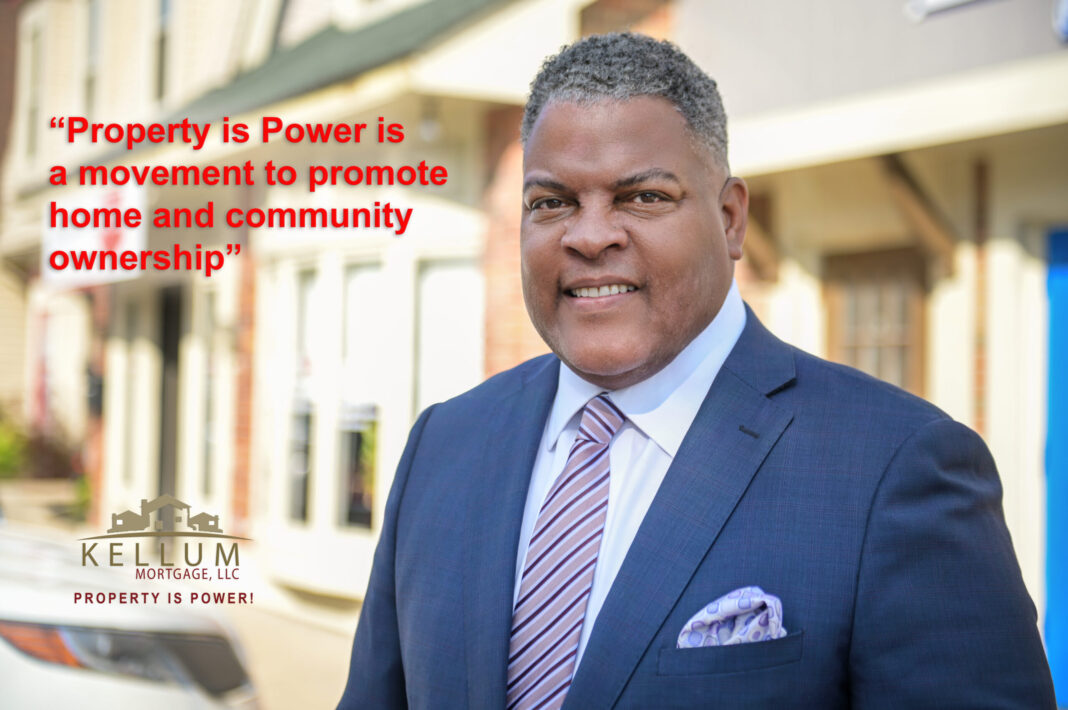
Property is Power! is a movement to promote home and community ownership. Studies indicate homeownership leads to higher graduation rates, family wealth, and community involvement.