
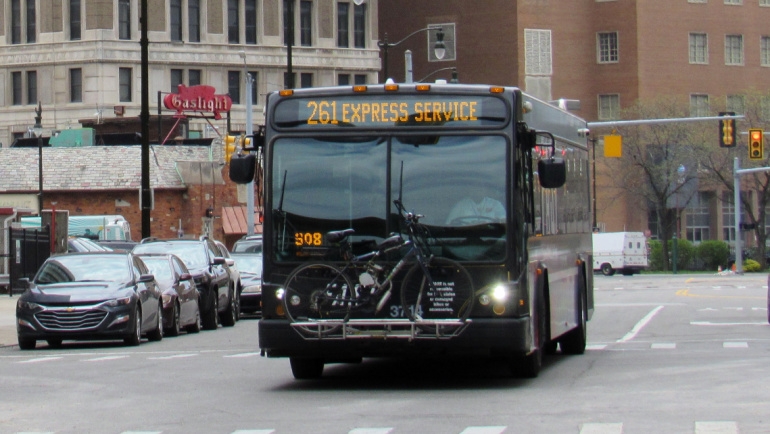

A major stretch of Gratiot Avenue that serves thousands of daily bus riders across Detroit and Macomb County is set to receive significant transit and pedestrian improvements after the Suburban Mobility Authority for Regional Transportation (SMART) secured a $25 million federal grant.
The funding, awarded through the federal Better Utilizing Investments to Leverage Development (BUILD) program, will support SMART’s Gratiot SMART Spaces Implementation Project, a 23-mile corridor improvement initiative designed to make bus service safer, faster and more accessible from St. Antoine Street in Detroit to 23 Mile Road in Macomb County.
The project includes improvements at 19 transit stations and will introduce new pedestrian safety features, upgraded passenger amenities and traffic enhancements intended to improve reliability for riders who depend on one of Southeast Michigan’s busiest transit corridors.
SMART officials said the grant reflects years of investment in regional transit and collaboration among local, state and federal partners.
“For the rider waiting on Gratiot in January, this grant means a warm shelter, a crossing that is safe to use, and a bus that arrives when the sign says it will,” said Tiffany J. Gunter, SMART’s CEO and general manager. “Our drivers, planners, and community partners have built a system worth investing in. This award is proof that when we invest local dollars in that system, we can bring federal dollars home to match them.”
SMART also credited Michigan’s congressional delegation, including U.S. Sen. Gary Peters, for supporting federal transit funding that helped secure the award.
The Gratiot Avenue corridor has experienced significant public and private investment in recent years, particularly within Detroit. Along portions of the corridor near Eastern Market and downtown, new residential developments, retail businesses, restaurants and commercial projects have reshaped long-vacant properties. The opening of developments such as the City Modern neighborhood, continued expansion around Eastern Market, improvements near the Rivertown district and new small businesses along the lower Gratiot corridor have increased activity while bringing more residents and workers to the area. Streetscape improvements, roadway reconstruction and investments tied to neighborhood revitalization have also contributed to renewed growth along sections of the avenue.
As development has accelerated, transportation planners have increasingly emphasized the need for transit infrastructure that keeps pace with growing demand and improves connections between Detroit and neighboring communities.
The Gratiot SMART Spaces project is intended to address both rider experience and traffic safety. Planned improvements include high-visibility pedestrian crossings, transit signal priority technology that allows buses to move through intersections more efficiently, queue jumps that help buses bypass congestion, bus bulbs that reduce boarding times, real-time passenger information displays and modernized shelters equipped with seating and weather protection.
The project also includes level boarding at key stations to improve accessibility for seniors, people with disabilities, parents traveling with strollers and other riders who benefit from easier boarding.
“Gratiot Avenue ties Wayne and Macomb Counties together, and for decades it has carried more riders than almost any corridor in the region,” said John P. Rea, chair of the SMART Board of Directors. “This investment means the workers, students, and seniors who depend on this corridor every day will have service that is safer, faster, and built to last.”
Wayne County Executive Warren C. Evans said the project represents the value of regional cooperation.
“Thousands of Wayne County residents count on Gratiot Avenue every single day,” Evans said. “When we work as one county and one region, we can compete for and win investments like this. That is what partnership delivers for the people we serve.”
Macomb County Executive Mark A. Hackel said the corridor has long served as an economic and transportation backbone for Southeast Michigan.
“Gratiot Avenue has always been one of our region’s most significant transportation corridors,” Hackel said. “For decades, it has connected communities, supported economic growth, revitalized neighborhoods and carried more transit riders than nearly any other route in Southeast Michigan. Macomb County has always believed in reliable, community-driven transit. This grant means better shelters, safer roads and faster service for our residents.”
According to SMART, ridership along its key transit corridors, including Gratiot Avenue, increased 40% between February 2025 and February 2026, reflecting continued demand for reliable public transportation throughout the region.
Transit officials say the planned improvements are expected to reduce crashes, shorten travel delays and improve overall rider comfort while making bus service more dependable.
The agency also found that the Gratiot SMART Spaces project is projected to generate more than four dollars in public benefit for every dollar invested. Those benefits include travel time savings, improved safety, increased accessibility and broader economic impacts tied to more efficient transportation.
Gratiot Avenue remains one of metro Detroit’s most heavily traveled corridors, linking residents to employment centers, healthcare providers, educational institutions and commercial districts across Wayne and Macomb counties. Thousands of workers rely on the route each day to commute between Detroit and suburban communities, while students, seniors and residents without personal vehicles depend on the corridor to access essential services.
Construction on the project is expected to begin in 2028, with the upgraded corridor anticipated to enter service in 2030.
Once completed, the improvements are expected to modernize one of Southeast Michigan’s busiest bus routes while strengthening connections between neighborhoods, businesses and employment centers that continue to shape the region’s economic growth.