
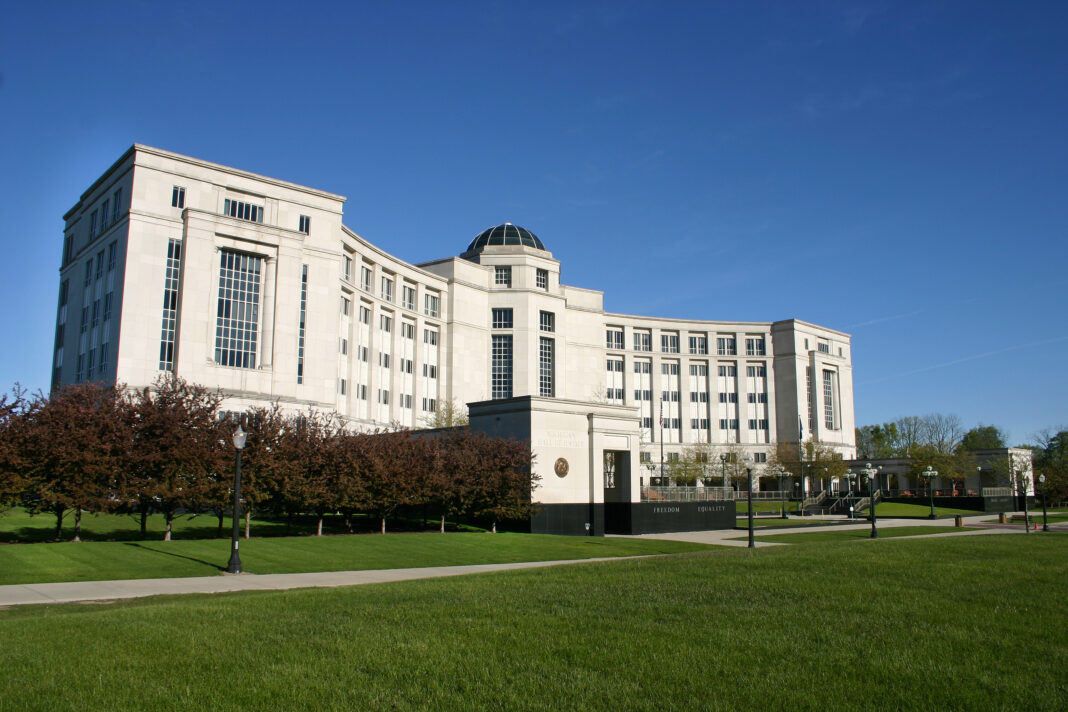

A woman shows up to court to testify, not knowing if walking through those doors could change more than the outcome of her case. For years, that quiet fear has shaped how some people engage with the justice system—especially immigrants navigating civil proceedings.
This week, Michigan Supreme Court moved to redraw that line.
The court adopted a new rule Wednesday prohibiting civil arrests in and around court proceedings, including administrative immigration arrests often carried out by U.S. Immigration and Customs Enforcement. The rule takes effect May 1 and marks a significant shift in how Michigan courts protect access to the legal system.
Under the new policy, “parties, attorneys, and subpoenaed witnesses are not subject to civil arrest while going to, attending, and returning from” required court appearances. The protection extends beyond the courtroom itself, covering what the court defines as “reasonable and direct travel” to and from those proceedings.
For communities already navigating legal vulnerability, that language carries weight.
Civil immigration warrants—unlike criminal warrants—are administrative and not issued by a judge. Advocates have long argued that their use in or near courthouses discourages participation in legal proceedings, undermining due process and accountability.
Public response to the proposed rule reflected that concern. More than 2,500 comments were submitted to the court in just over a month, signaling strong engagement from legal professionals, advocacy groups, and residents across the state. Support came from Dana Nessel, state lawmakers, and organizations including the State Bar of Michigan.
Nessel, in written comments to the court, pointed to prior federal practices that limited immigration enforcement in sensitive locations like courthouses. She argued those policies demonstrated that enforcement could continue without disrupting access to justice.
“The impact of the proposed amendment on ICE’s operations will be minimal,” Nessel wrote, adding that any disruption is outweighed by the need to protect participation in the judicial system.
Michigan now joins a growing list of states—including New York, Connecticut, and Illinois—that have enacted policies limiting immigration enforcement activity in or around courthouses. These measures are rooted in a broader national debate over how to balance federal immigration authority with state-level responsibility to maintain fair and accessible courts.
Within the court itself, the decision was not without disagreement.
Justice Noah Hood issued a concurring opinion emphasizing that the rule falls squarely within the court’s authority to manage courtroom operations. He framed the change as necessary to maintain order and ensure that individuals can participate in legal proceedings without interference.
“The rule functions to maintain order in courthouses and courtrooms,” Hood wrote, underscoring that it does not interfere with the powers of federal or state officials to enforce immigration law outside those protected contexts.
Justice Brian K. Zahra, the court’s lone Republican, issued a dissent, calling the rule “a political statement framed as a solution in search of a problem.” Zahra argued there is little evidence of courthouse-based immigration arrests in Michigan and raised constitutional concerns tied to the Supremacy Clause, which establishesfederal law as the highest authority.
“State courts have no authority to void a federal arrest,” Zahra wrote, warning that the rule could give individuals a false sense of protection if federal agents choose to act.
That tension—between perceived protection and actual enforcement limits—sits at the center of the policy debate. While the rule restricts civil arrests tied to courtparticipation, it does not eliminate federal authority. Instead, it draws a boundary around the judicial process itself, signaling that access to the courts should not come with added risk.
The timing of the rule’s adoption also intersects with legislative efforts underway in Lansing. A package of bills advancing through the state Senate seeks to further limit immigration enforcement actions in certain locations, including courthouses, and would place additional restrictions on federal officers, such as limiting the use of face coverings. While Democrats control the Senate and are expected to pass the bills, their future remains uncertain in the Republican-led House, where Speaker Matt Hall has declined to take up similar proposals.
For now, the court’s rule stands as one of the most immediate changes affecting how people move through Michigan’s legal system.
At its core, the decision speaks to a fundamental question: who feels safe enough to show up.
Courtrooms rely on participation—witnesses willing to testify, defendants willing to appear, families willing to engage with a system that shapes outcomes in housing, employment, and custody. Data and legal scholarship have consistently shown that fear of enforcement can suppress that participation, particularly among immigrant communities, though precise statewide figures on courthouse-related arrests remain limited.
What the Michigan Supreme Court has done is remove one layer of uncertainty from that equation.
Starting May 1, showing up to court in Michigan will carry a clearer expectation: that the path to justice—at least within the bounds of civil arrest—will not double as a point of detention.