
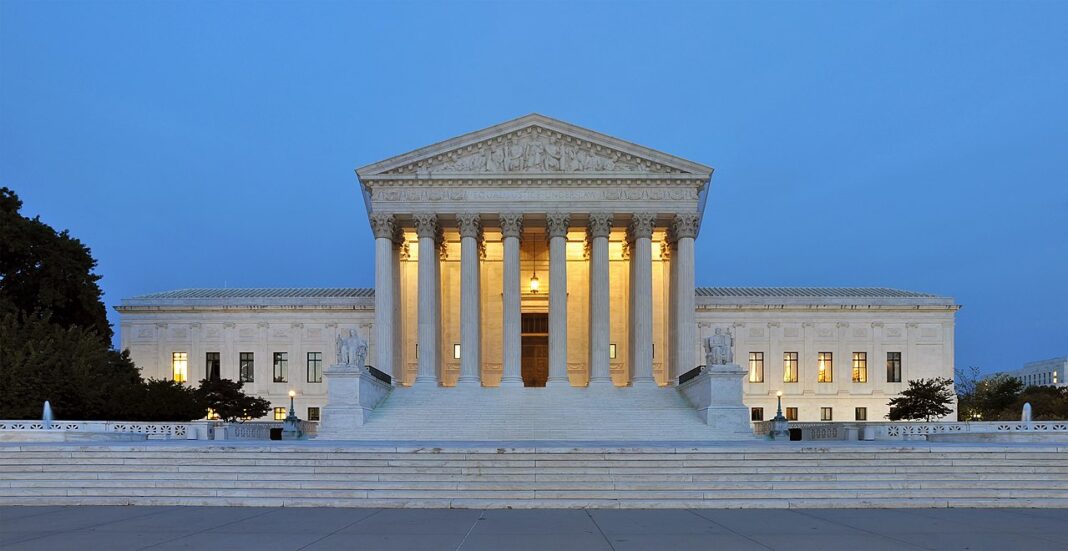

A Supreme Court decision handed down this week is already reshaping the political ground beneath Black representation in Congress, with legal scholars, civil rights advocates, and lawmakers warning that the ruling could accelerate a rollback decades in the making.
At the center of the shift sits the Court’s ruling in Louisiana v. Callais, where the conservative majority reinterpreted how Section 2 of the Voting Rights Act of 1965 should be applied. The decision narrows the scope of protections that have long been used to challenge maps diluting the voting strength of Black communities.
That legal change arrives at a moment when redistricting battles are already underway across the country—and it opens the door for states, particularly those under Republican control, to revisit congressional maps with fewer federal guardrails.
From Louisiana to North Carolina, redistricting experts have pointed to at least 15 congressional districts with significant Black populations that could face restructuring or outright elimination. Additional states like Texas and Missouri have already signaled willingness to revisit maps in ways that could further reduce the number of majority-Black or coalition districts.
What unfolds over the next several months remains uncertain. Some states have already moved through primary elections, limiting how quickly new maps could take effect. Still, the long-term implications are clearer: fewer protections against racial vote dilution, more aggressive map-drawing, and a renewed fight over who gets represented in Washington.
For Black political representation, the stakes are measurable.
Michigan’s fight over voting rights is already moving on the ground. Days before the Supreme Court ruling, the Michigan Chronicle reported from the Detroit Branch NAACP Freedom Fund Dinner, where House Democratic Leader Hakeem Jeffries, Detroit Branch NAACP President Rev. Dr. Wendell Anthony, and other civil rights leaders warned against the growing push to tighten voting rules under the banner of election integrity.
That warning carries weight now. The same political climate surrounding the Supreme Court’s ruling is also showing up in Michigan through the Americans for Citizens Voting proposal, a Republican-backed initiative that submitted well over the 450,000 signatures required to move toward the November ballot. If enough signatures are certified by the state, Michigan voters will be asked to decide whether to add new voter ID and citizenship-related requirements to the state Constitution.
Rev. Dr. Wendell Anthony told the Michigan Chronicle he expects to be part of a concerted opposition effort against the proposal. “They have collected over 700,000 signatures — that means people have been keyed up for that, and they paid a lot of money to get these signatures,” Anthony said. “And sometimes people may not know what they’ve signed. Somebody in the store, post office asked you to sign and you signed because a person looks so pitiful.”
Lt. Gov. Garlin Gilchrist, who recently earned the Democratic Party’s nomination for Secretary of State, also joined NAACP leaders in calling for an opposition campaign. Gilchrist said the premise of the proposal is misleading because noncitizen voting is already illegal.
“Our message is it’s already illegal to vote if you’re not a citizen,” Gilchrist told the Michigan Chronicle during the NAACP dinner. “If someone gets discovered attempting to do that, they get prosecuted and held accountable. We will need to make sure that we are reminded that we have already solved this problem, and that we don’t need attempts to make it harder for more people to vote or make it illegal to people who already can’t vote.”
That context matters because the fight over voting rights is no longer confined to Southern redistricting maps or courtroom arguments in Washington. Michigan voters are watching the same national strategy arrivethrough petitions, ballot proposals, and legal challenges. For Detroit, where Black voters have long carried the weight of statewide Democratic victories, the question is direct: whether new rules will protect elections or place new burdens on the very communities whose access has always had to be defended.
Following the passage of the Voting Rights Act in 1965, the number of Black members in the U.S. House steadily increased, supported in part by the creation of majority-Black districts designed to ensure compliance with federal law. Today, there are roughly 63 districts represented by Black lawmakers, accounting for about 14% of the House.
That number reflects decades of litigation, organizing, and policy work aimed at dismantling barriers that once kept Black voters from the ballot box—and from electing candidates of their choice.
History offers a sharper frame.
After Reconstruction ended in 1877, Black representation in Congress collapsed. For nearly a century, the number of Black members in the House hovered in the single digits or dropped to zero, shaped by Jim Crow laws, voter suppression, and racially discriminatory districting practices.
Legal protections under the Voting Rights Act changed that trajectory. Section 2, in particular, allowed courts to block maps that diluted minority voting power, even without explicit proof of intentional discrimination.
The Court’s latest ruling shifts that standard.
By emphasizing the need to prove intentional discrimination rather than discriminatory outcomes, the decision raises the legal bar for challenges to redistricting maps. Legal scholars say that change will make it significantly harder to contest maps that weaken Black voting strength, even when the impact is clear.
On Capitol Hill, members of the Congressional Black Caucus responded within hours of the ruling.
Rep. Yvette Clarke, who chairs the caucus, described the decision as a direct threat to Black political power.
“With this decision… the Supreme Court has opened the door to a coordinated attack on Black voters across this country,” Clarke said during a press conference. “This is an outright power grab. It’s about silencing Black voices, dismantling majority Black districts and rigging the maps so that politicians can choose their voters instead of the other way around.”
The concern extends beyond rhetoric. Redistricting has always operated at the intersection of race and partisanship. Majority-Black districts often lean Democratic, meaning changes to those maps can shift the balance of power in Congress.
That dynamic complicates how both parties may respond.
Republican-led legislatures could pursue redraws that break up majority-Black districts or reduce their influence. Some Democratic-led states may consider their own redraws, weighing whether to maintainexisting districts or spread voters across multiple districts to gain seats.
Either approach carries consequences for Black representation.
Even a modest reduction in majority-Black districts could mark the most significant decline in Black congressional representation in modern history. Civil rights advocates point out that representation is not only about numbers but also about policy influence, resource allocation, and the ability to advance legislation addressing disparities in housing, healthcare, education, and economic opportunity.
For communities on the ground, the impact of this decision will not arrive all at once. It will show up in court challenges that fail to move forward, in district lines that quietly shift, and in elections where representation no longer reflects the population.
It will also show up in places like Detroit, where the connection between policy and people remains front and center. Black political representation has long served as a bridge between community needs and federal action—whether securing funding for infrastructure, addressing environmental injustices, or advocating for equitable healthcare access.
That bridge now faces structural strain.
As states begin to test the limits of this new legal landscape, the question is no longer whether the Voting Rights Act has been weakened. That reality is already here.
The question moving forward is how communities, lawmakers, and advocates respond to a system where the protections that once safeguarded Black political power have been narrowed—and where the fight to be seen, heard, and represented returns to the forefront of American democracy.