

A new statewide poll of likely Republican primary voters is offering a clear early look at where Michigan’s 2026 gubernatorial race stands.
The survey, conducted April 21–24 by the Glengariff Group for the Detroit Regional Chamber, polled 500 likely GOP primary voters and found an engaged electorate that is already forming opinions about the field. Voters rated their likelihood of turning out at a 9.4 out of 10, a level of enthusiasm that suggests August won’t be a low-energy primary.
Roughly 41 percent of those surveyed are from the Metro Detroit region –is inclusive of Wayne, Oakland, Macomb counties and the surrounding Detroit MSA – which means what happens here will go a long way toward deciding who ultimately secures the Republican nomination.
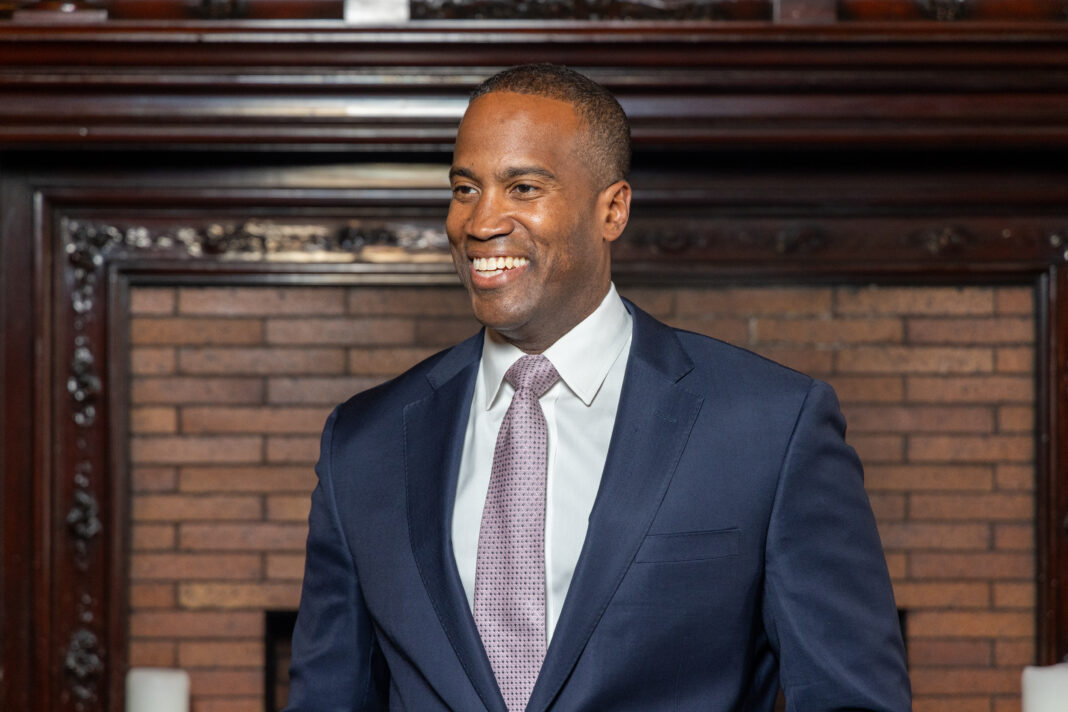
Right now, John James is out front. Statewide, he holds 37 percent support, a solid lead over businessman Perry Johnson who comes in just under 20 percent, and former Attorney General Mike Cox who sits just below 10 percent. Those numbers look even stronger when you zoom in on Southeast Michigan.
In the Detroit metro area, James pulls in 43.1 percent support. Johnson follows at 20.7 percent, and Cox lands at 13.8 percent. That gap shows where James is strongest across a state that is mostly red beyond that area.
Specifically in Wayne County, the Michigan county with the largest Black population, James is at 39.5 percent, but Cox jumps to 20.9 percent, which is where he polled highest across the state. That suggests Cox still has a base in Southeast Michigan that could grow if the race tightens. Oakland County is more competitive, with James at 30.2 percent, Johnson at 23.8 percent, and Cox at 17.5 percent. Meanwhile, Macomb County looks like a stronghold for James, where he’s nearing 49 percent support.
The poll also asked expectant voters about which candidates they know and how they feel about them. That’s another place where Metro Detroit stands out. James has nearly 90 percent name recognition statewide, but his favorability climbs higher in the Detroit region, where 62.8 percent of likely Republican voters view him positively.
Former Congressman Mike Rogers is not leading the Republican gubernatorial field, but his favorability rating in Metro Detroit is significantly stronger than in other parts of the state at 61.8 percent compared to 44 percent among all other regions.
Still, perhaps the biggest takeaway from the poll isn’t necessarily about any one candidate. It’s about the continued influence of President Donald Trump and the self-proclaimed MAGA faithful. The poll asked voters how much his endorsement could reshape the race at any moment.
The numbers are hard to ignore. According to the survey, 67.2 percent of likely Republican primary voters say they would be more likely to support a candidate who has Trump’s endorsement, including those who say they would be “much more likely” and those who say, “somewhat more likely.”
What’s notable is that this isn’t limited to one faction of the party. While 31 percent of self-identified MAGA Republicans are the most responsive to a Trump endorsement, even more traditional Republicans show some movement. And in Metro Detroit, those attitudes look almost identical to the rest of the state, suggesting that Trump’s influence isn’t diluted in urban or suburban Republican bases.
With the spotlight heavily on Michigan during this midterm election, the national influence in Michigan is hard to ignore due to sentiments of likely voters, and Trump knows well how his endorsement could be a potential gamechanger across Michigan and across the nation.
At the same time, Trump’s standing with GOP voters remains overwhelmingly strong. The poll shows 85.9 percent of Republican primary voters view him favorably. That includes broad support across regions, age groups and ideological lines, even if younger voters show slightly more skepticism.
All of that creates an interesting dynamic for candidates trying to navigate this primary.
For James, the relationship with Trump has evolved over time. During James’ Senate runs, he leaned into Trump’s support and ran closely aligned with the president’s messages. He appeared at rallies and positioned himself within that wing of the party. That alignment helped him build name recognition and credibility with Republican voters across Michigan and beyond.
But Trump’s endorsement has never been automatic, even for allies. Over the past several election cycles, he has shown a willingness to back different candidates depending on the moment. Sometimes he rewards loyalty, but sometimes he prioritizes perceived electability. He’s recently expressed discontent with James for giving up a crucial seat in Congress to pursue his gubernatorial ambitions. That has made James’ likeability take a dip among GOP leaders nationally, and that uncertainty hangs over this race.
Candidates like Johnson have made clear efforts to appeal directly to Trump’s base, leaning into messaging that aligns with the MAGA movement and positioning themselves as candidates who would carry that agenda forward. Others, like Cox and Aric Nesbitt, bring more traditional Republican resumes, with long-standing ties to party infrastructure but less direct connection to Trump’s inner circle.
There are still plenty of voters up for grabs, according to the poll. About 17.6 percent of respondents say they are undecided statewide. Even in Metro Detroit, where opinions tend to form earlier, more than 15 percent of voters haven’t settled on a candidate.
And then there’s the broader context shaping how voters are thinking. The poll shows that economic concerns are front and center, with 25.2 percent of voters naming the economy or inflation as the most important issue facing Michigan. Another 16.8 percent pointed specifically to removing the current term-limited Governor Gretchen Whitmer and shifting control of state government.
If this poll makes anything clear, it’s that the role and influence of Donald Trump is largely at play for the Republican party during the August primary. But with James holding a firm lead in these early polls, Michigan could have its first Black governor, thanks in large part due to the potential impact former Detroit Mayor Mike Duggan will have in stealing away votes from both the Democrats’ and Republicans’ nominee when the general election rolls around in November.