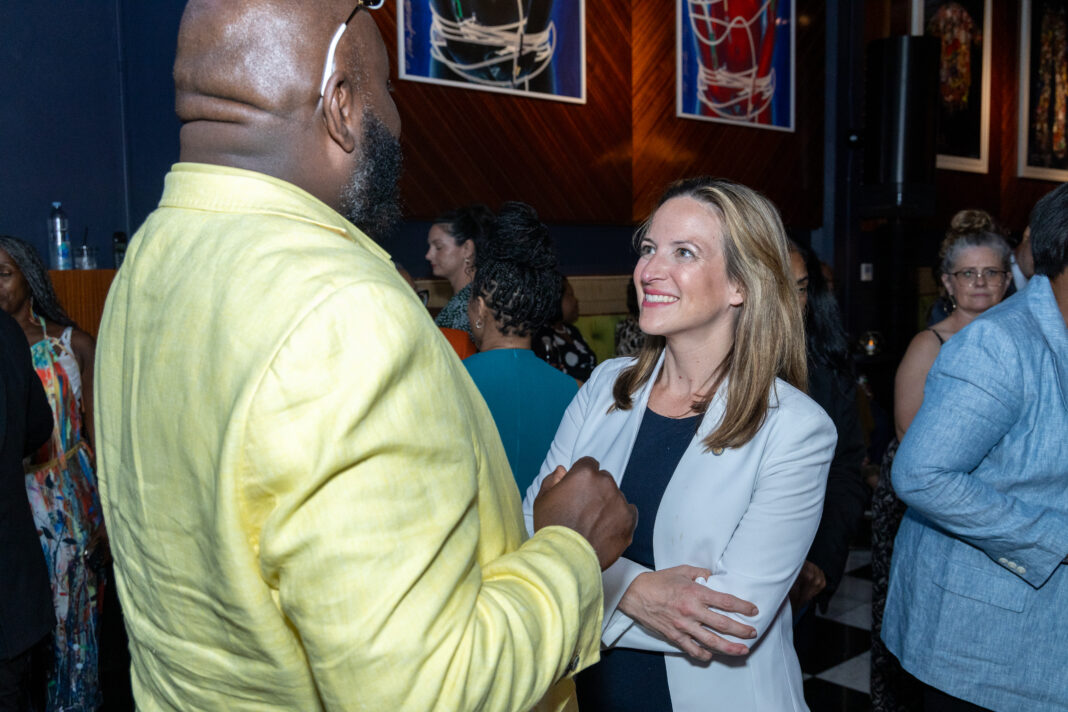


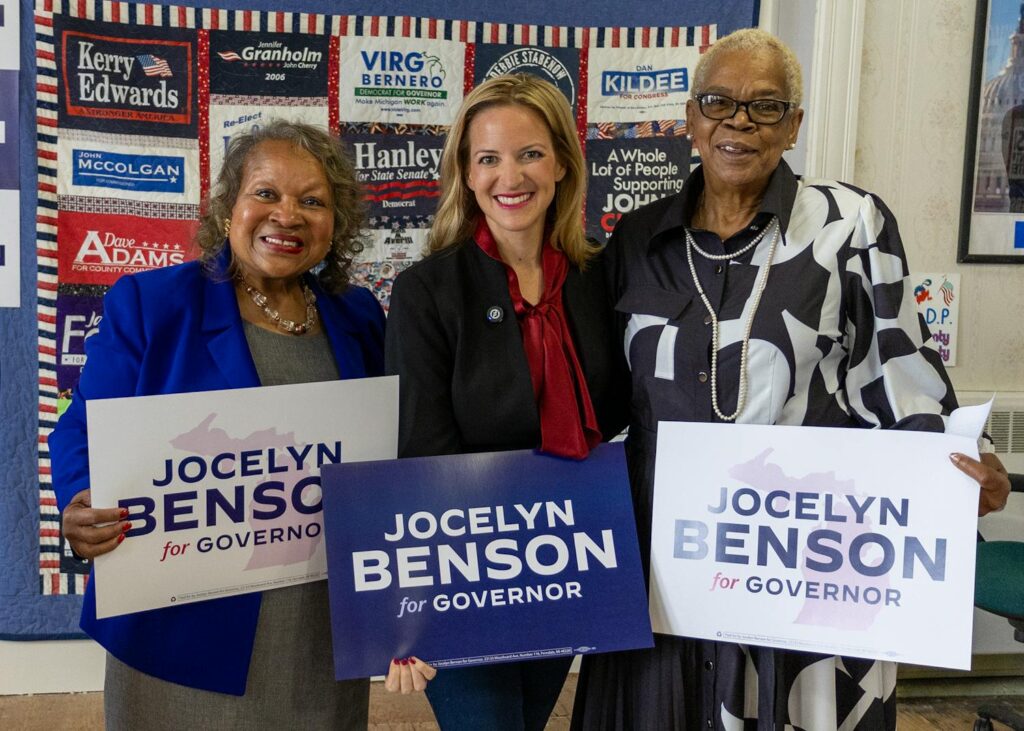
There’s not much suspense in the top line of Michigan’s Democratic primary for governor right now, as a new poll, conducted April 21–24 by the Glengariff Group for the Detroit Regional Chamber, surveyed 500 likely GOP primary voters survey of likely Democratic primary voters shows Secretary of State Jocelyn Benson with a commanding lead, pulling 66 percent support compared to just over 8 percent for Genesee County Sheriff Chris Swanson.
Nearly a quarter of voters were still undecided, but even that doesn’t meaningfully close the gap. On paper, it looks like a race that’s already settled as to who will be Michigan’s next Democratic nominee for governor.
Democratic voters across Michigan are highly motivated heading into August, the poll found, scoring their likelihood to vote at a 9.3 out of 10. Detroit voters are right there with them, even slightly above the statewide average at 9.4. That matters in a primary that will be decided by who actually shows up, and in a mid-term election where voter turnout is substantially lower than in presidential voting years.
Then there’s the question of what voters are thinking about. Across Michigan, the economy dominates, as more than 38 percent of voters cite inflation, jobs, or economic conditions as the most important issue facing their households and other Michigan families.
That economic anxiety could have been an opening for a challenger, as Benson’s competitors in this race haven’t tied her to any policies or issues directly related to the state’s economic conditions (rightfully so).
Benson’s advantage is built on a combination of high name recognition and broadly positive impressions. More than 85 percent of Democratic voters know who she is, and among those voters, she holds a strong favorable rating. Swanson, by contrast, is still largely undefined. Nearly two-thirds of voters say they’ve never heard of him, the poll shows.
That gap is even more pronounced in metro areas like Detroit, where media saturation and political awareness tend to be higher. In those spaces, not being known is often worse than being disliked.
While the poll doesn’t break out the gubernatorial vote specifically by city in the topline the same way it does for other races, the metro-versus-outstate split tells the story. Benson’s support remains strong in metro Detroit, while Swanson struggles to gain traction in the very region where Democratic primaries are often decided.
There’s also a subtle but important racial dynamic running underneath the data. Black voters – who make up a significant share of Detroit’s and Wayne County’s electorate – show slightly lower favorable ratings for Benson than white voters, though still solidly positive. This could be because of the looming racial discrimination lawsuit filed against Benson earlier this year, where four Black employees have sued Benson and the Michigan Department of State, claiming a “racially hostile work environment,” among other accusations.
But while the numbers paint a clear picture in the state’s gubernatorial race, Detroit’s influence shows up more differently when you look at the Senate primary numbers included in the same survey. That race is far more competitive.
In the Senate contest, Congresswoman Haley Stevens holds a narrow statewide lead, but her strength is heavily concentrated in metro Detroit. Among Black voters, she pulls more than 37 percent support, significantly ahead of her opponents. In Wayne County overall, she’s even stronger, approaching the mid-40s.
Statewide, Stevens, and her opponents in the primary Abdul El-Sayed and Mallory McMorrow are essentially clustered together, each drawing support in the low 20s, while more than 40 percent of Detroit voters remain undecided.
That suggests that Detroit voters are still shopping, still listening, and not yet locked into a choice in this high-profile race.
Another factor working in Benson’s favor is the broader political environment inside the Democratic base. The survey shows a party that is engaged, but also restless. Nearly two-thirds of Democratic primary voters say the two-party system isn’t working. A majority believe the Democratic Party’s values have changed over the last 20 years. The party is united on at least two issues, though: President Donald Trump. More than 97 percent of people polled had an unfavorable view of Trump and nearly 94 percent had a favorable view of current Michigan Governor Gretchen Whitmer.
Overall, voters appear to be leaning toward familiarity and stability, especially at the top of the ticket. With Whitmer’s approval rating among Democratic primary voters sitting well above 90 percent, that is a level of support that tends to benefit candidates who are seen as part of the same governing circle.
Benson, as a statewide officeholder who has been visible during high-profile moments around elections and voting rights, fits that mold.
Swanson’s path, if there is one, likely runs through that remaining undecided bloc. But time is not on his side. With fewer than one in ten voters currently backing him, and a large share still unaware of his candidacy, he would need both a rapid increase in name recognition and a compelling message that resonates in places like Detroit. That’s a tall order in a compressed primary calendar.
If anything changes between now and August, it will likely start in Detroit, where there’s a push for increased turnout, but also a high bloc of undecided voters.