


Black voters in Detroit are getting extra attention ahead of the midterm elections for U.S. Senate and governor as Republicans try to break up the largest Democratic voting bloc.
GOP candidates running statewide races in Michigan are spending more time in in the Democratic stronghold than in past election cycles.
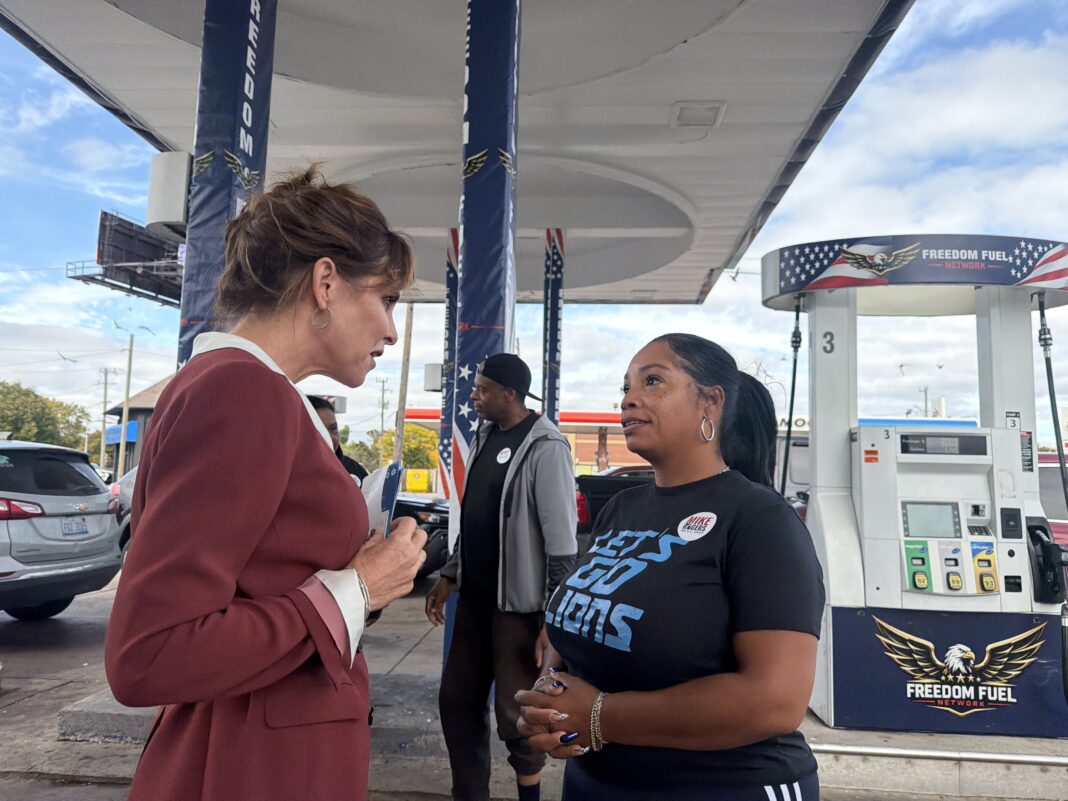
Mike Rogers’ campaign went viral Wednesday when it invited Michigan Chronicle for a stop on the city’s far east side Wednesday to highlight calls to suspend the state gas tax. His wife, Kristi Rogers, passed out $10 gas cards to excited customers at Freedom Fuel on Harper and Cadieux.
“We’re all struggling with these incredibly high gas prices and Mike knows this, which is why he’s called for the war in Iran to end,” Rogers’ wife said while recording a campaign video outside the gas station.
One of the customers to receive the gift card was east side resident Yolanda Coleman. Her and her husband plan to vote for Mike Rogers, as they’ve seen him on TV commercials, she said. Coleman pointed to the high gas prices as a reason she would support a Republican, saying she doesn’t blame the inflated prices on the president’s war in Iran.
“I really don’t know what to believe anymore because I look at both sides,” Coleman told Michigan Chronicle. “Nobody is really upholding what they’re saying and the people are suffering from all of this.”
Dennis Ester was across the Freedom Fuel when he saw Rogers and campaign staff handing out the gift cards.
“He ain’t here,” Ester said of El-Sayed. “It takes a lot of courage to come up here in the hood and come out and do this.”
El-Sayed on Wednesday was in Detroit at the historic Shrine of the Black Madonna church, where he answered questions beside Wayne County executive Warren Evans. The county executive is viewed as one of El-Sayed’s most credible endorsers among Detroit’s Black Democratic establishment, which largely supported his primary opponent.
“This is the most important candidate in my mind in the United States of America right now,” Evans said. “He worked for me for two years and I saw what he did, I saw his commitment to people who look like me.”
Black voters remain one of the most reliable constituencies for the Democratic Party, with nearly 78% supporting Democratic candidates in key battlegrounds during recent cycles. And they are still the Democratic Party’s most reliable constituents — 83% of Black voters supported former Vice President Kamala Harris.
But it wasn’t just Arab and Muslim voters who didn’t show up for Harris. In Detroit, there were 11,000 fewer voters who participated in this election than in 2020. In addition, Harris received 19,000 fewer votes than Biden. Trump received 19,667 votes in Detroit in 2024.
Much has been written about the tension between older Black voters and those sympathetic to the Palestinian cause over their support for the Uncommitted movement in February 2024. El-Sayed was among the more than 100,000 Michiganders who voted in protest of former President Joe Biden over his support for Israel during the beginning of its latest war in Gaza.
Biden and Harris supporters have argued the effort hurt the party leading up to the November election.
Detroit Branch NAACP President Rev. Wendell Anthony acknowledged the frustration in a question during the chapter’s event last month with former Vice President Kamala Harris, who came to Michigan to campaign with El-Sayed.
“People that we felt should have stood up. That’s over, you’ve came and you’ve made an endorsement. We respect that, but help some of the folks who may be holding that, and describe what the stakes are. In spite of that emotional feeling, what are you suggesting to us?” Anthony asked Harris.
Harris told Anthony she knows there was, “a whole lot of pain the night of the election, and the day after and for many days and months.”
Harris said the stakes are too high for those upset over aspects of a candidate they disagree with. Turnout directly dictates whether Democrats can flip or hold tightly contested congressional seats, she said.
“He endorsed me, the day I became the nominee,” Harris said. “I am here to support his candidacy and to encourage everyone to vote for him and get out for him. I know the history, but I’ve traveled thousands of miles… I understand if people are still carrying some pain about the outcome of that election. That’s OK, I do too. But when we look at the stakes… We cannot take ourselves out the game.”
The push to win over skeptical Black voters was clear during Harris’ visit on Tuesday, Sept. 22. El-Sayed and Harris highlighted the disparities related to Black maternal healthcare at Birth Detroit with women’s health advocates.
Kamau Clark, the lead organizer at We the People Michigan, says it’s unfair to place frustrations over Harris’ 2024 loss on El-Sayed.
“I think people look for the easy answer to decide why Kamala lost, I don’t think there was one answer. That’s underneath a lot of the racial tension folks feel. It would be much harder to talk about the fact that everybody keeps losing power this summer and everybody’s broke. I don’t know how much appearing with Kamala Harris will boost Abdul. But what will is voters feeling engaged and talked to about the things they care about. There is value in her adding her name to this race in Michigan.”
We the People has been working to connect with Arab Americans for Progress to build relationships with members of the Arab American community, Clark says. We the People is part of the Hold the Line coalition, a group of organizations across the city dedicated to countering voter suppression by protecting voters and monitoring polling locations. The group held a voter protection training event at TechTown in New Center earlier this month.
High gas prices, stagnant wages and inflation has been squeezing lower and middle-income households, over 90% of whom are Black, Clark says.
“Black voters are entitled to their feelings about the lack of economic opportunity provided to us,” Clark said.
However, he feels like the talk that Rogers could earn a major share of the votes in Detroit is overblown.
“We don’t want someone who’s just going to stamp everything that Trump wants to do,” Clark said.
In the city of Detroit, 66% of voters supported U.S. Senate nominee El-Sayed’s opponent U.S. Rep. Haley Stevens in the Aug. 4 Democratic primary. Coming out of the primary, El-Sayed’s campaign has become the most talked about in the country.
The former Wayne County health director needs Black voters in Detroit and Wayne County to turn out for him to defeat Rogers. He’s been pushing hard to win the support of Black voters who opposed him in the primary election.
Last month El-Sayed announced his own policy platform specifically for Black residents, he calls the THRIVE agenda.
Black residents across Michigan have a chance to elect the first Black governor in the state’s history in Republican U.S. Rep. John James, the party’s nominee. It’s the second time the Michigan GOP has nominated a Black candidate for governor. In 1986, William Lucas became the first Black gubernatorial nominee for either party in Michigan’s history.
But James’ campaign is getting badly outspent by his Democratic opponent, Secretary of State Jocelyn Benson, who has long positioned herself as a champion of Civil Rights. She moved to the city of Detroit two decades ago to work for the late Judge Damon Keith.
James’ campaign believes he can win over some Black voters who feel like Democrats have taken their vote for granted.
The number of Black adults identifying as or leaning Democratic dropped from 77% in 2020 to 66% in 2023. And 12% to 17% of Black adults identify as or lean Republican, according to a 2025 Gallup poll.