
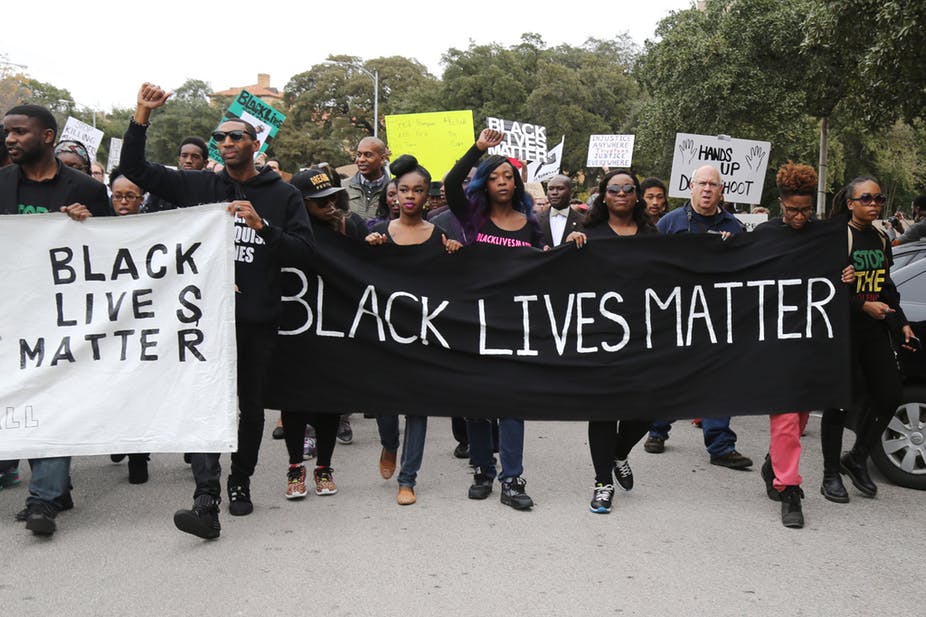

BLACK LIVES MATTER—Protesters in Pittsburgh in 2016 hold a Black Lives Matters sign and chant “What do we want?” “Justice.” When do we want it?” “Now.” (Photo by J.L. Martello)
Black Lives Matter (BLM) began in 2013 as a decentralized movement to protest systemic racism and police brutality. Local chapters spearheaded the movement by creating their own social justice campaigns and initiatives. The local chapters were associated with the Black Lives Matter Global Network Foundation (BLMGNF).
BLMGNF raised money and distributed it to local chapters.
In 2015, Time Magazine named BLM as a finalist for Time Person of the Year. Time Magazine chose BLM for their major impact on the national discourse about racism, policing, and justice in the United States.
That was a lot of attention for a relatively new social justice movement.
According to the 2015 CNN article “The Rise of Black Lives Matter: Trying to Break the Cycle of Violence and Silence,” all of the national attention forced BLM’s founders and local leaders to finally figure out what the movement was actually about and develop a long-term strategy so they could do more than demonstrate, disrupt, and “shut sh*t down,” as BLM frequently chanted.
In 2020, Patrisse Cullors, Alicia Garza, and Opal Tometi, co-founders of BLM, appeared on the cover of Time Magazine’s “100 Women of the Year” issue. Time elevated the three “groundbreaking activists” to the status of celebrities.
Unfortunately, controversies frequently surround celebrities.
In 2022, reports surfaced that Patrisse Cullors, who was also the executive director of BLMGNF, used donation money to purchase a $6 million mansion. BLM’s sharpest critics, as well as leaders of BLM’s local chapters, began to question whether all of the donations were put toward legitimate social justice causes. Cullors eventually resigned as executive director of the BLMGNF. She said to a reporter, “When you’re living in a White supremacist, capitalist country, movements for Black liberation are really difficult to sustain.”
Sean Campbell, an investigative journalist and adjunct professor at Columbia Journalism School, told NPR that the problem was BLMGNF and BLM were not treated as separate entities, and BLM’s movement was being unfairly maligned.
To commemorate BLM’s tenth anniversary, LA Times columnist Erika D. Smith stated that the BLMGNF scandal eroded public trust in BLM’s prominent personalities, but the movement remained powerful. The movement was being taught in schools, parents were talking about it with their kids, and previously neglected ideas like structural racism, White privilege, and equity—rather than equality—were suddenly part of the daily language of millions of Americans.
In other words, there was still a reason to trust and support local BLM chapters that carried out the movement’s actual mission—until the recent scandal at a local chapter.
USA Today reported, “Tashella Sheri Amore Dickerson, 52, the executive director of Black Lives Matter OKC (BLMOKC), was accused of embezzling more than $3 million in funds, the U.S. Attorney’s Office for the Western District of Oklahoma said on Dec. 11. She was indicted on Dec. 3 with 20 counts of wire fraud and five counts of money laundering. She is accused of using the funds on recreational travel to Jamaica and the Dominican Republic, food and groceries for herself and her children, retail shopping, a personal vehicle, and six properties in Oklahoma City.”
The funds in question were used to pay bail for demonstrators following George Floyd’s death in 2020. Apparently, Dickerson placed $3 million in returned bail checks in her account rather than the BLMOKC’s.
The editorial board of the New York Post went on to remark that Dickerson is typical: in fact, most BLM branches operate as slush funds for their local leaders. They went on to say that last year, the DOJ charged the previous director of Black Lives Matter of Greater Atlanta with stealing $450,000 in donations.
That solitary case, together with Dickerson, does not support the editorial board’s conclusion that the majority of local BLM officials embezzle donor money.
However, the BLM name has been tainted to the point where leaders of local BLM chapters who have never been involved in corrupt activities and continue to develop initiatives to challenge systemic racism and police brutality should consider rebranding their organizations.