
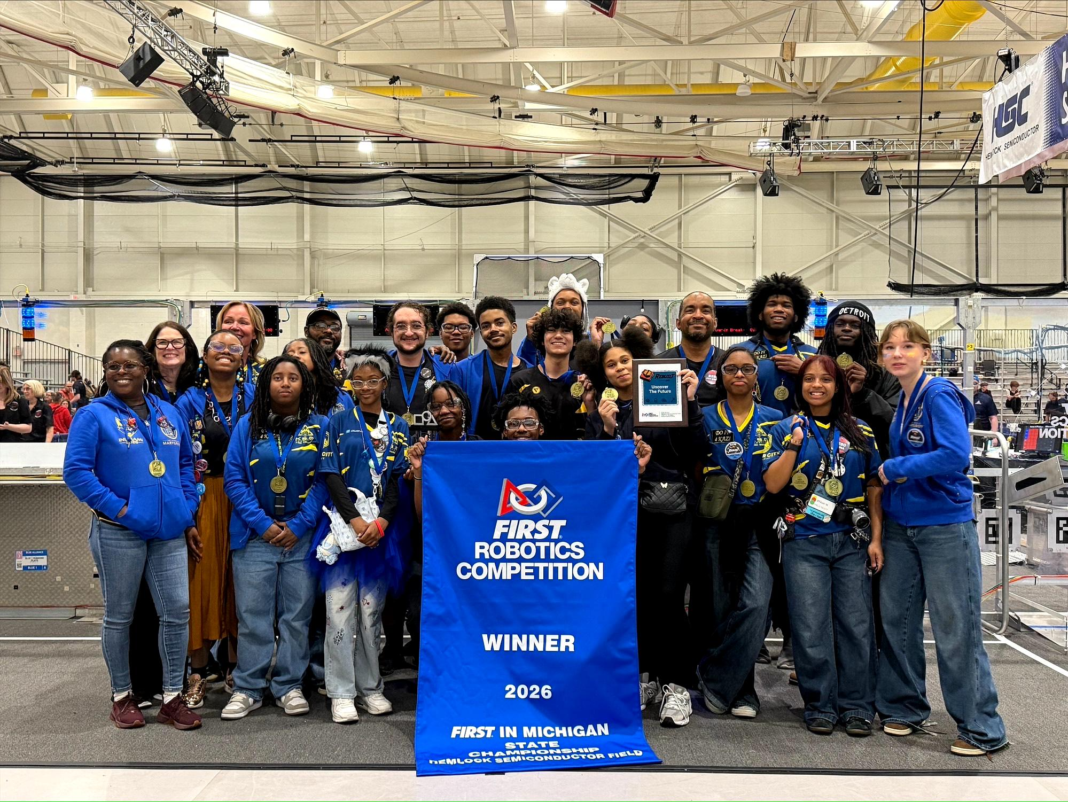


A beautiful thing is happening at The School at Marygrove, and it is moving with speed, precision, and purpose.
Next week, Marygrove’s robotics team, Team 8280 K9.0 Robotics, will head to the FIRST Robotics World Championship in Houston, marking the first time in 18 years that a Detroit Public Schools Community District high school has qualified for the global stage. The last DPS school to make it to Worlds was Chadsey High School in 2008.
For Marygrove, the moment carries more than excitement. It reflects years of rebuilding, relentless learning, and the kind of student achievement that signals what is possible when talent, discipline, and opportunity meet.
“We’ve long set the goal of wanting to get to the world championships, and we knew that Detroit teams hadn’t been in quite some time,” said head coach Leon Pryor. “So it was really important for us to break through that ceiling.”
That ceiling did not crack overnight.
Marygrove’s team was relaunched just four years ago. Today, the team of 13 students in grades 9 through 12 has risen to become one of the strongest robotics programs in the state. They ranked 25th out of 531 teams and earned the “Gracious Professionalism Award,” a recognition that honors teams who compete with excellence while showing respect, collaboration, and integrity.
Pryor said the team’s rise came through a mindset rooted in steady growth.
“We use a technique, which I learned in industry, called Kaizen, which is the principle of continuous improvement,” Pryor said. “We’re always looking at ways to make our team 3 to 5% better. What ends up happening is that that 3 to 5%, when you project that over years, ends up being quite large.”
That approach has helped transform Marygrove into a place where students are not simply participating in robotics but building at a world-class level.
“Our kids have entered the world class and are now building world-class robots,” Pryor said.
That achievement is visible in the team’s robot, “Inugami,” named after the Japanese phrase for “dog spirit.” The name fits the team’s canine-inspired identity and continues a tradition of naming robots after legendary dogs. Pryor said the students vote on the names each year, but the engineering behind this year’s robot is no game.
Built entirely from scratch at Marygrove beginning in January, Inugami is now rated among the top 13% of robots in the world based on scoring ability. The machine has 16 motors, two cameras for computer vision navigation, and the ability to move in any direction at high speed. It can collect game pieces rapidly and shoot 50 balls into a target in about three seconds.
“Our robot can literally shoot 12 to 15 balls per second,” Pryor said. “It’s amazing when it shoots. You just see this waterfall of balls flying into the target.”
The robot also includes an optical targeting system that allows it to identify the target and aim itself with accuracy.
“The kids don’t aim the robot,” Pryor said. “The robot actually knows where the target is and they hit a button and it aims itself so that we have perfect accuracy wherever we go.”
What makes that even more striking is who built it.
“All of this was designed, fabricated and built by Detroit kids,” Pryor said.
That point matters deeply to Pryor, an engineer and a DPSCD parent whose own son first pulled him into robotics years ago when he was still in elementary school. Pryor said he got involved after seeing his son’s team struggle and deciding to use his engineering background to help.
“I told my son that I was going to get involved and use my decades of engineering experience,” Pryor said. “And I’ve just been kind of following him since.”
That path eventually led him from elementary robotics to middle school competition and then to Marygrove, where he was asked to help rebuild the program after COVID. He said the transition to coaching high school robotics brought new demands, including heavier, faster, more complex machines and a constant need to keep learning alongside students.
“I’ve been studying robot control theory, fabrication, materials,” Pryor said. “I’m often learning the stuff 30 minutes before I teach the kids, but that journey’s been a great one because they’ve learned with me, and in some respects, they’ve surpassed me.”
That humility is part of what has made Pryor such a respected leader in Michigan robotics. He is an award-winning coach whose work has already been recognized at the state and world levels. In 2023, he won the Compass Award for middle school robotics at the Michigan State Championship and was runner-up for the same award at the World Championship. In 2024, he earned the Woodie Flowers Finalist Award at the Michigan State Championship for the high school FIRST Robotics Competition.
Still, Pryor makes clear that the real story belongs to the students.
“We’re not a team where the adults build the robot,” he said. “The kids build it, and I’m really, really, really first and foremost about building their skills.”
That skill-building now extends beyond Marygrove’s walls. Pryor said the team helps support more than 150 other robotics teams in Detroit through the Motor City Alliance, helping grow access and opportunity across the city’s robotics ecosystem. Marygrove has also developed a state-of-the-art robotics lab inside the school, giving students the tools and space to design, test, and create at a high level.
For Pryor, robotics is bigger than competition. He sees it as a pathway to careers, economic mobility, and long-term change for Detroit families.
“In Detroit, this matters,” he said. “An entry-level engineer can make $89,000 to $120,000 a year right out of college. So we’re talking about what I like to refer to as a generational pivot, where we’re creating opportunities for entire families.”
That kind of shift is part of what makes this Marygrove moment so powerful. Students are learning advanced engineering, computer vision, fabrication, and design. They are collaborating under pressure, solving real problems, and proving they can compete with some of the best teams in the world.
Houston will give them a chance to do exactly that.
The FIRST Robotics World Championship brings together hundreds of teams from more than 20 countries and turns the George R. Brown Convention Center into a global hub of innovation, learning, and competition. Pryor said the experience opens doors for students who may be traveling for the first time, meeting peers from around the world, and seeing possible futures in engineering and technology.
“This is kind of a lifetime event that these kids won’t forget,” Pryor said. “There’s all kinds of colleges there. NASA often shows up with their lunar and Mars rovers, so the kids can get exposed to what the endpoint of this journey looks like.”
Before they head to Houston, Marygrove students will get their flowers at home.
Marygrove’s robotics team is not just heading to a world championship. They are carrying the pride of their school, the strength of DPSCD, and a story about what can happen when Detroit students are trusted to build something extraordinary with their own hands.
Marygrove’s success is also part of a broader story unfolding across Detroit.
More than 20 students from Southwest Detroit will also represent their community on the global stage this year as Team 5577, the Kinematic Wolves from Detroit Cristo Rey High School, heads to the FIRST Robotics World Championship in Houston. Their qualification marks the second year in a row that a robotics team from Southwest Detroit has advanced to the international competition. Last year, Team 4680, the AzTech Eagles from Cesar Chavez Academy High School, made a record-breaking run of their own.
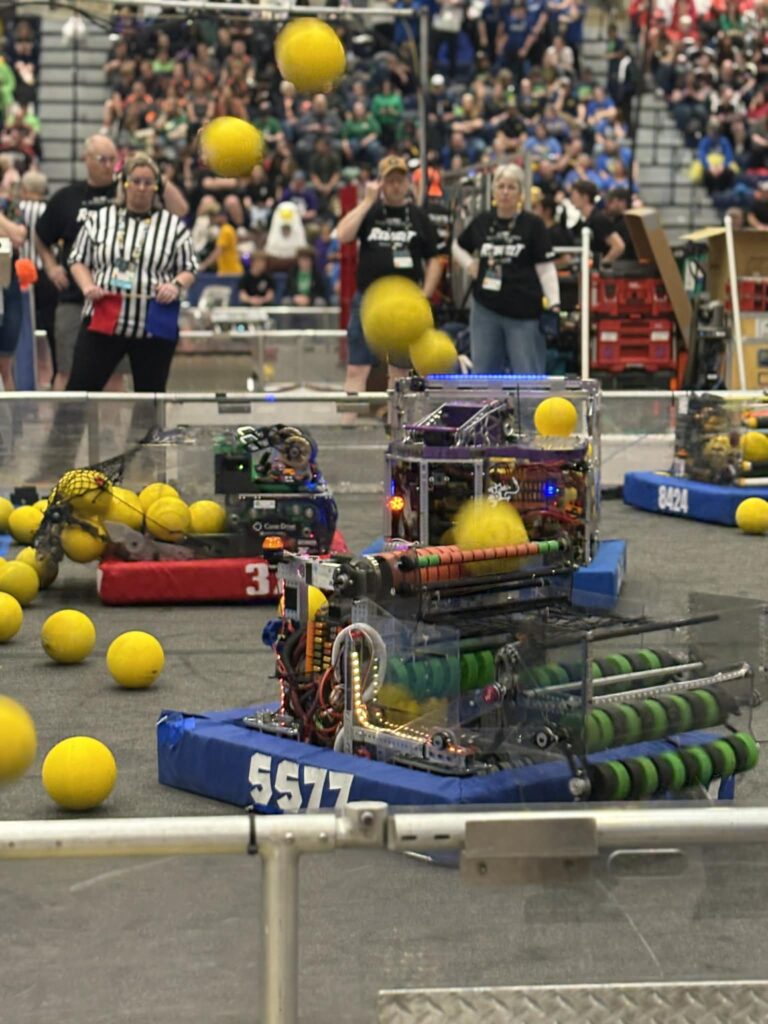
For Team 5577, the trip marks a historic breakthrough. This is the first time the Cristo Rey team has qualified for the World Championship in Houston in the team’s more than 10-year history. The team earned its bid after winning the Impact Award, considered the highest honor a team can receive at a FIRST Robotics event.
“Watching Team 5577, the Kinematic Wolves, earn their place at the 2026 FIRST Robotics World Championship in Houston is nothing short of inspiring,” said Marisol Bien Teachworth Walton, director of youth development at DHDC. “These young people—bright, driven, and deeply collaborative—are showing the world what’s possible when talent meets opportunity.”
Walton said the team reflects what can happen when students are rooted in both technical learning and community support.
“As a DHDC robotics bridge team rooted in community and culture, they represent the power of Hispanic youth as builders, innovators, creators, and future engineers,” Walton said. “I am incredibly proud of what they’ve accomplished and even more excited for what lies ahead.”
Team 5577 is also a founding member of the Robotics Engineering Center of Detroit, a community robotics space that has supported more than 175 students and more than 20 elementary, middle, and high school teams in recent years. The center, based at DHDC, provides hands-on STEM education and mentorship opportunities for young people, many of whom come from underserved communities. By connecting students to advanced technology, industry leaders, and a dedicated space to sharpen their skills, the center helps open pathways to college, internships, and future careers.
The Cristo Rey team recently rejoined the RECD network of teams, and this season marks another major milestone for that pipeline. Team 5577 is now the third RECD team to advance to the World Championship in the last five seasons.
For a district full of talent, promise, and perseverance, that is exactly the kind of beautiful thing worth celebrating.