
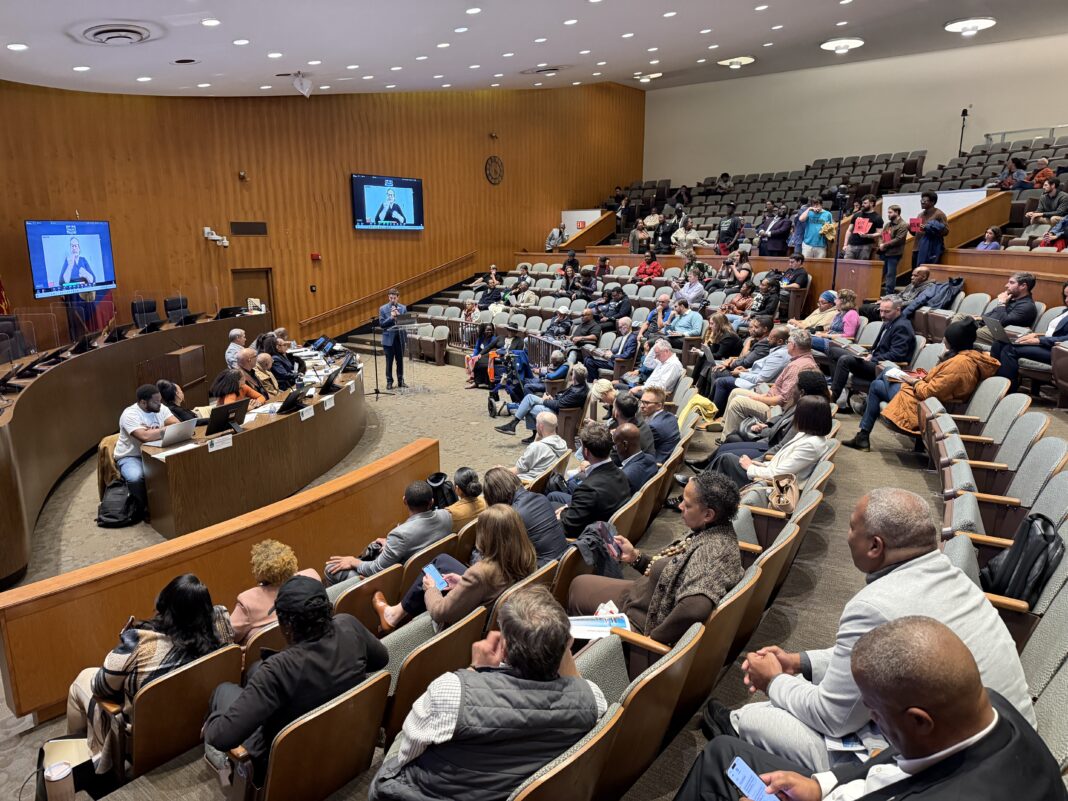


Residents on a council appointed board voted to approve a benefits agreement that will deliver more than $40 million in community benefits for the $2.2 billion Renaissance Center redevelopment.
General Motors and Bedrock are asking for $548 million in tax incentives ($75 million of which is already approved) to build what officials have pitched as the state’s finest family destination.
The Neighborhood Advisory Council’s (NAC) approval is just a recommendation; Detroit City Council must vote to approve the deal before developers are able to move forward.
Developers want to make the area surrounding the Renaissance Center more pedestrian friendly, maintaining access to the riverfront through construction and tearing down the two towers facing Windsor. Bedrock officials on Tuesday also expressed an intention to bring back a movie theater, subject to “commercial forces beyond its control,” as an anchor component of the Renaissance Center East redevelopment.
Bedrock officials offered high fives and handshakes following Tuesday’s vote that happened after a contentious back and forth between several NAC members and members of the audience inside the Erma Henderson Auditorium at the Coleman A. Young Municipal Center.
“Tonight’s overwhelmingly positive vote unlocks the way forward for Bedrock and General Motors to deliver on the most robust Community Benefits Agreement in Detroit’s history,” Bedrock said in a statement after Tuesday’s approval. “In collaboration with the Neighborhood Advisory Council (NAC) and City of Detroit, not only will Detroiters benefit from unprecedented investments in workforce development, affordable housing, neighborhood development, small businesses, and youth programming, but we are one step closer to reimagining the Renaissance Center and building the best family-friendly waterfront destination in the country.
Bedrock officials thanked the NAC and Mayor Sheffield’s planning and economic development teams, “for working so hard and coming together to make this historic agreement possible for the community.”
NAC members thanked each other for their participation and contribution to the agreement that has been weeks in the making.
The discussion surrounding what public benefit Detroit residents would get from the project became tense throughout the eight weeks of public meetings. The final included personal insults from both members of the public and the neighborhood advisory council.
NAC chair Jermaine Dickens toward the end of Tuesday’s meeting replied to one out-of-turn comment with a “Yo momma” joke.
And Bedrock CEO Jared Fleisher apologized last week after a back and forth with council member Denzel McCampbell, of District 7 after calling McCampbell’s line of questioning, “indecent.”
McCampbell, one of two Democratic Socialists of America members on council, said during a committee meeting it is his responsibility to ask questions on behalf of residents. McCampbell referenced Gilbert’s ability to make a $1 billion donation and that GM is about to spend $20 million on stock buybacks.
Bedrock and GM announced a $1 billion “gift” through the creation of new nonprofit, a 501(c)4, to own and operate the new Renaissance Center and the 35 acres of nearby riverfront. The nonprofit board would be steered by Rev. Wendell Anthony, president of the Detroit Branch NAACP, and Bill Emerson, a former CEO of Gilbert’s Rocket Companies.
Of the $43.5 million in programs to benefit the public agreed to by the NAC, Bedrock and GM; $15 million will go toward housing; $10 million toward small business; $8 million for a community hub; $6 million for workforce/education and $4.5 million for free resident parking.
Michigan Black Business Alliance director Charity Dean was one of many public commenters who thanked Bedrock for its engagement throughout the process, and for hosting an event to engage small businesses.
“The $10 million committed to small business and a community benefits process is historic,” Dean said. “This has never happened before.”
Joe Louis Barrow Jr., Joe Louis’ son, also called in to support the project.
“I spent countless hours with the team at Bedrock talking about the court’s future, the importance of access, opportunity, inclusion, and representation.”
Resident Brian English, said he supports the project because it aims to increased tourism, jobs for Detroiters and apprenticeship programs.
But not everyone was excited about the agreement. Opponents of the project said there are too many promises of “good faith efforts” rather than hard commitments. Many residents advocated for public ownership as part of the project, which developers denied.
“This deal is a robbery from our city,” said resident Josh Larky. “It’s a land grab of some of our most valuable real estate, and the benefits in this plan are both too small and largely uncommitted.”
Nicole Small of the Detroit People’s Platform criticized the NAC for not making certain negotiations with developers public. She received an applause from members in the audience holding up red “vote no” signs.
“This is the only room that I have heard support for this project,” said activist Eden Bloom. “Look at the public comments in the media, social media. Nobody wants this. Everybody’s upset about the billion dollars and taking half a million from the city.”
“Detroit doesn’t get to keep our library money because it looks the billionaires. So does our school money,” said progressive advocate Elana Herrada. “I just wanted to say that the tax capture is destroying the livelihood of Detroiters by not feeding our institutions that most people in Detroit need.”
Members of groups like the Detroit People’s Platform and the Metro Detroit DSA offered critique and outright opposition during public comment throughout the eight week process.
“We have been told that our concerns are indecent, which then makes for this call for nonprofit ownership even more confusing because I think it raises more questions than resolves,” Theo Pride of the Detroit People’s Platform.
Council member Gabriela Santiago-Romero of District 6 told Michigan Chronicle in an interview she feels like the community benefits process needs reform in order to truly deliver a worthy return.
“The way that the community benefits ordinance is set up in the system is not actually set to give us the most value, and that’s and we’re gonna keep seeing this.”
NAC member Teron Haynes was the lone no vote at the neighborhood advisory council’s final meeting Tuesday.
“I do support and encourage development. I do support and encourage union labor. I do believe that this specific development could be good for the city,” Haynes said. “However, I have found no reason to trust the developer throughout this process.”
Developers want the project’s city and state level approvals done before the end of the year, before the next governor takes office and reforms the state’s process for large tax breaks, a future tax capture called a Transformational Brownfield. The amount for the Renaissance Center project is projected at $300 million over a number of years.
Both candidates for governor have expressed a desire to reform the Michigan Economic Development Corporation (MEDC), which is the entity that staffs the body responsible for approving the tax capture.