
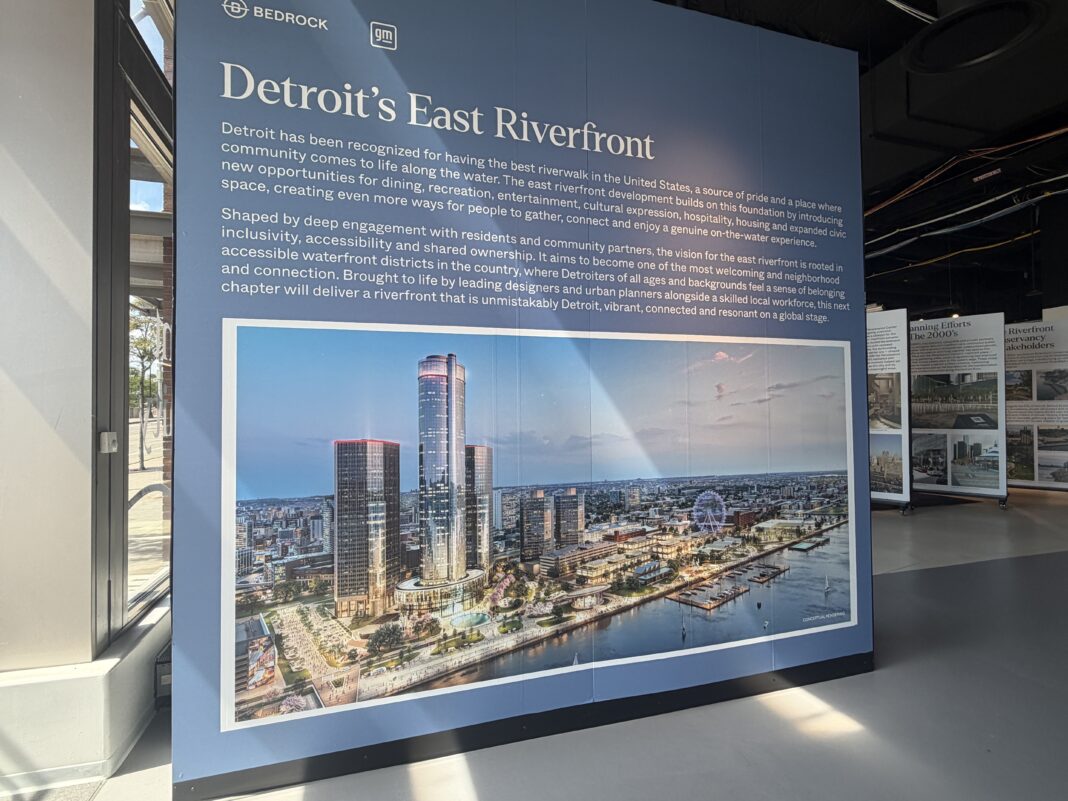

Bedrock and General Motors are pitching a plan to transform Detroit’s Renaissance Center, formerly the GM headquarters, into Michigan’s finest family entertainment destination.
Employees with the development company are calling the plan the largest redevelopment project in the United States. Bedrock says it wants to capitalize being on the water.
“I like to look at it too — looks great. But at some point, you want to be on the water to take advantage of it as a resource,” Brian Watkins, Bedrock’s government affairs director, told Michigan Chronicle during a tour of the developer’s new office space where the public can share feedback.
The public will have a chance to share concerns with the development company owned by billionaire Dan Gilbert at upcoming community benefits meetings at the Coleman A. Young Municipal building, the first being Tuesday, Aug. 18 at 6pm.
Some who came to the meeting Tuesday evening were vocally opposed to the plan to tear down two of the structures that surround the Marriott hotel, the cylindrical centerpiece of the Renaissance Center.
Bedrock Detroit and General Motors want to redevelop the Renaissance Center, and the surrounding east riverfront. The plan includes tearing down two of the center’s towers to make use of underutilized land. The developers say more than 40 acres of underutilized land will become a mixed-use neighborhood that better connects the city to the Detroit River.
The total cost of the project is approximately $1.6 billion, developers say. Bedrock says it will spend $1 billion, General Motors says it will spend $250 million. The developers say they will receive about $75 million from the Downtown Development Authority for the project. They also want to take advantage of $250 million in public financing available through a state economic development program.
The goal is to build 934 new mixed-income residential units, more than 470,000 square feet of retail, entertainment, dining, and community recreation space, in addition to a renewed 858-room hotel with meeting rooms, event facilities, and an observation deck at the top of the Marriott hotel.
Approximately 17 acres of new civic space, including parks, plazas, waterfront greens, and a newly constructed marina, “will strengthen public access to the river while creating new destinations for residents and visitors,” developers say.
Other amenities include 675,000 square feet of modernized office space, over 3,700 parking spaces to support future growth, and improved pedestrian connections to the Detroit Riverwalk.
The towers that will be preserved could become office space and mixed-income housing and retail, officials said.
5-10 year timeline
During a tour of the new East Riverfront Community Hub at Beaubien Place, 521 Atwater Street, representatives from Bedrock said the underutilized Renaissance Center and vacant surface lots will turn into an active year-round waterfront destination that supports new housing, jobs, recreation, tourism, water access, and long-term economic growth.
The developers say the goal is to see the Detroit City Council and requisite community benefits board approve the project prior to the end of the fourth quarter 2026 with a goal to begin the first phase of the projects in 2027.
Watkins told Michigan Chronicle Tuesday the entire redevelopment process will take 5-10 years, with the full build-out of the whole 35+ acre vision extending beyond that. Key milestones that affect that timeline include the community benefits ordinance process and city approval.
RenCen tower “deconstruction”
Another piece of the timeline will depend on permitting, specifically for the selective deconstruction process to rid the site of the towers. Watkins said the demolition of the building won’t include explosives that create a dust storm similar to what happened during the demo of the old Hudson’s building.
“I was actually working downtown during the Hudson’s implosion,” Watkins said. “I was at work that day. And it was the weirdest thing. There was an incredible dust storm that lasted a week. This will be nothing like that. This will be what we call selective deconstruction, meaning they’re going to start inward to the two towers and start to slowly deconstruct from the inside out, so that these towers are deconstructed, not imploded, not a wrecking ball.”
Currently, all five towers are connected by a podium. The first piece of the deconstruction will be to disconnect each tower from that podium, so they can sit independently with its own mechanical, electrical and plumbing.
“That gives each tower its independence, which is the way that we create these pathways,” Watkins said. “Which is the way we create ground floor commercial, an ability to be able to get in and around because right now they’re connected. You can’t pass through there at all — we’ve created a way to open it up.”
Community benefits process
The Community Benefits process will determine what public benefit the development is required to follow through on. A nine-member neighborhood advisory council made up of volunteer residents who live within the project’s impact area will lead the process and vote to approve the benefit package.
While the impact area includes downtown and the east riverfront area near the Renaissance Center, developers Tuesday encouraged Detroit residents from each council district to participate in the process.
There’s a map of the entire city at East Riverfront Community Hub, the office near the riverfront where Bedrock is inviting the public to share concerns and feedback. Sticker dots meant to mark where residents live so far include Sherwood Forest, Palmer Woods, Midtown, Brush Park and downtown. But the developers say soon they hope to see the map filled with stickers from across the city.
“We’ve reach out citywide,” Watkins said.
“We’ve got roadshows scheduled for every single council district. We’re not just sticking right here in the impact area. We’ve got a schedule that will allow us to take this to the neighborhoods and say, ‘Guess what? This is what we’re doing downtown. This is what we want you to know, to understand and talk about. This is what we want your feedback on.'”
Inside the community hub on Atwater there are examples of entertainment districts from other cities to draw inspiration from best practices around the country for active waterfronts. Officials have pointed to Chicago’s Navy Pier or Baltimore’s Inner Harbor as references.
At the first meeting community benefits ordinance meeting members of the public voiced their frustration with the plan, many arguing against tearing down the towers.
Eric Dueweke, the Detroit community organizer and educator with CDAD, said his problem with the plan is that it’s rushed.
“Construction of this isn’t going to start until after the Final Four and then ramming this through the summer time doesn’t seem right,” Dueweke said. “It seems like a way to minimize community involvement in the process.”
Detroit Board of Police Commissioner Scotty Bowman said he supports keeping the entire Renaissance Center and encouraging new tenants to enter the building after losing its signature tenant, GM.
“Stop incentivizing competing buildings until the Renaissance Center is occupied,” Bowman said.
Jennifer Stallings Dewey, senior counsel for community engagement for GM, said reimagining the space around the building is the only path forward.
“We’ve sort of done all that we can,” Stallings Dewey said. “We have to shift to ‘What can we do from here?'”