


Detroit has always measured excellence differently.
Here, excellence does not live only in a corner office, behind a pulpit, inside a classroom, or at the head of a boardroom table. Detroit knows excellence by the people who keep showing up. The men who mentor without cameras present. The men who build institutions brick by brick. The men who carry responsibility in public and private. The men who understand that Black leadership in this city has always required a deep relationship with service.
That legacy sits at the center of the Michigan Chronicle’s 2026 Men of Excellence Awards & Induction Celebration, where this year’s honorees will be formally recognized Thursday, June 18, 2026, at 6 p.m. at the International Banquet & Conference Center, located at 400 Monroe in downtown Detroit.
The annual recognition has become one of the Chronicle’s signature platforms for honoring Black men whose work continues to shape the region’s civic, professional, cultural, educational, and economic landscape. The 2026 class reflects a broad portrait of leadership across Metro Detroit and Michigan, from faith and education to housing, health care, labor, public service, entrepreneurship, finance, the arts, and corporate leadership.
What makes this year’s class significant is the range of institutions represented and the shared responsibility that runs through their work. These are men leading schools, guiding congregations, expanding access to care, strengthening public systems, supporting small businesses, advancing housing solutions, protecting labor, building cultural spaces, and helping shape how communities experience opportunity.
The honorees include Bishop Lambert W. Gates Sr. of Kingdom Apostolic Ministries, Rev. Darryl Williams of St. Stephens AME Church, and Pastor Quantez Pressley of Third New Hope Baptist Church, men whose leadership reflects the enduring role of the Black church as a place of spiritual care, civic grounding, and community direction.
Education is also deeply represented in this class, with leaders such as Lawrence Hood of Detroit Academy of Arts and Sciences, Kevelin B. Jones II of Flint Community Schools, Jerry Lawrence Jr. of University Prep Science and Math High School, and Myron Montgomery of East English Village Preparatory Academy. Their inclusion speaks to a larger truth for Black communities across Michigan: schools remain one of the most important places where futures are either narrowed or expanded. The men leading within these spaces carry the daily charge of shaping students who deserve access, rigor, safety, identity, and possibility.
Health care and wellness also stand among the class through honorees such as Dr. Herman J. Glass II of Glass Chiropractic Health Plaza, Dr. Cleamon Moorer Jr. of Eye Care for Detroit, Dr. Teronto Robinson of John D. Dingell VA Medical Center and Corewell Health, and Dr. Warren Woodruff of Caring Smiles Family Dentistry. Their work reflects the importance of trusted care in communities where access, prevention, and culturally grounded medical relationships remain essential to long-term well-being.
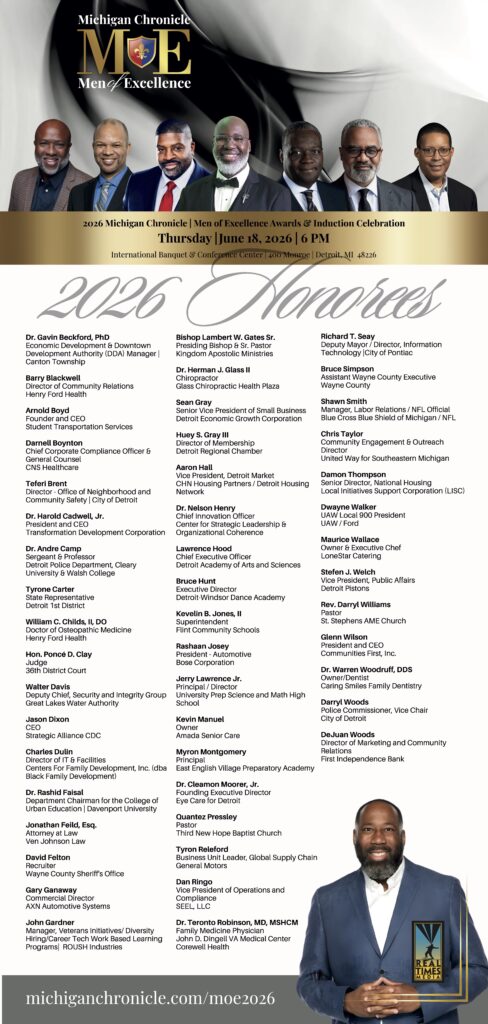
The 2026 class also carries a strong economic development and business leadership thread. Sean Gray of the Detroit Economic Growth Corporation, Huey S. Gray III of the Detroit Regional Chamber, Stefen J. Welch of the Detroit Pistons, DeJuan Woods of First Independence Bank, Rashaan Josey of Bose Corporation, Tyron Releford of General Motors, Dan Ringo of SEEL, LLC, and Glenn Wilson of Communities First, Inc. represent the kind of leadership that touches business growth, corporate strategy, public affairs, banking, community development, and regional investment.
That matters in Detroit because economic opportunity has never been abstract for Black communities. It shows up in whether entrepreneurs can access capital, whether neighborhoods benefit from development, whether institutions invest in talent, whether business leadership reflects the communities it serves, and whether Black professionals are positioned to influence decisions that reach beyond symbolic representation.
Housing and community stability are also reflected through honorees such as Aaron Hall of CHN Housing Partners and Detroit Housing Network, and Damon Thompson of Local Initiatives Support Corporation. Their work sits inside one of the most pressing realities facing Detroit and cities across the country: the need for housing systems that protect families, support neighborhoods, and create pathways toward stability rather than displacement.
Public service and civic leadership are also central to this year’s class. Richard T. Seay serves as Deputy Mayor and Director of Information Technology for the City of Pontiac. Bruce Simpson serves as Assistant Wayne County Executive. Darryl Woods serves as Police Commissioner and Vice Chair for the City of Detroit. These roles matter because the daily function of government shapes how residents experience safety, technology, county services, accountability, and public trust.
Labor, too, remains part of this story. Dwayne Walker, UAW Local 900 President with UAW/Ford, represents a tradition deeply tied to Detroit’s identity. Black labor leadership has helped shape the region’s middle class, its manufacturing legacy, and its ongoing conversations about wages, dignity, and worker power.
Arts, culture, and community life also have a place in this class through honorees such as Bruce Hunt of Detroit-Windsor Dance Academy and Maurice Wallace of LoneStar Catering. Their work reminds us that community is built through more than policy and boardrooms. It is built through movement, food, gathering, discipline, creativity, and spaces where people see themselves reflected with care.
Shawn Smith’s work across labor relations at Blue Cross Blue Shield of Michigan and as an NFL official reflects the kind of excellence that crosses sectors with discipline and precision. Chris Taylor of United Way for Southeastern Michigan represents the connective work required to bring outreach, service, and resources closer to the people and neighborhoods that need them. Kevin Manuel, owner of Amada Senior Care, reflects the growing importance of elder care and family support as communities continue to navigate aging, caregiving, and dignity for seniors.
The 2026 Men of Excellence class does not tell one story of success. It tells many stories of responsibility.
Black men are too often flattened in public narratives, reduced to statistics, crisis frames, or limited portrayals that fail to capture the full scope of their leadership. Men of Excellence offers a fuller picture. It honors men who are shaping systems, mentoring young people, carrying institutional memory, building economic pathways, and leaving evidence of their work in the lives of others.
The June 18 induction celebration will bring that work into the room. Families, colleagues, community leaders, and supporters will gather to honor men whose careers speak to achievement, but whose impact speaks to something deeper.
Excellence, in this city, has always required more than arrival. It requires stewardship.
The Michigan Chronicle’s 2026 Men of Excellence honorees represent that charge. They are part of a continuing legacy of Black men who lead with skill, service, vision, and accountability. Their names now join a tradition that reminds Detroit what leadership can look like when it is rooted in community and built to last.