
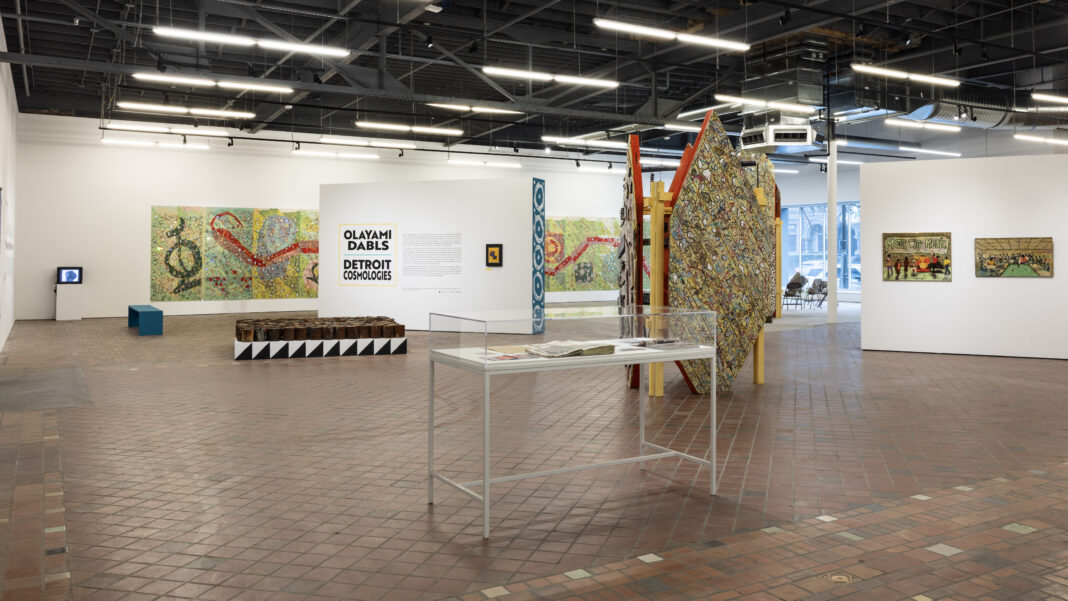

The Museum of Contemporary Art Detroit has reopened with a fresh coat of vision and a deeper sense of legacy, marking not only the end of months-long renovations but the beginning of its 20th anniversary year with a spring season rooted in Detroit’s creative inheritance. The reopening carries both celebration and symbolism, anchored by the renaming of its main campus as the Julia Reyes Taubman Building in honor of the late MOCAD co-founder, whose imprint on the institution helped shape one of the city’s most daring cultural spaces. It is a fitting gesture for a museum that has long positioned itself as less white cube, more civic experiment.
The reopening weekend unfolds as both homecoming and happening, with public programming that leans into MOCAD’s signature blend of art, dialogue, and Detroit energy. But the real draw is the spring exhibition season itself, which feels less like a relaunch than a statement. Under the banner of “A Practice of Multiplicity,” the season centers Detroit artists whose work has long expanded definitions of contemporary art while reflecting the city back to itself.
At the heart of the season is Olayami Dabls: Detroit Cosmologies, the first comprehensive museum retrospective of the visionary artist, cultural historian, and founder of the MBAD African Bead Museum. Spanning more than four decades, the exhibition treats Dabls not simply as an artist but as a keeper of cosmology, memory, and resistance. Sculptures, paintings, archival material, and his nkisi-inspired assemblages transform the gallery into something spiritual as much as visual. Dabls has always understood Detroit as sacred terrain, and this exhibition honors that understanding, positioning his work as both archive and prophecy.
If Dabls brings ancestral monumentality, Carole Harris offers something quieter but no less radical. This Side of the River, the first major museum exhibition dedicated to Harris, revisits quilting not as craft but as abstraction, storytelling, and political language. Her layered, improvisational textile works pulse with rhythm and memory, carrying the visual syntax of Black Detroit through fabric, form, and fragmentation. Harris has spent decades challenging hierarchies between fine art and domestic tradition; here, that challenge takes center stage.
The season also includes work by Martha Mysko, while Paris-based artist Loris Gréaud activates the Mike Kelley Mobile Homestead, but the emotional core of the spring program belongs unmistakably to Dabls and Harris, two artists whose practices hold Detroit’s past and future in conversation.
For a museum reopening after renovation, MOCAD is doing something more ambitious than unveiling upgrades. It is reopening with a thesis — that contemporary art in Detroit is inseparable from history, community, and cultural memory. At 20, MOCAD is not just looking back. It is reopening by asking what it means to keep building a future through art.