
By Aaron Foley, Editor-at-Large
The Detroit Public Schools Community District could expand its African-centered curriculum to more schools beyond the district, its superintendent said at one of two schools in the city currently implementing the practice.
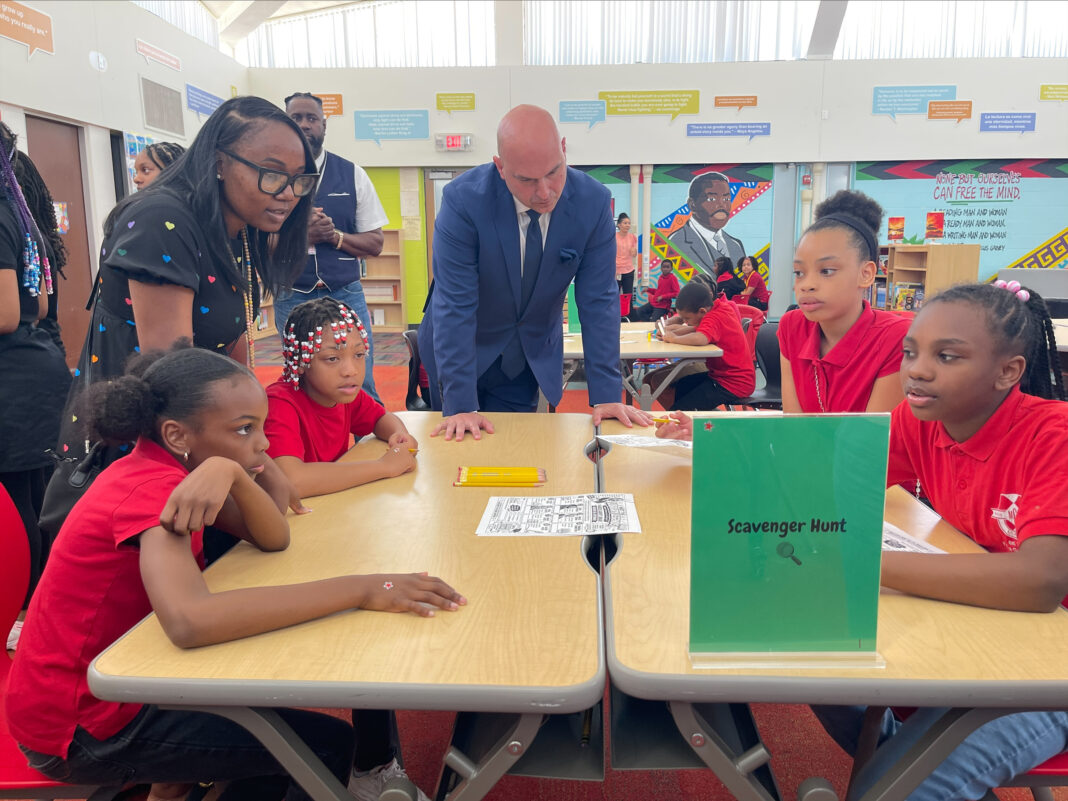
“Students need to appreciate and understand their history, their roots,” DPSCD Superintendent Nikolai Vitti said after a ribbon-cutting for a new student library at Marcus Garvey Academy on the city’s east side.“It’s part of their identity. I think it’s important for any school district, but especially ours [with] 80% of our students being African American. They should have an option throughout the portfolio of schools for a very specific African-centered education.”
Marcus Garvey Academy and Paul Robeson Academy are the only two schools in DPSCD to fully deploy African-centric education, a curriculum that emphasizes the history and contributions of Africans and African Americans year-round across multiple subjects, rather than relegate it to one month or one specific course. The curriculum was more widespread across the former Detroit Public Schools district from the 1970s throughout the 2000s.
Vitti became superintendent of DPSCD in 2017 after public schools in the city were controlled by the state-managed Educational Achievement Authority. Much of the past decade has been focused on trying to stabilize the once-bankrupt district since, he says, but as he goes into year 10, there is opportunity to revisit concepts from years back.
“We’re trying to expand [ACE] across the district, through our teachers, through professional development,” Vitti says. “As students understand who they are, their ancestors and their rich history behind that, it builds confidence. It creates empowerment, it creates pride, and that’s not easily accessible, unfortunately. And today, unfortunately, you know, we have a president that attacks the history of Black Americans, and it makes it even more important to double down on exposure and the commitment and the investment.”
Vitti clarified that Black history and current events are not absent from classrooms in other DPSCD schools.
“You can go to any DPSCD school and we’re intentional about students seeing themselves through the books they read and the history that they’re exposed to — a distinct critique of what’s happening now and in the past in our country.”
While both a majority of the district and the city it serves are mostly Black, both entities have seen an influx of non-Black families – to which Vitti says everyone, regardless, should be familiar with the concept of ACE.
“I think understanding the reality of the history of this country as it relates to race is important for all children, but especially our students,” he says.
Vitti also spoke about the role DPSCD plays in recent efforts, be they encouraged by newly elected Detroit Mayor Mary Sheffield or a non-municipal collective, to woo new families to Detroit and keep existing ones in place.
“We’re just starting to have conversations with the new administration on that. Mayor Sheffield and I have been working a lot on the transportation side of things [as it relates to] after-school programming,” he says.
Addressing transportation needs for Detroiters has been a futile effort for officials (regardless of whether households have students). But in the decade since Vitti has been at the helm, families seeking to place their children in some of the city’s higher-performing schools – public, charter or private – have found themselves not only competing for limited slots, but also plotting out their own transportation routes that may include longer commutes over the course of their students’ time in the classroom.
Chrysler Elementary School in Lafayette Park, for example, has always been a popular K-5 choice for families in and around its neighborhood, but now draws families that live far across both the east and west sides. A family may then shuttle their child to somewhere as far off as Bates Academy in the west side Bagley neighborhood for middle school, in the hopes of landing them at Renaissance High School on the west side or Cass Technical High School in Midtown. The commute by bus or by car to these schools or the others on the parents’ short wish-lists can vary wildly based on proximity.
Vitti sees the glass half-full on the concept of Detroit having a number of higher-performing schools. “It keeps those families in the city. It also continues to attract those students that are higher performing staying in the city and in DPSCD,” he says. But he’s also aware that transportation challenges are at the root of the larger issue.
“I think if we’re going to continue to see more students attend DPSCD and more families staying and moving to the city, we have to have a stronger mass transportation system,” Vitti says. “When you look at other large cities, they have more reliable, and scaled access to transportation. My hope is that in the years that come, the mayor will seek more investment in mass transportation and the burden on families – all families, middle class and lower socioeconomic, are getting to where they want to go.”