
Photo credit: Monica Morgan Photography
By: Jasmine West
Detroit’s future has never rested on one block, one institution, or one funding stream. It lives inside classrooms, neighborhood corridors, public spaces, nonprofit networks, youth programs, and the families still asking whether the city’s growth will reach their front porch.
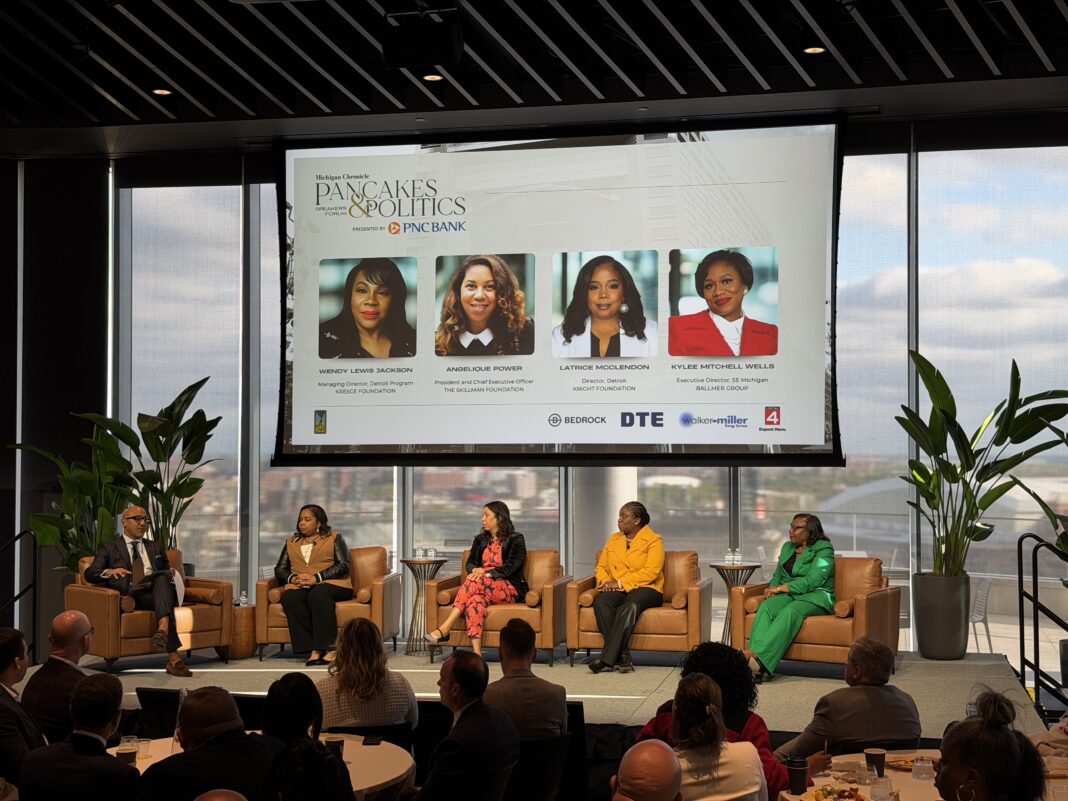
That truth shaped the latest Michigan Chronicle Pancakes and Politics conversation, where a panel of leading women in philanthropy examined how investments in Detroit neighborhoods, education, public spaces, youth development, and people can create ripple effects across Southeast Michigan and the state.
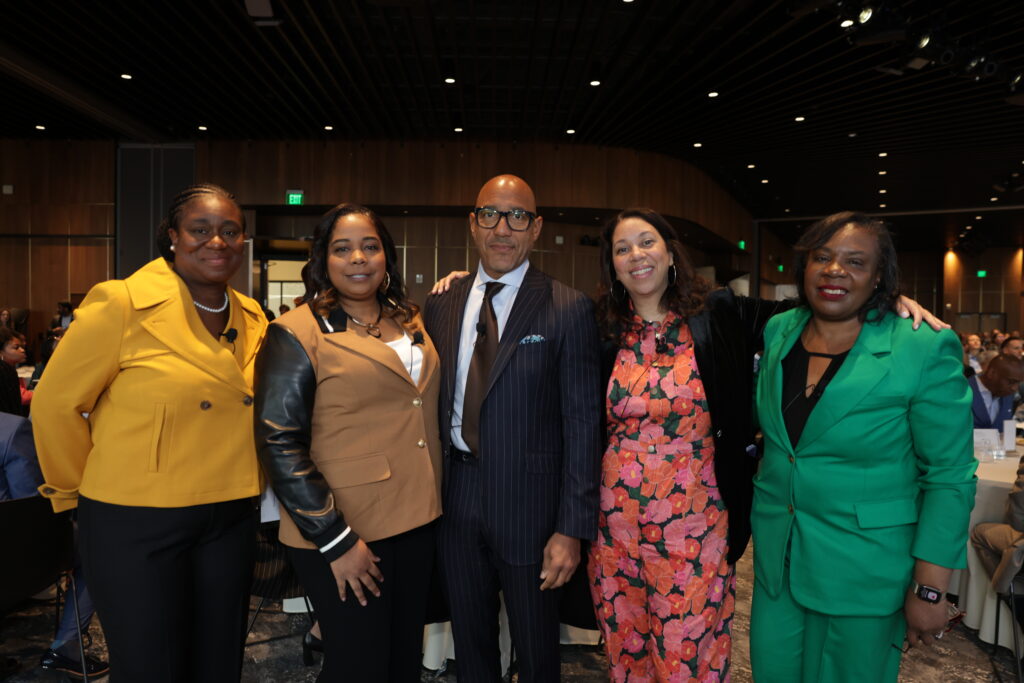
Moderated by Dennis Archer Jr., the discussion brought together Latrice McClendon, Detroit director for the Knight Foundation; Angelique Power, president and CEO of The Skillman Foundation; Kylee Mitchell Wells, executive director of Southeast Michigan Ballmer Group; and Wendy Lewis Jackson, managing director of the Detroit Program at The Kresge Foundation.
Detroit’s story stretches beyond the city limits. Its neighborhoods have long carried cultural, economic, and civic weight for the region. The question before the panel was how philanthropy can support that power without replacing government responsibility, community voice, or long-term public investment.
Archer opened the conversation with education, asking what needs to change from an infrastructure standpoint at the government level when it comes to Detroit schools.
McClendon pointed directly to school funding and the need to shift how Detroit students are discussed.
“We need equitable funding for all students but especially for Detroit public school students,” McClendon said. “Surrounding suburban schools get more per pupil and we need to have a narrative shift that there is good and brilliance in our students even against facing tough situations at home with lack of resources. The ladies that are sitting here with me have committed over $40 million to DPSCD and that’s why philanthropy is so important, it takes an entire village to support our students.”
Archer pressed further, noting that philanthropy is often used as a bandage for systemic problems. He asked what must change at the government level so philanthropy can enhance education rather than simply patch what is broken.
Power said Michigan’s education challenges require a cohesive public vision, not isolated grants.
“Michigan is 44th in terms of education,” Power said. “We didn’t get here overnight, and philanthropy isn’t going to fix it with a grant. We need a cohesive vision for education infrastructure. We want Michigan to be a top 10 state for education. What is everyone’s responsibility from state to district?”
Mitchell Wells thanked Gov. Gretchen Whitmer for making education funding a priority, while pointing to Michigan’s fragmented system as a barrier.
“I want to thank Governor Whitmer for being the first governor to put as much money into education in Michigan,” Mitchell Wells said. “We have a fragmented system. We have 800 districts and when there’s a fragmented system, it isn’t easy to track the money. We have to get on track.”
Power framed the challenge as structural and cultural. She said Detroit must think about education as a full system of learning, not only a school system, especially as artificial intelligence and digital tools reshapethe future of work.
“The skills that you’re going to need to be resilient in an AI digital world, we have to think about this as a system of learning, not just a system of schools,” Power said.
She added that Detroit’s strength cannot be separated from the well-being of its residents.
“There is no strong Detroit unless there are strong Detroiters,” Power said. “Until every family feels like they have a strong school to send their kids to, we have a lot of work to do. It’s not that the ideas or innovations aren’t there. It’s that the capital isn’t there.”
Mitchell Wells lifted up the district’s health hubs as one example of investment that reaches beyond students alone.
“The health hubs are an investment where, at certain schools throughout the Detroit district, they have resources for the entire family,” Mitchell Wells said. “Shoutout to Latrice and superintendent Dr. Vitti for putting those health hubs in place.”
Panelists also pointed to recent DPSCD progress as part of Detroit’s broader education story. McClendon noted that the district is at an 88% graduation rate and “on track to outpace the state.” Mitchell Wells added that Detroit Public Schools will be highlighted among gains happening across the country.
For the panel, Detroit’s neighborhoods remained central to any honest conversation about growth. Jackson said the city has learned from the older assumption that downtown investment would naturally trickle out to surrounding communities.
“We’ve learned so much from the thought of investing downtown will trickle throughout the rest of the city,” Jackson said. “It’s important to think about the success of the city as a thriving downtown and the growing economic engines located in our neighborhoods because that’s what really makes or breaks a neighborhood.”
Archer connected that point back to education, noting that school performance and announcements tied to DPSCD matter because they help determine whether families, employers, and key players are drawn to the city.
Jackson said trust-based philanthropy has changed how foundations approach neighborhood investment.
“Trust-based philanthropy is changing the game,” Jackson said. “How do we ensure that residents are helping make decisions on where resources go? At Kresge we are working directly with residents on the design of where the investments go in neighborhoods.”
Detroit’s recovery is often measured through what people can see, including buildings, roads, parks, and commercial corridors. The panel argued that social infrastructure carries equal weight in long-term regional growth.
“We try to integrate these approaches,” Jackson said. “You have to think about early childhood education, arts and culture, and you have to marry it with safe neighborhoods as well as climate and how to integrate. We all are trying to look at this much more holistically.”
Darienne Hudson of United Way asked the panel about innovation, nonprofit partnerships, and measurable results. Mitchell Wells pointed to Ballmer Group’s partnership with United Way around summer youth programming.
“I am so happy that Ballmer has been able to partner with United Way,” Mitchell Wells said. “We are coming up on three years of a summer youth program and we are trending close to 70,000 kids this summer. We are so proud to say we have been able to invest under my leadership. That is a partnership that really cares about the youth and I’m glad to be in partnership.”
McClendon pointed to Black Tech Saturdays and the Joe Louis Greenway as examples of work connected to thriving neighborhoods, public spaces, technology, culture, and civic life.
“We need to make sure that we have thriving neighborhoods,” McClendon said. “Knight Foundation is the biggest funder of journalism in the country. We truly believe that arts and culture, advancements of public spaces and tech are very important to us at Knight.”
Power reminded the room that nonprofits are facing real pressure, and that community support must extend beyond applause.
“Nonprofits are under attack right now, and I think it is very important that we shout out the ones we know,” Power said. “It’s important to put all of our dollars and volunteer hours to nonprofits who are here to help us.”
Dr. Chanel Hampton, director of education and youth affairs for the City of Detroit, asked how philanthropy can shift the narrative to include all Detroit children and how foundations are bringing youth voice into grantmaking, decision-making, and daily work.
Power said young people must be partners, not afterthoughts.
“We are in service to young people, but we need not do things for young people but with young people,” Power said. “At Skillman we have a youth council who gives grants, who decide what they want to focus on and what they want to give. It is extremely important that we look at our work with youth lenses. To have youth a part of policy as well.”
Archer also asked how neighborhood investment can prevent displacement. McClendon said the conversation should begin with residents who have remained, built, organized, and sustained their communities.
“We need to focus less on displacement, and we need to focus on the residents that are here and founders who have stayed and amazing CDCs,” McClendon said. “Making sure that residents who are currently there are being heard and we need to welcome new things in neighborhoods as well.”
The conversation closed with job readiness, skilled trades, and how philanthropy can help Detroit students prepare for a changing economy.
Power said the economic landscape is shifting quickly, but education and preparation still matter deeply.
“The economy is changing so fast right now,” Power said. “The one thing we do know is that graduating high school and college, there will be more opportunities for more salary and healthcare. Detroit has the Detroit Promise, so college is paid for, and not enough students are taking advantage of that. Beyond that, it is important to start before high school.”
McClendon pointed to DPSCD’s high school redesign as part of that preparation.
“On behalf of DPSCD, we are in the middle of high school redesign, and it’s needed because we are focused on what Michigan students need in order for our kids to graduate, go to college and be able to come back and live in Michigan,” McClendon said.
Mitchell Wells said philanthropy must also be introduced as a career path early, especially for students who may not know the sector exists.
“There’s more that we need to do throughout the school year,” Mitchell Wells said. “I want to be in the schools talking to students about philanthropy. It’s important that we get out early to talk to kids about these careers, some that need a four-year degree and some that don’t, that have large salaries.”
McClendon ended with a clear statement of commitment.
“Philanthropy can’t solve problems, but we can determine who we will invest in,” McClendon said. “Regardless of what’s happening at the federal level, we will continue to fund, and we are very unapologetic about funding Detroit. We all know what Detroit looks like and we are going to continue to fund Detroit.”
The conversation made plain that Detroit’s future will require more than isolated investment. It will require equitable school funding, resident-led neighborhood development, youth voice, nonprofit strength, public-private alignment, and a shared belief that Detroit’s people are not problems to manage, but leaders to invest in.