


When Michigan’s political and business leaders talk about data centers, they do so like they’re the next auto industry and the next big thing that can drag the state into the future.
Ambassador John Rakolta Jr., Chairman of Walbridge, described data centers as the most significant economic development opportunity for the Detroit Region in the last 150 years. He compared these facilities to the railroads of the 19th century or the interstate highway system, saying that while internal staffing may be specialized, the surrounding economic activity within a 50-mile radius is substantial.
The pitch in favor of data centers focuses on jobs, innovation, investment, economic growth, and, in a state that’s spent decades trying to reinvent itself after manufacturing losses hollowed so many communities, that message sounds hard to resist.
But residents across the state – especially those in rural areas where investors are seeking to buy cheap land for data center investments – are starting to ask questions about who actually benefits?
That question is getting louder as giant AI-driven data centers begin spreading across Southeast Michigan and beyond. These facilities, which power cloud computing and artificial intelligence systems, require enormous amounts of electricity, massive cooling systems, tons of fresh water, and acres of land. They often arrive with tax breaks and promises of economic revival. What they don’t always bring is transparency.
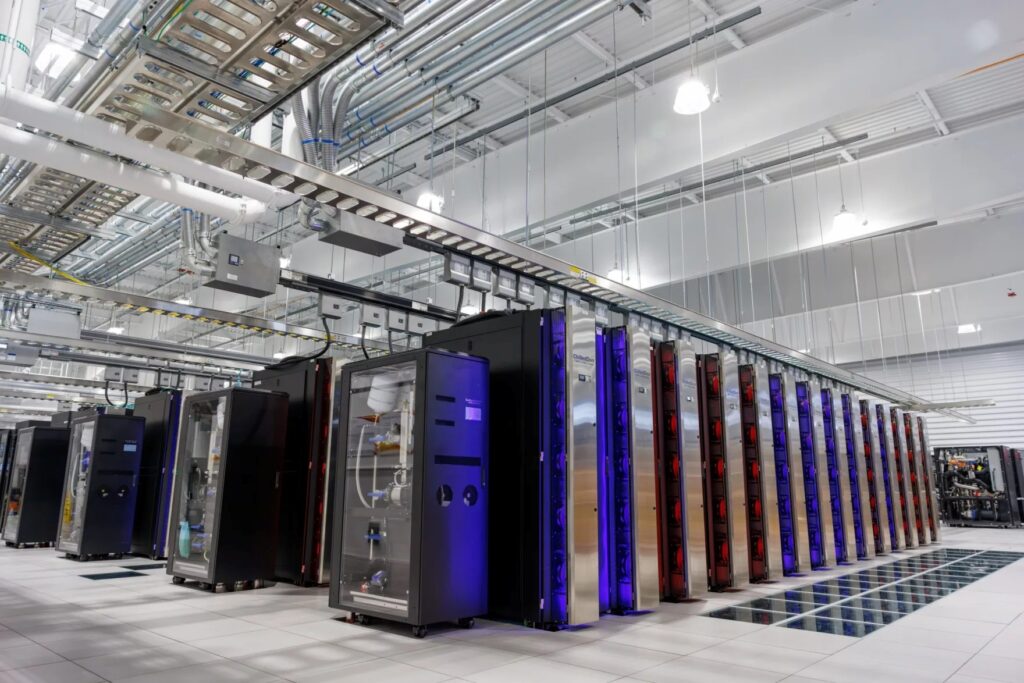
The AI boom is being sold as proof that the economy is strong, but the reality underneath the headlines looks very different because in the first quarter of 2026, roughly 75% of all U.S. economic growth came from AI-related spending. Take away the massive investments being poured into data centers and AI infrastructure, and the nation’s economic growth would have been almost flat.
That’s not the kind of growth most families actually feel in their everyday lives. Wages are still tight for many households. Housing costs remain high. Cities are still fighting for investment that reaches neighborhoods instead of balance sheets.
What’s driving the numbers right now is a spending spree by a handful of tech companies racing to dominate artificial intelligence. Giants like Meta, Alphabet, Microsoft, Amazon, and Oracle are expected to spend more than $440 billion on AI infrastructure in 2026 alone.
The question for places like Detroit is whether this AI economy will create real opportunity for local communities, workers, and small businesses or whether it will mostly benefit a small circle of already-powerful corporations building the digital backbone of the future.
Former Detroit Mayor Mike Duggan, now running for governor, has acknowledged that concern directly. Earlier this year, Duggan said communities are increasingly angry because projects are often negotiated behind closed doors before residents even know what is happening. He told Michigan Chronicle that the state needs to set standards for data centers and said no project should move forward unless developers pay infrastructure costs, protect water resources, and secure meaningful community approval.
His comments make it clear that the politicians supporting data centers recognize the distrust surrounding them.
And Detroiters have reasons to be skeptical because for decades, neighborhoods in the city have been asked to absorb the environmental consequences of other people’s economic vision.
Heavy industry, truck traffic, refineries, incinerators, polluted air – those burdens have historically landed hardest in Black and working-class communities, even leaving the 48217-area in Detroit as one of the country’s most polluted zip codes.
So when residents hear that a new wave of industrial-scale digital infrastructure is coming, powered by diesel backup generators and demanding huge amounts of energy and water, many people see a familiar pattern repeating itself.
Environmental advocates across Michigan have warned that data centers could increase utility costs and strain the electrical grid while delivering relatively few permanent jobs in return. Some critics describe the projects as “extractive,” arguing that local communities take on the environmental and infrastructure burdens while multinational tech companies reap the profits.
Tyler Marie Theile, vice president and chief operating officer of the Anderson Economic Group, said in a recent forum that a small data center facility employing about 25 full-time workers can generate roughly $1 million in annual payroll for local households and more than $1.1 million in annual tax revenue for the municipality.
Half of those jobs would be new to the community, she said, and more than 100 indirect jobs would be supported through spending and related activity. She added that a large data center could generate economic activity comparable to hosting two Detroit Lions playoff games each year.
But the tension from residents still resides. They ask: if that’s what the city gets from having data centers, how much profit must the owners of the data centers be turning? And what non-financial costs could befall the communities?
That tension is especially sharp in Detroit, where city leaders are trying to balance economic development with long-standing environmental justice issues. Earlier this year, Detroit City Council approved a resolution urging the city to consider a two-year moratorium on new data centers while officials study their environmental and economic impacts.
“I asked the city to slow down on siting data centers. It wasn’t because I am opposed to them; I’m neither for nor against data centers in Detroit. All I want is for us to learn more so we can make educated decisions about sensible community informed zoning regulations for the location of these facilities in our city,” Detroit City Councilmember Scott Benson said.
“I’ve made it clear to the stakeholder’s group that utility bills cannot increase for our residents. I’ve also made it clear that we must lean into the sustainability issues, particularly around water usage, and find a way to ensure we aren’t damaging our natural resources.”
The decision to pause reflected growing anxiety over what unchecked expansion could mean for residents who already deal with high utility bills, high asthma rates, flooding, and aging infrastructure.
But the other side of this conversation is that Detroit needs investment. The city needs a stronger tax base and new streams of revenue as funds from the city’s $826 million in COVID relief are going to be exhausted soon. The city needs redevelopment of vacant industrial land. It needs technology jobs that can keep younger workers in Michigan instead of losing them to places like Texas or California. Supporters of data centers argue that if Michigan refuses these projects, other states will gladly take them instead.
A coalition backed by organizations including the Michigan Chamber of Commerce, DTE Energy, and the Detroit Regional Chamber has pushed back against what they call “misinformation about data centers,” arguing the facilities are essential to Michigan’s future economy.
There is some truth in that. Artificial intelligence is reshaping industries everywhere, and the infrastructure behind it has to exist somewhere. Michigan leaders are understandably nervous about missing another technological shift after watching the state lose population and economic influence over the last several decades.
Lt. Gov. and Secretary of State candidate Garlin Gilchrist has often framed Michigan’s tech future around innovation and digital infrastructure, particularly as the state tries to position itself as a hub for advanced mobility and emerging technology industries.
While he has generally promoted technology investment as part of Michigan’s economic future, critics argue that the state still lacks strong guardrails for communities that may bear the costs of that growth.
Secretary of State Jocelyn Benson has also started calling for stricter safeguards around data center development, including stronger public hearings and protections for residents and ratepayers. That shift matters because concern about data centers is becoming politically mainstream and it’s no longer confined to protests by environmental activists.
Meanwhile, Detroit’s new mayor Mary Sheffield has spoken frequently about equitable development and making sure longtime-Detroit residents benefit from investment rather than being displaced or ignored. That framework is going to be tested if major tech infrastructure projects continue moving toward the city.
Perhaps one of the biggest criticisms of data centers from protesters is that the promised economic payoff often feels underwhelming compared to the scale of the projects themselves.
A manufacturing plant employing thousands of workers is one thing. A giant warehouse-sized server facility employing a relatively small permanent workforce is another. Residents look at these massive developments and wonder why they should accept increased energy demand, noise concerns, land use changes, and environmental risks for what may amount to only a modest number of long-term jobs.
There is also the issue of public subsidies. Michigan lawmakers approved major tax exemptions for data centers in 2024 in hopes of attracting investment. Supporters say those incentives are necessary to compete nationally. Critics see them as another example of corporate welfare where public resources flow to some of the wealthiest companies in the world while ordinary residents continue struggling with affordability.
And underneath all of this is a larger philosophical question about what kind of economic development Detroit and Michigan actually want.
Should the state aggressively chase every emerging industry regardless of environmental cost? Or should it slow down and ask whether communities are genuinely benefiting?
The reality is that data centers will likely become a major part of Michigan’s future – economically and environmentally. At this point, that seems inevitable. The real issue is whether residents will have meaningful power in shaping how these projects happen, where they go, and who profits from them.