
Let’s take a moment to set the record straight on Palmer Park.
Because first off, yes, there is a little bit of a double entendre there. And second, if you didn’t catch it, then you just might be in for a treat – and we’re not talking about the ones at the donut shop across the street. What readers need to know is that the girls, Dutch or otherwise, are outside. And from the looks of things recently, they’re going to stay there.
This editor was riding on Seven Mile on May 16 and had to double-check the calendar app to make sure it wasn’t July after taking in the sight of what appeared to be hundreds of young patrons swarming the park. Was Hotter Than July – arguably Palmer Park’s most well-attended event, the annual celebration of Black LGBT pride, the event this editor knows good and well – rescheduled? No. Did we miss a new event on Detroit’s revitalized social calendar? Perhaps.
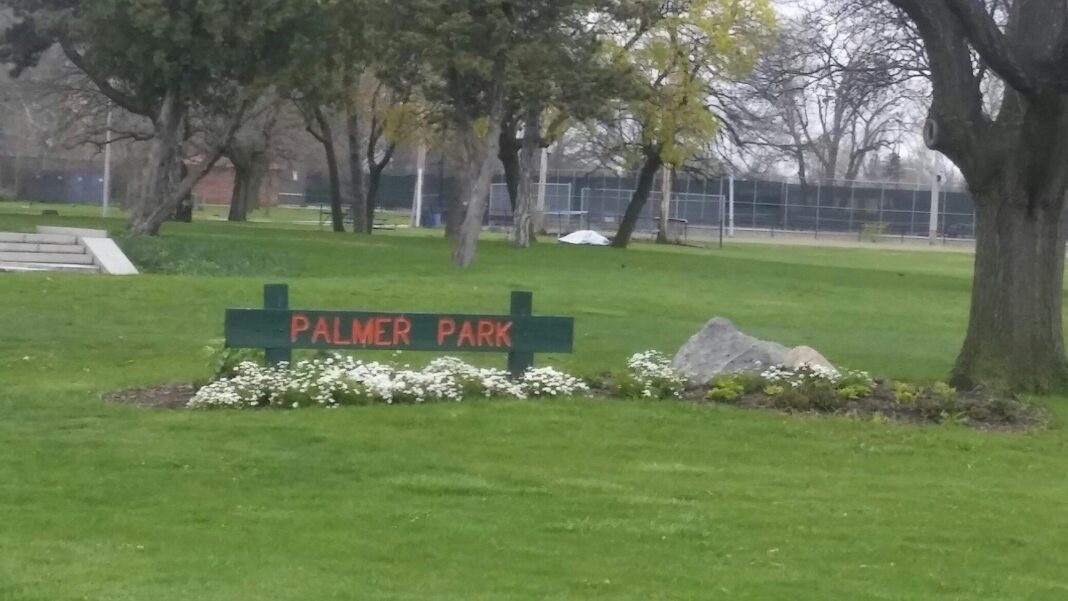
A generation after the queen takeover, Palmer is now undergoing a teen makeover. What’s old is new again, and amid Detroit’s ever-persistent question of “what is there for young people to do in this city,” it seems like an answer was in plain sight here in the 133-year-old park with just as many acres.
“There’s something about this younger generation,” a wise-beyond-their-years 31-year-old rideshare driver tells me during a recent ride at the tail-end of May, “that’s just so open. I dropped off two girls over there, and they couldn’t have been more than 18, and I was telling them the whole history associated with Palmer Park and to be careful. And they were just like, ‘ok!’”
A number of TikToks from the weekend of the 16th have been in circulation since then – and before you ask this ‘80s baby how said TikToks ended up on my feed, please familiarize yourself with how GPS-based algorithms work. The abbreviated clips showed a far more inclusive Palmer Park than what this editor is used to back when the gworls were outside. Young people mingling across gender expression and presentation. All-Black groups with a token white friend – what? A few BGLOs were even strolling in the midst. And while this reluctant unc knew better than to drop by the scene unprompted, it’s safe to say that others in my age range also understood the assignment since not a single person over, say, 25, was spotted at all.
Well, let’s walk that back a bit: Palmer Park abuts Detroit’s 12th Precinct, and some DPD officers were on guard. But amid the (justified) discussion of over-policing and over-curfewing our youth, there were no reported incidents from the weekend.
That’s not to say there wasn’t any handwringing. The People For Palmer Park, the nonprofit conservancy that has been in partnership with the City of Detroit in maintaining the park, posted to its socials that it would be “working with the 12th Precinct to increase safety plans throughout the park” alongside a screenshot of Detroit Mayor Mary Sheffield’s statement regarding violence at a downtown teen takeover. But Palmer Park is certainly not downtown, and the kids in the park weren’t so much taking over – unless maybe this was a secret D9 plot to get all attendees to pledge next fall – as they were discovering that the park actually exists, prompting one PP-area resident to comment “it’s so disappointing to see such a valuable organization align with criminalization of our children” and another to ask “why is this necessary?”
As an imperfect and uncertain future unfolds, that “whole history” of Palmer Park lingers. Depending on who you ask, history is clearly taught differently across generations.
“They’re saying Palmer Park is DL?” asked Ava Perry, a local TikToker with around 2,700 followers. “I had no clue – I mean, I’m gay so…”
This unc let out an auntie scream after seeing this. Oh, how we have failed our youth! Another far more prolific local TikToker, “Sid,” a 72,000-followed user with braces that was described in other videos by Palmer Park attendees as “that dude with the braces,” was also perplexed: “Aye, why the f*** they talkin’ bout Palmer Park is a DL spot, like what the f***? Bruh, I ain’t never heard no s*** like that. So you telling me I went to Palmer Park and I’m DL now?”
No, young man, you are not DL, but here’s the lowdown on why such a sentiment persists – and why these kids today, just…these kids today, Lord. All history must be revisited to explain the present – and maybe it’ll also help straighten out the more seasoned among us as well.
In the 1800s, well before the automotive industry took root in Detroit, most denizens got around on foot. The wealthiest among us back then, however, had horses and carriages at their disposal. Most of Detroit back then was concentrated around what we know was downtown and Midtown; to “get away from it all,” wealthy folks would go “up north” to their log cabins scattered around what we now see as Eight Mile and Woodward. (Also in this area is a street close to Six Mile and Pontchartrain called Log Cabin. Right?) Among them was Thomas Witherell Palmer, a one-time U.S. Senator representing Michigan who owned 140 acres of land northwest of the growing city center.
Palmer has too long of a history to detail here; he was also one of the founders of the Detroit Institute of Arts and was instrumental in women’s suffrage. In the context of this discussion, his donation of his land holdings to the city of Detroit in 1893 formed the basis of the park that would come to bear his name in 1897. After his death, parts of the land – closer to Six Mile in modern-day – was subdivided into residences beginning in the 1910s, creating what we now see as the apartment building historic district. Along the way, more subdivisions with single- and multi-family homes of varying sizes – Grixdale, Palmer Woods, Sherwood Forest – would also come to define the area.
It’s worth noting Palmer Park’s role in the Black middle class of Detroit, as documented by Chronicle staffers over the last 90 years. The sport of golf as both a communal and aspirational activity among Black folks in this town was robust enough for frequent, regular coverage beyond outings and tournaments, to the point where “what course do you play” was just as an important question as “what high school did you go to.” A regular column by Chronicle sportswriter Sportie J., “At Palmer Park,” briefly appeared in the paper throughout 1967, supplementing the longtime golf column “The 19th Hole” by Frank Lett. In the latter half of the previous century – and again, far too much to document for this week’s purposes, but a separate piece could be forthcoming – Palmer Park and its surrounding neighborhoods would frequently be in the background of both progress and struggle for Black Detroiters, as demands for better conditions at the Palmer Park golf course were the prelude to a number of historical precedents in town.
Ironically, it’s the ’60s when the aforementioned “whole history” of Palmer Park that most folks’ experiences are colored by starts to take shape, as the Chronicle starts to report on an uptick of “immoral” behavior in the area, like the time when a plainclothes Highland Park policeman was solicited by another man trying to molest him on a park bench (Oct. 30 1965 issue). There were long-running issues with prostitution along Woodward Avenue that seemed to sandwich the insulated Palmer Park area, with an Aug. 16,1969 piece noting specifically that 8 and Woodward at the Ferndale border and 6 and Woodward, and all points south of the Highland Park border, as the hot zones.
But by the 1970s, a headline declared the Palmer Park area as a full-on “combat zone.” See if this from the Aug. 13, 1977, issue sounds familiar: “The two-mile stretch of Woodward, which snakes alongside Palmer Park, continues to be Detroit’s premier home for hustlers, hookers, dope dealers, and homosexual bars. A tour of Woodward is perhaps more graphic than watching one of the X-rated movies shown daily in a former bank building, which squats in the corner of Six Mile. Long-haired male prostitutes slouched suggestively outside one of the many area bars which cater to the ‘gay ghetto’ population.”
What’s missing from the Chronicle archives – and trust, this is no slight to our forebears – is reporting on the changing population of the apartment and condominium buildings in the area that, at one point, housed the highest concentration of LGBT residents in the city. (In 1982, noting the demographics of the area, the Chronicle reported that organizers would stage the city’s first Gay Pride Day would be held in Palmer Park of that year; it has since evolved into what we now know as Motor City Pride. A decade later in ’95 would be the first Black gay pride at the Park, which is now Hotter Than July.) One can fill in the blanks based on how gayborhoods in general evolve.
First, while the Chronicle noted that some “fashionable” and “swanky” apartments and condos were desired by well-to-do Black Detroiters in Palmer Park (as well as any other luxurious apartment building; places like 1300 Lafayette, for example, are described with similar terms), the neighborhood itself still had just as many affordable, efficiency-priced residences. More spacious condos were built in the 1950s and 1960s, but the majority of the apartment buildings were built in the 1920s and 1930s at the height of the Art Deco movement. And while no Detroit neighborhood was immune to crime, one could presume that with growing crime rates in Palmer Park coupled with persistent action to improve conditions at the same-named recreational facilities, rental rates and property values may have been just a bit less than, say, the riverfront apartments on Jefferson that have proximity to Indian Village and the mayor’s residence.
Touring through Chronicle classifieds, you’ll always notice a famous address listed for sale or for rent. That includes bars (and their liquor licenses) everywhere. The most notable of Palmer Park bars in both past and present day remains Menjo’s, which is now a gay bar – but, per Chronicle reporting weighed against present-day timelines, was once the Black-owned Menjo’s Supper Club that featured Black performers, frequently compared to Paradise Valley hangouts because it recaptured the spirit of a bygone era – lost to freeways first, and time later. This iteration was short-lived; like many bars and lounges in the 1970s and 1980s as Detroit’s overall economic fortunes fell, Menjo’s changed hands and clientele.
The Palmer Park area was primed for an influx of a population looking for beauty in the midst of chaos – which, if you talk to any queer person, is probably how they’d describe themselves. Like Paradise Valley, however, Palmer Park is a “could’ve been” district of Detroit – as in “this place could’ve been” something different if other things hadn’t happened. As much as the area’s recreational activities continued throughout the decades – especially golfing at Palmer, a favorite of legendary Chronicle publisher Sam Logan – there was little coalescence between that community and the queer community. Both would suffer under the crushing weight of Detroit’s financial woes; in the 2010s, the City nearly closed the Park entirely, golf course and all. And while the park now may be on the rebound in 2026, it’s well reported that most of the apartment buildings are either vacant, dilapidated, owned by an out-of-state speculator, or, in some cases, all of the above.
What hasn’t changed in all these years is Palmer Park’s reputation as a destination for anonymous sex. History documents the tragic, rumor perpetuates for the sordid, but there is truth in both those accounts and still more to be found in others.
Anonymous sex in this context is sex between parties with no previous affiliation. Where it gets complicated – and what ultimately defines popular narrative – is what happens prior to initiation, during the act itself and the final outcome, all of which can also change definition at any time. Anonymous sex that comes by way of a monetary or some other proprietary exchange can be classified as sex work or prostitution, the latter of which was and still is a criminal act. Anonymous sex that results from a person seeking sex from another person in a public setting is also criminalized but not often discovered; that’s what we sometimes call cruising.
There are nuances, and we’ll try our best to include them all to preempt any unintentional offense. Sex work is work. Sex work can be survival work. Not all sex in exchange for money or goods is prostitution. An anonymous sex encounter that begins with no monetary exchange but results in one isn’t prostitution either, nor does it make the receiving party a sex worker unless they decide to identify as such. Rape can result if one party refuses consent at any point during the encounter. More importantly in this context, we’re broadly speaking of the difference between prostitution and cruising – and in Palmer Park, both practices have been omnipresent.
“Is Palmer Park DL?” Well, that requires even more nuance. As long as there has been human life, there has been same-sex attraction, but same-sex attraction predates things like “monogamy,” “prenuptial agreements” and “expose pages.” So, let’s say you’re an upstanding, married Black man in Sherwood Forest with a wife and two kids, but you’re craving a little something different and know you can get it just a stone’s throw away if you go cruising around Merrill Plaisance in your Grand Cherokee and don’t want anyone to find out – that’s DL, short for “down low,” a term first used in the late 1990s specifically for Black men who publicly identify as straight and do not tell their female sex partners (be they married or dating) that they engage in sexual encounters with other men.
DL men do not identify as gay, do not participate in gay scenes like bars or clubs, are not in a closet because there’s no closet for them to come out of (unless they’re in denial, and that’s only for them – not us – to say), and thus – well, at least back in this unc’s day – are not considered part of the LGBTQIA community at large. DL men in Detroit for years have frequented Palmer Park looking for and engaging in anonymous sex with other men, though, so in a way, yes, Palmer Park is DL, but not just that. DL men have not been the only ones cruising for sex in the Park; gay men, closeted gay men, bisexual men, trans men, trans women, lesbians, nonbinary people and everyone else in between have done so for decades – be it by approaching someone on a park bench and hoping they’re not an officer in disguise, or using a GPS-based app like Sniffies as many folks do today.
“All my life, Palmer Park been a no-go zone,” says 27,000-followed Detroit_Quack on TikTok, who’s part of the salt-and-pepper-bearded side of the Detroit internet. “That’s just somewhere you just don’t be frolicking around.” He’s right – and likely referring to the more dominant narrative of sex work that defines folks’ initial recollections of Palmer Park. Going back to the blaring “combat zone” headline of the Chronicle’s 1977 piece, a young mother tells reporter Brian Flanigan that she had to purchase a 115-pound dog to ward off strangers “asking me for my price” when she and her son wanted to walk through the park.
Prostitution up and down Woodward has largely been defined by johns and women sex workers (and it’s important to note that either party can be the first to initiate an exchange), with the women in the scenarios largely being painted as pariahs, lost causes or hopeless victims. Various efforts, as the Chronicle would report, from government, the religious community, or even dedicated individuals, looking to curb prostitution over the years would drone on to no end.
This editor, who’s old enough to remember regularly observing sex workers in the blocks surrounding the Chronicle’s pre-Midtown 479 Ledyard address, came of age at the confluence of several of Palmer Park’s identities. It was known that Palmer Park was the spot for the girls, gays, and theys to commiserate, be it for the big gathering in July or a low-key weekend ki. Something troubling was simmering beneath the surface that we often talked about amongst ourselves, but would come to larger attention after it couldn’t be ignored: That members of our own community were dropping like flies at 6 and Woodward.
In 2015, with Hotter than July approaching, the Chronicle acknowledged the growing number of trans sex workers – almost always women – in the Palmer Park area in an issue from that month. “The one thing I don’t think people really talk about when it comes to violence against trans women is the simple fact that we have been told by society that we are not qualified to work regular jobs, but then turn around and still get criminalized for the only resource we have which is sex work,” said Bré Campbell, then-executive director of the Trans Sistas of Color Project.
That was a decade ago, a decade that included persistent efforts from local LGBT activists to bring more attention to the violence in the area – be it against trans women or anyone. The 2010s also broughtincreased police crackdown on sex work, or putting in new things – like a strip mall with a Meijer in it – that would deter it altogether, making 8 and Woodward a little more visually appeasing. We’ve even seen the death and rebirth of Dutch Girl Donuts, and if you hear any saxophones getting louder, it’s because the People for Palmer Park instituted more free musical events in the park in recent events.
That’s not to say that everything that made Palmer Park what it is now has completely disappeared. Still, all the while, a new generation has come along discovering the new Palmer Park, one that’s a mile south of no less than three inner-ring suburbs that Detroit families moved to in recent years and accessible by a public bus system managed by a mayor that waived fees for any student riding them. “We just did that Palmer Park s***, and that s*** was low-key f***ing lit – and safe,” posted EJ, a young buck with just over 1,000 followers on TikTok. “If people understand that people are just trying to have fun, and vibe out, and s*** like that.”
Well, if the kids are still saying “lit,” then this editor agrees – let’s keep this s*** f***ing lit. We can acknowledge Palmer Park’s history without dwelling in it and still teach the babies, but we can learn from them as well. They answered their own question when they were looking for something to do. The question now is, how do we make sure they can keep on doing it?