
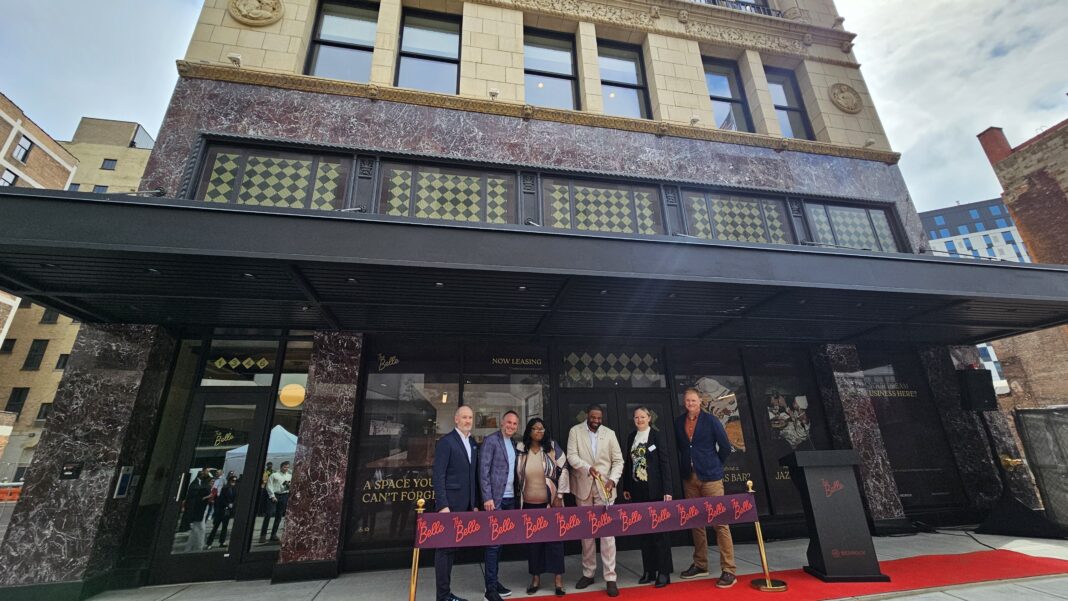


As restaurants, nightlife destinations, cultural institutions and new housing continue to reshape one of Detroit’s most historic corridors, The Belle is adding 42 new residential units to a neighborhood finding its rhythm once again.
On a stretch of Broadway where Detroiters once gathered to shop, work, eat and experience the city’s cultural life, another set of lights has turned on.
The Belle is Bedrock’s newest restored residential building in downtown Detroit’s Paradise Valley neighborhood, and it officially opened for pre-leasing this week, bringing 42 apartments and future retail space to a corridor that has become one of the city’s most active destinations.
The 100-year-old building arrives as Paradise Valley continues to attract new restaurants, nightlife venues, entertainment destinations, and public space investments, creating the kind of street-level activity that gives neighborhoods their identity.
For Bedrock CEO Jared Fleisher, that’s what makes the opening significant.
“We could not be more excited to see Paradise Valley become the hub in downtown that it once was and is destined to be again,” Fleisher said.
Over the last several years, Paradise Valley has steadily reemerged as a destination where Detroiters gather long after the workday ends. Restaurants have opened their doors. New businesses have established themselves. Public spaces have drawn residents and visitors into the neighborhood. Plans surrounding Music Hall continue to add anticipation for what comes next.

Fleisher sees each addition contributing to a larger ecosystem.
“We’ve got restaurants coming back,” he said. “The Music Hall. We see that incredible development here on Broadway and it’s happening around the corridor. It’s coming back, baby. It’s coming back.”
That momentum is visible throughout the district.
The Belle sits in a location that naturally connects several of downtown’s most active destinations. Within a short walk are the central business district, Greektown, Comerica Park, Ford Field, and some of the city’s busiest entertainment corridors.
“It’s so strategically located between the core of the CBD and the stadiums and the Greektown district,” Fleisher said.
The building itself has been part of Detroit’s story for a century.
Originally opened in 1926 as the Broadway Exchange Building, the 11-story structure was commissioned by Clara Sherr and designed by renowned Detroit architect George D. Mason, who also designed the Grand Hotel at Mackinac Island, Detroit’s Masonic Temple, and other historic landmarks around the state. The building housed commercial businesses, service providers, and creative enterprises during an era when Broadway functioned as one of downtown’s most active commercial corridors.
Like many buildings in the area, it eventually sat largely vacant. Today, restored architectural details tell the story of its earlier life while new residents begin writing the next chapter.
Brian Rebain, principal at Kraemer Design Group, said the project represents years of planning and restoration work that extended far beyond a typical renovation.
“This street, this building feels home to me as much as the place that I live,” Rebain said during the ribbon-cutting ceremony.
For Rebain, one of the most rewarding aspects has been watching not only The Belel come back to life, but also the broader activity surrounding it.
“Seeing it all come alive – not only with the redevelopment of The Belle, but also the surrounding places and perhaps most exciting, activation of the pedestrian alley behind us connecting them all together – all of this is extremely fulfilling personally and professionally,” he said.
That idea of connection surfaced repeatedly throughout the celebration.
The Belle does not exist in isolation. Residents who move into the building will walk to restaurants. They’ll attend performances. They’ll support nearby businesses. They’ll become part of the daily flow of people moving through Paradise Valley.
Fleisher described the project as one piece of a much larger effort to reconnect a neighborhood with its historic role as a gathering place.
“Sometimes we talk about a beautiful smile with some missing teeth,” he said. “This was one of the missing teeth. We had to complete that smile.”
The metaphor resonates because Paradise Valley has always been more than a collection of buildings.
Historically, the neighborhood served as one of Detroit’s most important cultural and economic centers, home to Black-owned businesses, entertainment venues and entrepreneurs who helped shape the city’s identity.
While today’s Paradise Valley is writing a new chapter, many leaders see preservation as an important part of that work.
Detroit City Council Member Renata Miller reflected on the significance of restoring buildings that longtime Detroiters still remember.
“When our seniors come downtown and see buildings like The Belle that have actually been restored, it reminds them of their heritage and their culture and what Detroit once was,” Miller said.
She noted that redevelopment and preservation are often discussed as competing priorities, but projects like The Belle demonstrate that both can happen simultaneously.
“This redevelopment shows that we can have our history preserved and develop our future at the same time,” Miller said.
For longtime Detroiters, the building’s restoration carries meaning beyond architecture.
The Belle joins a growing collection of restored structures helping reestablish the physical character of a district that has always occupied a unique place within Detroit’s story. Original terrazzo flooring, marble finishes, wood trim, historic corridors and restored façade elements remain visible throughout the building, preserving details that connect today’s residents with previous generations who passed through the same spaces.
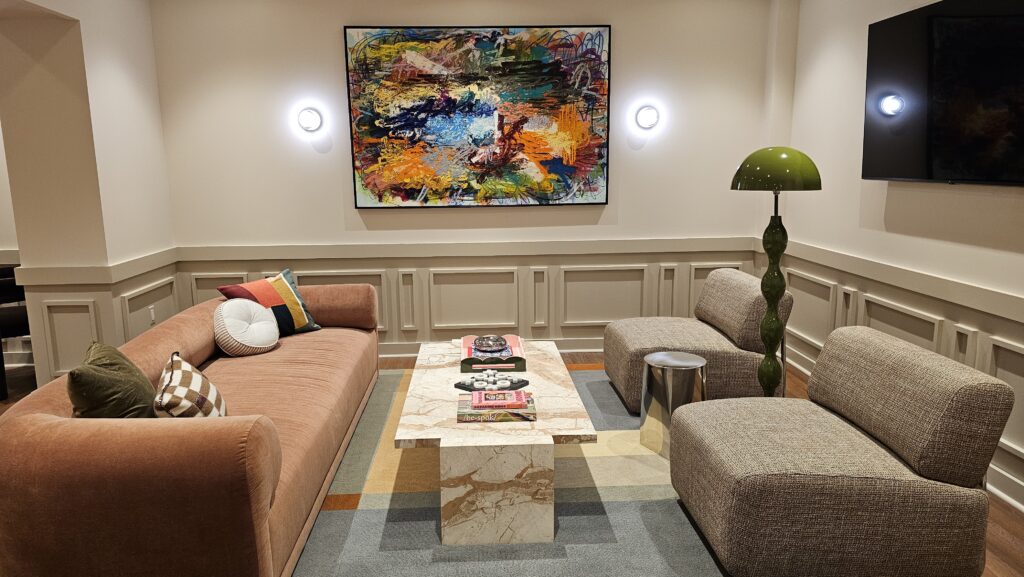
At the same time, new housing creates opportunities for the neighborhood’s businesses to grow alongside a larger residential population.
That relationship between residents and local businesses remains central to how leaders envision Paradise Valley’s future.
Jonathan Mueller, senior vice president of development for Bedrock, noted that Broadway has long functioned as a center of activity filled with businesses, artisans and entrepreneurs.
Now, another generation of residents will have the opportunity to experience the neighborhood from their front doorstep.
As the Music Hall continues planning future additions and nearby developments bring new activity to surrounding blocks, many believe Paradise Valley is entering another period of growth defined not by any single project but by the accumulation of many.
Restaurants, entertainment venues, housing, public spaces, and retail each adds another reason for people to spend time in the neighborhood. And each helps restore the sense of place that made Paradise Valley one of Detroit’s most important destinations.
For Fleisher, the significance of that momentum comes back to the neighborhood’s history.
“When you understand the history of Paradise Valley – what it was as a gathering place, as an economic engine – it’s on its way all the way back,” he said.
On Broadway, The Belle’s doors are open, but just outside, the neighborhood continues to grow around it.
For information about living at The Belle’s 42 studio, one-, and two-bedroom apartments, visit thebelledetroit.com/.