
Candidates running to be elected to the state’s opening U.S. Senate seat and governor’s office will participate in primary debates for June and July.
The primary election, where voters will decide general election matchups for U.S. Senate and governor, is Tuesday, Aug. 4.
Fox 2 Detroit announced this month it will host a Democratic gubernatorial debate on June 4 and a Republican gubernatorial debate on July 8.
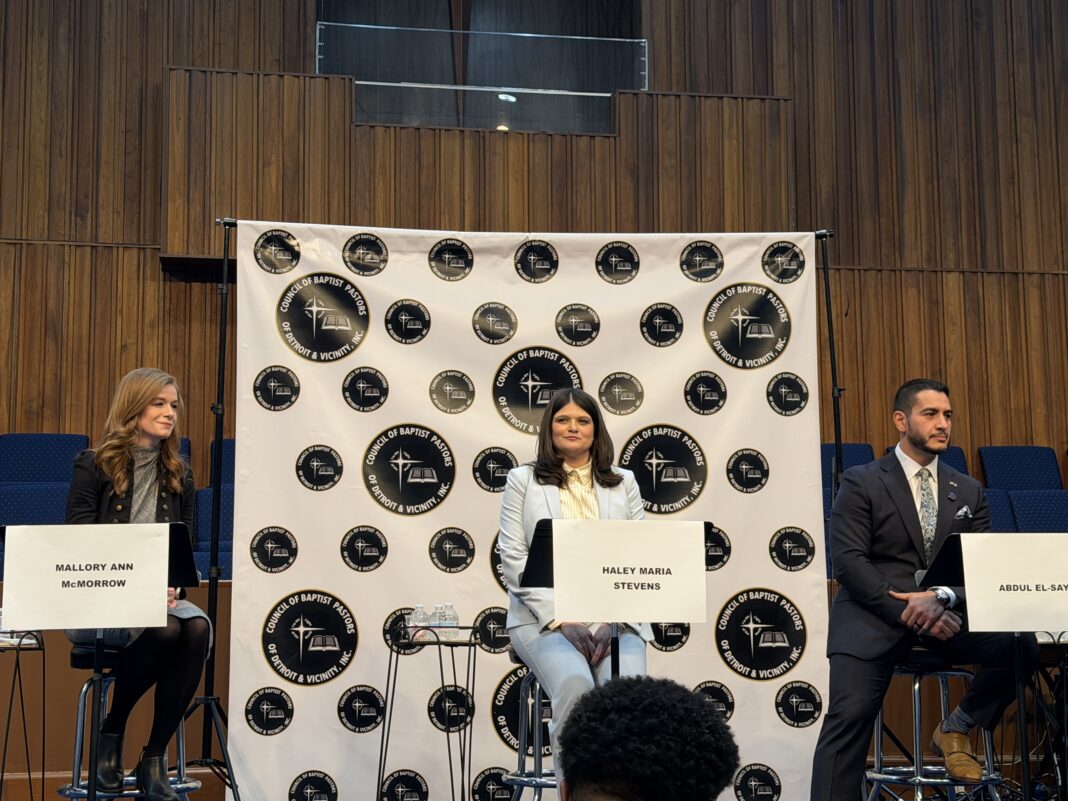
The three Democratic U.S. Senate candidates, Abdul El-Sayed, state Sen. Mallory McMorrow and U.S. Rep. Haley Stevens, will participate in a debate on the network July 27.
The three U.S. Senate candidates have already participated in multiple forums together, including one hosted by the American Federation of Teachers earlier this month and another last month hosted by the Council of Baptist Pastors of Detroit and Vicinity.
A debate later this month will take place at the Detroit Regional Chamber’s Mackinac Policy Conference on Mackinac Island.
A governor candidate forum on gun violence prevention and democracy will take place at the Cathedral Church of St. Paul this Saturday, May 16 at 2pm. Democrats Genesee County Sheriff Chris Swanson and Secretary of State Jocelyn Benson are both attending.
The Michigan Democratic Black Caucus, Faith Caucus, Jewish Caucus and Senior Caucus are hosting a Michigan Senate candidate forum June 1 at 7:45pm on Zoom. The forum will be co-moderated by members of each caucus.
While McMorrow is not listed on the flyer, Stevens and El-Sayed are set to participate.
Campaigns say there are other forums being planned yet to be announced.
The U.S. Senate race has been the talk of the country as Democrats nationwide cheer on the candidate in Michigan’s primary race that best represents their own vision for the direction of the party.
El-Sayed, a former Detroit and Wayne County health director, represents the more disgruntled and critical of party leaders, aligning with U.S. Sen. Bernie Sanders, who endorsed his campaign. McMorrow’s campaign, backed by Elizabeth Warren, is more pragmatic. She’s not promising to abolish ICE or deliver universal healthcare, like El-Sayed. And Stevens represents the moderate wing of the party that remains loyal to the state of Israel when many in the party have become hostile to the nation’s government, and accused it of committing genocide against Palestinians living in Gaza.
However, the Michigan governor’s race hasn’t been dominating headlines of late.
The Republicans spending the most money to get their name out, businessman Perry Johnson and U.S. Rep. John James, are facing challenges to petition signatures they filed to make the August primary ballot.
It’s been four years since a signature scandal led to an unknown media personality winning the nomination for Michigan’s Republican gubernatorial candidate. That scandal also led to the conviction of two people accused of fraud through a petition firm they owned.
The practice of forging signatures is practically incentivized by Michigan law, which allows petition signature gatherers to be paid by each signature they collect. That’s the argument from lawmakers who have unsuccessfully attempted to pass legislation barring cash for signature process.
Republican candidates James Craig, Garrett Saldano and others were blocked from appearing on the ballot in 2022. Johnson was the only candidate who missed the ballot because of the signature scandal in 2022 who is running for governor again.