


There’s a particular kind of spectacle that happens when a new building opens in downtown Detroit. People immediately start asking what it cost.
With Cosm Detroit, the question is more complicated than a construction budget.
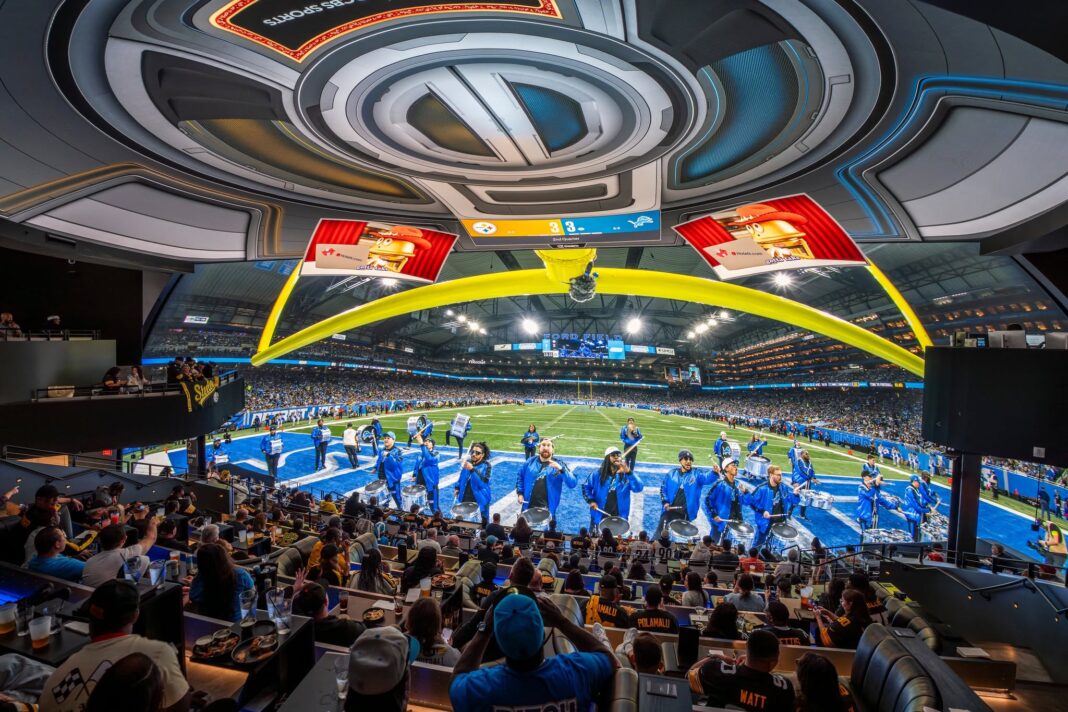
The 70,000-square-foot immersive sports and entertainment venue opened to the public on Thursday, Sept. 10, at 25 Cadillac Square, brought with it an 87-foot-diameter LED dome, wall-to-wall screens, reserved seating, food and beverage service, a rooftop deck and the ability to transport an audience from downtown Detroit to a sporting event happening thousands of miles away. Its opening-night presentation took viewers to Melbourne, Australia, for an NFL game between the San Francisco 49ers and Los Angeles Rams. The venue has a capacity of roughly 1,500 people across its three levels and outdoor spaces.
It is difficult to put a price on that kind of novelty. It is equally difficult to ignore the prices attached to it.
Cosm has not publicly disclosed a specific construction cost for the Detroit venue. (Online estimates range anywhere from $50 million to $120 million.) What is known is that the company raised more than $250 million in a 2024 funding round to expand its national network of venues, with Dan Gilbert’s ROCK among the investors. Detroit is the company’s fourth U.S. location, following venues in Los Angeles, Dallas and Atlanta. Sony Pictures announced a $100 million strategic investment in Cosm in June.
That puts Detroit inside a very small club of cities with access to this technology. Cosm goes beyond another sports bar with a bigger television. Its Shared Reality platform is designed to put an audience inside the action, using an enormous curved LED display to create the sensation of sitting courtside, on the field or inside another environment entirely. The innovation is real, and so is the potential economic value of having something in downtown Detroit that people cannot experience in many other places.
But the history of the land makes the economics more complicated.
For years, this was supposed to be the Monroe Blocks.
In 2017, Bedrock announced an ambitious $830 million redevelopment of the site. The plan called for an 814,000-square-foot office tower, about 482 residential units, retail and restaurants, and 1.5 acres of public open space. The larger collection of Bedrock projects announced at the time represented more than $2.1 billion in investment.
Construction on Monroe Blocks began in December 2018. Then the project stalled. By 2019, construction had effectively stopped as Bedrock reassessed how to proceed with its collection of major downtown developments.
COVID-19 changed the economics of downtown real estate even further. Office demand shifted. Development plans changed. Years passed.
The site became something else in the meantime: a place where Detroiters could play.
The Monroe Street Midway turned a large downtown development site into seasonal public entertainment. It featured Rollout Detroit, basketball courts, pickleball, mini-golf, arcade-style attractions, swings and other activities. Entry to the Midway was free, while roller skating cost $13 and included skate rental. The basketball courts and mini-golf were free. At one point, the Midway had attracted nearly 100,000 visitors in a single year, including more than 20,000 roller skaters. Bedrock later said the Midway had welcomed more than 240,000 guests over its three years before the site served as hosting grounds for the NFL draft in 2024.
That history is important because it reveals something downtown Detroit had been missing.
People could go downtown to work. They could go to restaurants. They could attend a Lions, Tigers, Red Wings or Pistons game. They could visit Campus Martius. They could attend a concert or festival.
The Midway provided something different: permission to simply play.
That is the piece of the downtown entertainment ecosystem Cosm now occupies, at least in part. The city needed another destination built around entertainment, gathering and spectacle, and Cosm fills that gap in a major way. It creates another reason to come downtown without requiring a traditional sporting ticket, a concert ticket or a reservation at a restaurant. It also gives visitors another reason to stay downtown before and after an event.
The question is who gets to participate.
Cosm’s current pricing makes that question unavoidable. General admission for many sporting events starts at $11, granting access to first-come, first-serve seating options at the bar or one of the general admission areas. Official listings also show Hall tickets beginning around $17 and reserved Dome tickets that can reach well into the hundreds depending on the event. At the high end, assigned seating can reach roughly $460 when demand is high.
For a city where the median household income is $39,938 and 32.7% of residents live below the poverty line, $11 is accessible in a relative sense. A $460 ticket represents roughly 1.2% of the annual income of a household at Detroit’s median income before accounting for food, housing, transportation, child care or anything else.
And a ticket is rarely the entire cost of an outing.
There’s parking, food, drinks, maybe merchandise. For a family, the economics multiply quickly.
That does not mean Cosm has to be inexpensive. That’s an important distinction.
A technologically sophisticated entertainment venue does not necessarily have an obligation to function as a public park. Building and operating a 70,000-square-foot venue filled with expensive display technology, hospitality services and premium seating costs real money. There is nothing inherently wrong with creating a premium experience in downtown Detroit. Cities need businesses that can attract visitors, generate tax revenue, employ people and persuade people to spend time and money in their urban cores.
But Detroit also has a particular history with accessibility.
The Monroe Street Midway was explicitly built around that idea. It gave people a reason to come downtown without first asking whether they could afford a ticket and its programming created opportunities for young people, families and people who may not have considered downtown entertainment to be for them.
Cosm can’t replace all of that, but it also doesn’t need to.
What it can do is create a different kind of civic value.
Imagine a teenager in Detroit seeing a Michigan football game projected across an 87-foot dome. Imagine a visitor coming downtown specifically because Cosm is something they cannot experience at home. Imagine a sports fan watching a championship game in a room designed to make thousands of people feel as though they are occupying the same physical space as the athletes.
That is an economic asset, too.
The value of downtown isn’t determined solely by square footage or property assessments. It’s also determined by whether people have reasons to be there. Cosm creates one.
The development also continues the transformation of the Cadillac Square site from an unfinished chapter into a piece of downtown’s entertainment infrastructure. The current development plan includes a 34,000-square-foot market hall and additional residential and retail development in a subsequent phase.
So the cost of Cosm can’t be reduced to the price on the ticket.
There is the cost of building it. There is the cost of giving up the original Monroe Blocks vision. There is the cost of losing the Monroe Street Midway and the free, informal play it provided. There is the cost of admission for a Detroit household trying to make a night downtown work.
And there is the value on the other side of the ledger: innovation, jobs, visitors, spending, entertainment and the simple fact that Detroit now has something almost no other American city has.
The more important question may not be whether Cosm is worth the money. Perhaps it’s whether Detroit can make sure the growth of its entertainment economy creates enough doors for Detroiters to walk through.
Cosm doesn’t have to be everything to everybody. It doesn’t have to be the new Midway, a public park, a sports bar and a cultural institution all at once. It can be what it was built to be: an extraordinary new entertainment experience.
But a city as economically diverse as Detroit should keep asking who gets to experience extraordinary things. That’s the real cost of Cosm — and, potentially, its greatest opportunity.