
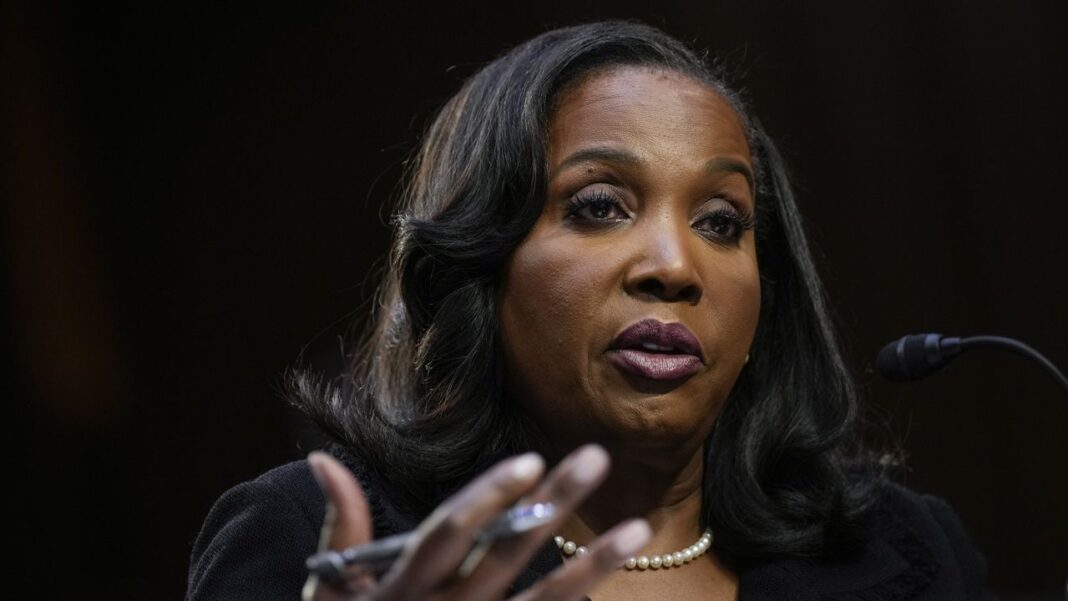

Thirty-year mortgage rates do not wait for politics to calm down. They move on expectations, on fear, on the credibility of the institutions that set the cost of money. That reality sat just under the surface Wednesday as the U.S. Supreme Court weighed President Donald Trump’s effort to fire Federal Reserve Governor Lisa Cook over mortgage-fraud allegations Cook denies, with justices openly warning that the move could shake the Fed’s independence and spook markets.
As justices signaled discomfort with Trump’s attempt to fire Cook over unproven mortgage-fraud allegations, the legal fight widened into something bigger than one set of loan documents: whether a president can intimidate the nation’s central bank into obedience. Cook denies wrongdoing, and she holds a history-making seat appointed as a Federal Reserve governor. That context sits quietly behind the legal briefs and the market anxiety, and it presses a question that does not require a courtroom transcript to be understood: Is this “for cause” removal really about paperwork, or is Cook being targeted because she’s Black?
The case, Trump v. Cook, is a legal fight with an economic pulse. Cook, appointed in 2022 by President Joe Biden, became the first Black woman to serve as a Fed governor. Trump’s attempt to remove her tests a century-old design meant to keep monetary policy insulated from political punishment and political reward. Congress built the Federal Reserve system in 1913, after repeated financial panics, and gave Fed governors fixed terms with removal permitted only “for cause,” a deliberate constraint meant to protect the central bank from direct presidential control.
On Wednesday, the justices’ questions suggested a shared unease with the administration’s theory of power and process. Multiple reports described skeptical reactions from conservative and liberal justices alike, including pointed questions about due process and what evidence supported the allegations used to justify removal. Justice Brett Kavanaugh, a Trump appointee, warned in open court about the implications of letting a president effectively rewrite the Fed’s insulation by declaring “cause” and daring courts to look away.
At the center of the dispute is the administration’s claim that Cook falsified mortgage documents tied to two properties by listing them as primary residences. Cook denies wrongdoing. Her legal team argues the administration “cherry-picked” paperwork to cast lawful applications as something sinister. The allegations were initially pushed publicly by Bill Pulte, the Trump-appointed head of the Federal Housing Finance Agency.
Cook’s lawyers have also argued that similar multi-mortgage applications appear in the financial histories of prominent Trump administration figures and even Pulte relatives without any suggestion of criminality, a point raised to underline how selective enforcement can look when the target sits on the board that votes on interest rates.
Cook’s lawyers say the paperwork was framed to look criminal when it was not, and they point to reporting showing other high-ranking Trump administration figures have had multiple mortgages without similar allegations. That context raises a question the courts will never write into an opinion, but communities living with unequal scrutiny recognize on sight.
Cook is not just any governor. When she joined the Federal Reserve Board in 2022, she became the first Black woman to serve as a Federal Reserve governor in the institution’s history. No public filing in the case proves racial intent, and the administration insists the dispute is about “cause.” Still, the effect of a removal attempt aimed at the Fed’s first Black woman governor would be felt far beyond one seat on a seven-member board, especially if “cause” becomes whatever a president says it is.
The Trump administration’s stance goes further than one governor. Government lawyers argue that once a president decides “cause” exists, courts have no role in second-guessing that determination. Critics see that as a pathway to a purge: fire a governor or two, install loyalists, and tilt rate-setting toward presidential preference.
That argument lands inside a broader campaign of pressure on the Fed and its chair, Jerome Powell, who Trump appointed in 2018. Trump has publicly attacked Powell, including saying on CNBC, “Either he’s incompetent or he’s crooked.” The attacks escalated this month when the Department of Justice served the Federal Reserve with grand jury subpoenas tied to Powell’s testimony to the Senate Banking Committee about cost overruns in renovations to Federal Reserve buildings.
Powell responded with unusually direct language in a statement posted on the Federal Reserve’s website, saying the threat of criminal charges was not truly about his testimony or the renovations. “Those are pretexts,” Powell said. He framed the subpoenas as retaliation for the Fed setting interest rates based on what officials believe will serve the public rather than aligning with the president’s preferences.
When presidents apply overt pressure for lower rates, investors can respond by demanding higher long-term rates to compensate for inflation risk and political interference. Daniel Tarullo, a Harvard law professor and former Fed governor, put it plainly in reporting that circulated ahead of arguments: when long-term rates rise on inflation fears, “Mortgages and business investment” take the hit.
Homeownership is already a fragile ladder in many Black neighborhoods, shaped by appraisal gaps, credit barriers, and the aftershocks of foreclosure crises that stripped wealth block by block. A credible, independent central bank cannot fix those structural problems. It can keep them from getting worse through political games that drive up borrowing costs for working families, small businesses, and first-time buyers.
That economic reality is part of why the Cook case has drawn a rare coalition of warnings.
Business leaders have publicly cautioned against meddling with the central bank, including JPMorgan Chase CEO Jamie Dimon, who said interference with the Fed “will have reverse consequences,” including the risk of higher inflation and higher borrowing costs over time.
The legal question in front of the Court is narrower than the political stakes: whether Cook can remain in her position while the case proceeds and whether Trump can remove her immediately based on his asserted “cause.” Lower courts have blocked the removal so far.
A federal judge, Jia Cobb, ruled that the administration’s attempt to fire Cook likely violated her Fifth Amendment due process rights and did not meet the legal standard for “cause,” according to Reuters reporting.
At the Supreme Court, the clash is also symbolic.
Cook is represented by Paul Clement, the former U.S. solicitor general under President George W. Bush. Clement urged the justices not to unravel a century of central-bank structure on an emergency posture, warning there is no sound reason to abandon long-standing independence on a thin, early record.
The Court’s own recent words complicate Trump’s push.
In a prior emergency-docket opinion, the justices described the Federal Reserve as a “uniquely structured, quasi-private entity” tied to the historical tradition of the First and Second Banks of the United States. That language has been read as a signal that the Court may treat the Fed differently than other independent agencies whose leaders Trump has sought to remove.
Trump’s allies argue the opposite.
Jacob Huebert, senior litigation counsel at the conservative New Civil Liberties Alliance, has said Article II of the Constitution vests executive power in the president and that a president must be able to remove officials he does not want to work with, rather than being forced to “share executive power.” That legal worldview treats the Fed’s independence as a choice, not a constitutional necessity.
Still, the justices’ questioning suggested they understand the Fed’s “choice” has become a pillar of economic stability. If presidents can fire governors based on contested claims from political appointees, the independence promise starts to look optional, and markets tend to price in instability quickly.
A final ruling is expected later this year, with reporting suggesting a decision by early summer. Between now and then, the Cook case will keep carrying two messages at the same time: one about legal authority, and one about whether the country’s financial guardrails can hold when a president decides those guardrails are the problem.
The justices can decide what “cause” means and how much deference a president gets in claiming it, but they cannot control what the country hears when a president tries to oust the Fed’s first Black woman governor while publicly escalating attacks on the institution’s leadership. The Federal Reserve was built to survive political tempers because the cost of money touches everything from mortgage payments to business investment to whether families can keep their footing when prices rise.
If “cause” becomes a presidential shortcut, independence becomes theater, and working people pay the premium.
So, when this case ends and the headlines move on, the unanswered piece will still sit on the table for Black communities that have watched selective scrutiny play out for generations: Was this enforcement, or was it a message—delivered through Lisa Cook’s seat—that Black authority at the highest levels remains conditional?