
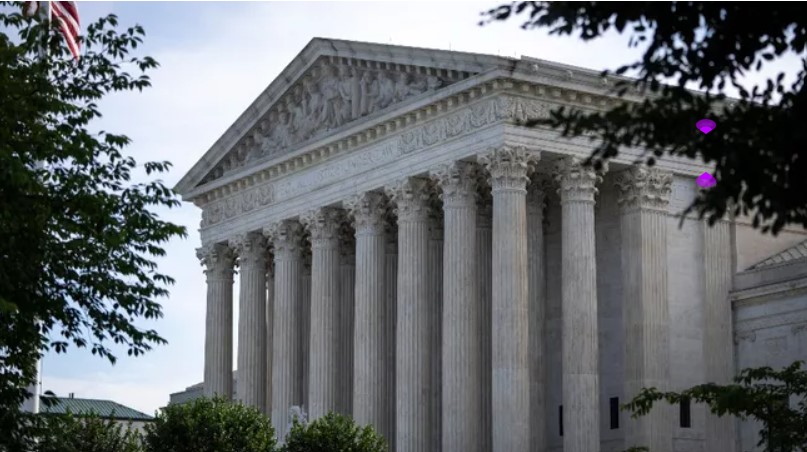

Experts say the U.S. Supreme Court’s decision to gut Section 2 of the 1965 Voting Rights Act will benefit Republican lawmakers across the country.
The Supreme Court, in a 6-3 decision along party lines, ruled Louisiana’s 2024 election map, which created a second majority-Black congressional district, was “an unconstitutional racial gerrymander.”
The decision is drawing intense criticism from African American institutions and leaders, as experts say the decision is expected to diminish the voting power of racial minorities. The decision made Wednesday is the latest move by the country’s High court which effectively ends the landmark 1965 Voting Rights Act, a result of the Civil Rights Movement.
Redistricting experts say Republican-led state Legislatures in Southern states will likely diminish the amount of Democratic-majority House districts that were protected under the Voting Rights Act prior to Wednesday’s Supreme Court decision.
The conservative justices said the focus of Section 2 must be banning “intentional racial discrimination.” GOP supporters of the ruling say it moves the country toward a “colorblind” society, while liberal opponents say it erases protections for racial minorities passed in the civil rights era.
President Trump on social media praised the decision. Earlier this year, Trump told reporters that white people were “treated very badly” as a result of the Civil Rights Movement.
The focus of Section 2 must be banning “intentional racial discrimination,” wrote Justice Samuel Alito, whose majority opinion was joined by his fellow conservative-leaning justices. The ruling means there now will require proof of intentional discrimination — something that is extremely difficult for plaintiffs to show.
“Only when understood this way does (Section 2) of the Voting Rights Act properly fit within Congress’s Fifteenth Amendment enforcement power,” Alito wrote.
Justice Elena Kagan, in dissent, accused the majority of making changes that “eviscerate the law.”
Justices Elena Kagan, Ketanji Brown Jackson, and Sonia Sotomayor all dissented.
In a 48-page opinion, joined by the liberal justices, Kagan warned the ruling “demolishes the foundational right Congress granted of racial equality in electoral opportunity.”
“The Voting Rights Act is—or, now more accurately, was—‘one of the most consequential, efficacious, and amply justified exercises of federal legislative power in our Nation’s history,’” Kagan wrote. “It was born of the literal blood of Union soldiers and civil rights marchers. It ushered in awe-inspiring change, bringing this Nation closer to fulfilling the ideals of democracy and racial equality. And it has been repeatedly, and overwhelmingly, reauthorized by the people’s representatives in Congress. Only they have the right to say it is no longer needed—not the Members of this Court.”
In Michigan, Democratic leaders renewed calls for the state Legislature to pass its own version of the Voting Rights Act.
“This U.S. Supreme Court decision creates renewed urgency to pass the Michigan Voting Rights Act to always ensure every Michigan citizen can freely and fairly participate in our elections,” Secretary of State Jocelyn Benson said in a statement Thursday.
While Republican-led southern states like Florida are scrambling to update their maps to add Republican-majority districts, it’s unclear whether the changes will prompt district boundaries to change in Michigan.
Rebecca Szetela, the vice chair of the state’s independent redistricting commission, told Votebeat she believes the commission could be called back in the wake of the ruling.
“I think it’s likely the maps that were drawn by Michigan’s Independent Redistricting Commission are likely going to be challenged and may, under this ruling, need to be redrawn,” she told Votebeat on Wednesday, just a few hours after the decision was released.
The redistricting commission, which finished its work on Michigan’s current political districts in 2024, can be reactivated under certain circumstances.
“The Republican Party is ruthless,” Michigan Democratic Party Keith Williams said of the ruling. “Donald Trump has said ‘To hell with the law.’ I like what they did in California, but it’s going to be a free for all until you get a president and a Congress with the intelligence to do what’s right.”
California last year approved Proposition 50, allowing a new, voter-approved Congressional map for the 2026 election that boosts Democratic representation, aiming to pick up five additional seats. The move, backed by Democratic leaders like former President Barack Obama, came in response to Republican gerrymandering in Texas.
Williams and Jessica Alexander, the chair of the Michigan Democratic Jewish Caucus, released a statement Thursday criticizing the Supreme Court’s decision weakening Section 2, a critical tool used to challenge discriminatory voting practices and vote dilution.
“Empty statements and performative gestures aren’t going to dig us out of this,” state Rep. Donavan McKinney, D-Detroit, said in a statement Thursday.
McKinney, who is challenging U.S. Rep. Shri Thanedar to represent Michigan’s 13th Congressional District, said U.S. lawmakers should expand the Supreme Court, “and implement anti-corruption reforms that would have prevented this.”
Anthony Eid, the chair of the state’s redistricting commission, told Michigan Chronicle Thursday that a challenge to Michigan’s recently redrawn maps is “probably less likely than it is likely.” Eid said Michigan has some of the most fair maps in the country.
“If the commission does get sued, it will defend its work,” Eid said.
“We have split government, even if districts were sued they’d still be drawn by an independent commission. Neither would have much to gain, there’s no chance of one or the other party drawing the maps, which seems to be the impetus.”
“I thought the Supreme Court would completely get rid of Section 2 — even though it doesn’t get rid of it, it takes away most of its enforcement mechanisms,” Eid said. “Everyone in the voting rights space has been monitoring this. Not many are surprised they ruled this way.”
Eid explained the tension between the Voting Rights Act and the Constitituion, saying redistricting commissions must use race to create districts.
“Now, the court said that if you use race, you’re doing an unconstitutional racial gerrymander,” Eid said. “They’re making it so you can partisan gerrymander for any reason. Most black voters are democratic voters and that’s the main issue. Southern states will redraw maps to get rid of minority representation and Democratic representation.”