
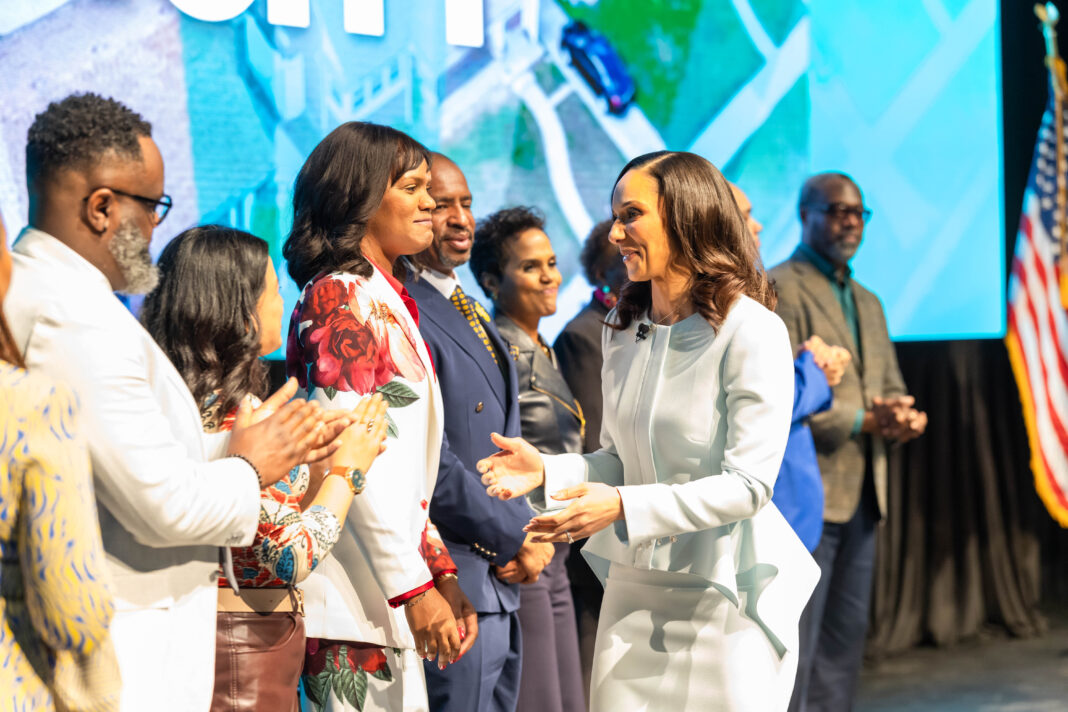

Neighborhood investment is a major priority of the city’s new administration, Detroit Mayor Mary Sheffield declared at Tuesday’s State of the City address.
Her address, inside of the Jemele Hill Auditorium at Mumford High School located on the city’s Northwest side, was intentionally held in a Detroit neighborhood as a symbolic nod to her campaign promise to focus more on neighborhood revitalization efforts as mayor.
She unveiled her neighborhood anchor plan and doubled down on her past comments saying investment into the neighborhoods must go further than previous administrations.
“Every neighborhood deserves investment and we will tailor a plan for every community to rise higher,” Sheffield said, adding that investment is coming to more than just a few square miles downtown.
The mayor announced the Detroit Housing for the Future Fund 2.0 led by LISC Detroit. A $50 million investment will provide grants and low interest loans to build and preserve affordable housing in the neighborhoods.
Sheffield also announced what she called an aggressive retail strategy.
Currently, most Detroit neighborhoods lack adequate shopping centers, sit-down restaurants and grocery stores. And some of those businesses currently set up in neighborhood commercial corridors are in desperate need of improvement.
Sheffield also said she will be creating a new director of retail role to attract and recreuit national retailers like Meijer, Marshalls, TJ Maxx, Aldi to come to Detroit. She said for too long, the city has waited for retailers to come.
“My administration will go out and compete for that investment,” Sheffield said. “Because strong neighborhoods need more than housing and infrastructure. They need vibrant commercial corridors where people can shop, work and gather close to home… The market is here, the residents are here, the opportunity is now.”
She said the goal is to make Detroit the easiest, most predictable and attractive city in America for retail.
Sheffield also touched the plan to use Public Lighting Authority bond savings to bring 3,000 new mid-block streetlights to Detroit neighborhoods. She signed an executive order March 19 to direct the funds to be used for streetlight, which will be installed later this year.
“Residents will have the opportunity to participate directly in community engagement sessions that will start next month,” Sheffield said.
Sheffield during her mayoral campaign said she wanted to encourage homeownership.
The City of Detroit’s down payment assistance program is back online, funded with $9 million from the Community Development Block Grant and Community Development Block Grant Disaster Relief funds.
Eligible applicants can apply for up to $25,000 in down payment, pre-paids, and closing cost assistance when buying a home.
The city is also part of an effort to bring those who left back, those who are here to say and gain new residents.
Sheffield was present Thursday morning at the launch of a new citywide growth plan in partnership with Dan Gilbert and several other local organizations called the Move Detroit Coalition.
The program will support current and future residents with up to $15,000 to support homeownership and business growth and $1,000 in relocation assistance to Detroit.
Former Michigan growth officer Hillary Doe is the president and CEO of Move Detroit. She was appointed by Gov. Gretchen Whitmer to help find solutions to raise the state’s population.
The state saw an increase of 27,922 people (.3%) from July 2024-2025, Census Bureau data shows. The U.S. Census estimate released last May shows Detroit’s population estimate at 645,705, a gain of 12,487 from the 2024 report.