


Photo credit: Monica Morgan Photography
By: Jasmine West
Michigan has the water, land, universities, skilled workers and industrial history that other states would be eager to claim.
Yet the state continues to lose ground in income growth, educational outcomes and its ability to attract and retain young people. During the final Pancakes & Politics forum of the 2026 season, some of Michigan’s leading voices in business, government and energy confronted the gap between what the state has and what it has been able to accomplish.
The CEO roundtable brought together DTE Energy President and CEO Joi Harris, Oakland County Executive Dave Coulter and Business Leaders for Michigan President and CEO Jeff Donofrio. Dennis Archer Jr., chairman and CEO of Sixteen42 Ventures, moderated the conversation on how Michigan can become more competitive.
The discussion moved across workforce development, education, entrepreneurship, regional transportation, population growth and the expanding data center industry. Underneath each topic was a question that has followed Michigan for years: How can a state with so many natural and institutional advantages continue to trail its peers?
Donofrio said Michigan’s economic position has steadily declined over the last two decades, pointing to the state’s fall to roughly 40th in per capita income.
“What can we do to make Michigan a more competitive state?” Donofrio asked. “There’s been a continued slide in the last 20 years, where we were a top 10 state in categories like per capita income, and now we are 40th.”
He cited Mississippi’s improvements in literacy as an example of a state refusing to accept poor outcomes. Mississippi, he said, moved from 39th to ninth in literacy rankings while Michigan continues to wrestle with persistent educational gaps.
Donofrio gave Michigan an “incomplete” grade.
Harris offered two grades: one based on Michigan’s current performance and another based on what she believes the state can become.
“This state has promise, and I see it in our young people, in the universities, in the business leaders that I engage,” Harris said. “If I had to give it a grade by the numbers, it would be a C. But if I had to give it a grade based on potential, I’ll give us an A. I’m an optimist.”
Coulter gave the state a B-plus, arguing that Michigan must acknowledge where it is falling short without overlooking the progress underway in Detroit and Oakland County.
“It’s really important to acknowledge our shortcomings and not bury our heads in the sand, but the opportunity here is greater than the challenges,” Coulter said.
He pointed to Oakland County’s strong local communities and high per capita income, along with Detroit’s continued progress and stronger relationships across municipal borders.
“There’s no more us versus them,” Coulter said. “We just need to be more intentional to get us back to an A.”
Archer gave Michigan a C and stressed that improving the state cannot be assigned solely to Lansing, one political party or one institution.
“If you look at the things you can apply a metric to, there’s room for improvement,” Archer said. “This is not incumbent upon the governor, the state House, the superintendent. This is upon all of us.”
That shared responsibility became especially clear during the panel’s discussion about data centers.
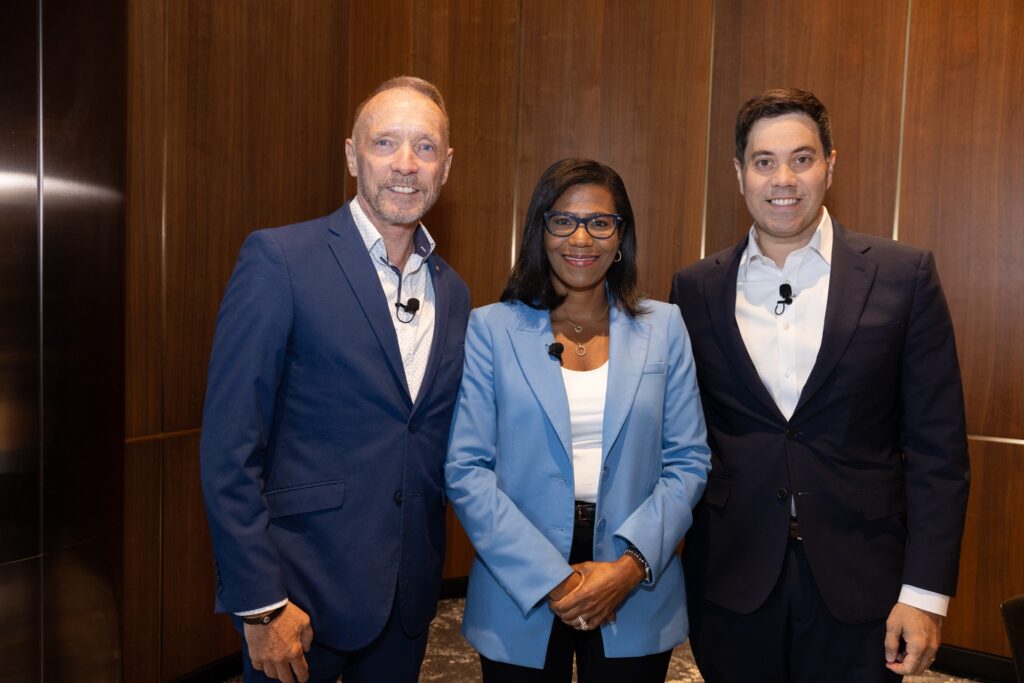
Photo (L to R) Dave Coulter, Joi Harris, Jeff Donofrio.
Michigan’s abundance of land, water and energy infrastructure has made the state an attractive location for companies seeking to construct the large facilities needed to operate cloud computing systems and artificial intelligence technology. The proposals have also generated opposition from residents concerned about electricity rates, water usage, environmental consequences and whether surrounding communities will receive any lasting economic benefit.
Harris said data centers are already embedded in daily life, supporting everything from entertainment and online searches to business operations and artificial intelligence.
“You’ve probably passed by two or three data centers on your way to work,” Harris said. “They’re already embedded.”
She emphasized that DTE does not build data centers. The company supplies electricity to customers, including homeowners, small businesses and large technology companies.
Under Michigan law, Harris said, hyperscale data center operators must pay the costs, and sometimes even more, associated with serving their facilities rather than shifting those costs onto existing utility customers.
“We cannot subsidize data centers on the backs of our existing customer base,” Harris said. “The law prohibits us from using cross-subsidization.”
She argued that adding major customers can place downward pressure on rates by spreading the fixed costs of the electrical system across a larger customer base, comparing it to splitting a ride-share with friends. She also said contracts with hyperscalers can help finance batteries and increased renewable energy production.
Harris pointed to DTE’s recently announced agreement with LG Energy Solution for 1.6 gigawatts of battery capacity, which she said represents $1.6 billion in investment and approximately 1,800 Michigan jobs.
“We’re using local suppliers and electricians to do these jobs,” Harris said. “This is a once-in-a-lifetime opportunity.”
Coulter said Oakland County government does not have a formal role in approving individual data center developments, but he cautioned industry leaders against dismissing public skepticism.
“I don’t have the luxury of saying, ‘You just don’t understand. Just wait,’” Coulter said. “We have to do a better job of communicating.”
He said developers and service providers should meet with residents well before construction begins, provide clear information and treat concerns about water, energy use, noise, land and community impact as legitimate.
“The developers themselves need to do a better job with transparency,” Coulter said. “The people’s concerns are valid, and they need to be addressed.”
Donofrio said Michigan took a more thoughtful approach to regulating data centers than some other states. He noted that more than 100 data centers already operate in Michigan and argued that the infrastructure could become as important to the next era of economic growth as railroads and interstate highways were to earlier generations.
“If we don’t take advantage of this, we may look back five years from now and say we really missed out,” Donofrio said.
Both Donofrio and Harris rejected the idea that data centers create few jobs. While the completed facilities may not employ as many workers as a traditional automobile plant, they said their construction, maintenance and continued modernization require electricians, pipefitters, HVAC technicians and other skilled tradespeople.
Still, the larger question was whether those opportunities will reach Detroiters, Black-owned businesses and workers who have historically been shut out of major public and private investments.
Kylee Mitchell Well, Executive Director, Ballmer Group Southeast Michigan asked the panel how companies and governments are ensuring that jobs and contracts are accessible to people who have been excluded in the past.
Harris said DTE has invested millions of dollars in local and statewide contractors and is deliberately working to expand access to its projects.
Coulter urged entrepreneurs who were unsuccessful in securing a county contract to continue applying.
“I believe very passionately that the opportunities we create are and should be available to everyone because too many people have been left out,” Coulter said. “So many people are afraid of data centers because they feel as if they’re being left behind. My job is to level the playing field so that everybody can be successful.”
Donofrio said Michigan’s leaders must recognize that ability exists in every community, even when access to capital, education and professional networks does not.
“Talent is equally distributed, but opportunities are not,” Donofrio said.
Education remained central to the panel’s competitiveness argument. Michigan cannot attract companies, expand entrepreneurship or raise household incomes without improving the systems that prepare young people for work and higher education, the panelists said.
Donofrio also warned that Michigan’s aging population will make it increasingly difficult to maintain economic growth and afford public services. Young adults are moving toward cities and states where they see stronger career opportunities, active communities and a better quality of life.
Michigan’s neighboring states and metropolitan areas, including Columbus, have grown faster, he said. Reversing that trend will require communities where young workers can find housing, transportation, entertainment and a clear path toward career advancement.
Harris said DTE recruits students from historically Black colleges and universities and local colleges, bringing them to Michigan for internships and employment opportunities. The company also encourages its suppliers to create similar pathways.
“We are teaching them what it means to be professionals along the way,” Harris said.
She challenged business leaders to replace negative conversations about young people, including public criticism of so-called teen takeovers, with a serious commitment to training, employing and mentoring them.
“How do we leave this room today and say, ‘What are we going to do to commit to our youth?’” Harris asked.
Coulter said internships must be paid and should be paired with apprenticeships that allow students to gain workplace experience without being expected to work for free.
“Once a student sees it and gets paid, their rate of success is substantially higher,” Coulter said.
The final forum of the season did not produce one simple solution for Michigan’s economic challenges.
Instead, the panelists described competitiveness as the result of interconnected decisions: whether children can read, whether entrepreneurs can secure contracts, whether workers can travel across the region, whether companies communicate honestly with residents and whether young people can envision a future for themselves in Michigan.
The state’s natural resources and industrial legacy may give it an advantage. The panel’s message was that potential, by itself, is not progress.