

If one were to bump into hometown hooper Jalen Rose around town these days and ask if he’s excited for next season, he’ll probably respond with two wildly disparate answers.
But it depends on the definition of “season” and in which context. A predictable response would be that Rose is looking forward to seeing how far the Pistons can go next year after a stellar run on the court that had the team in spitting distance of a championship. But one wouldn’t be wrong if they’d expect Rose to discuss his new favorite streaming series – one that he just happens to produce and star in.
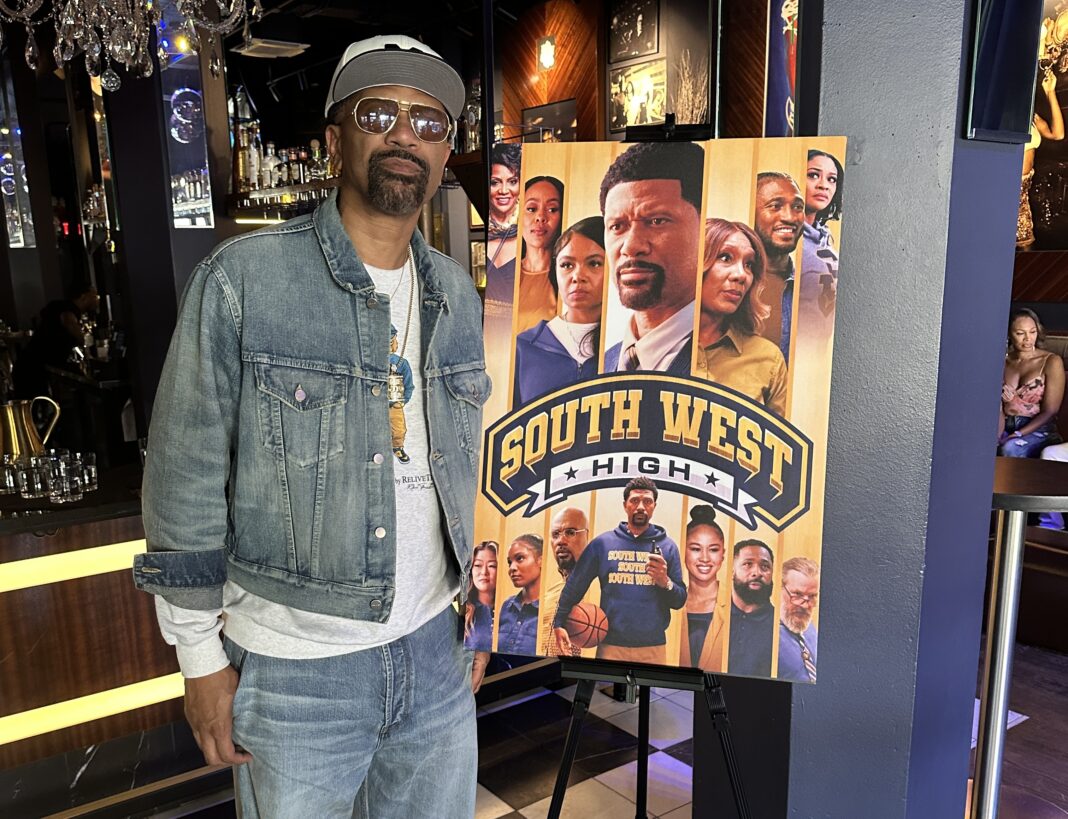
“I don’t know what’s going to happen in season two yet,” Rose told an intimate crowd at a wrap party at The Vinyl Society, where the cast of “South West High” were on hand to watch the first season finale of the Detroit-based high school drama.
Rose’s name appears in the credits of all five episodes of “South West High” three times as creator, an executive producer and its first-billed cast member, so one would think he of all people would know what would happen in its next season. He actually doesn’t – a reality indicative of current conditions around bringing Black stories to the small screen.
“South West High,” inspired by Rose and co-producer Ty Mopkins’ days as students at Detroit’s real-life, now-demolished Southwestern High School, is something of a “Degrassi” if it were produced on this side of the Ambassador Bridge. The teen drama follows the emotional ups and downs of students at the school and their relationships – and without giving away too much, there’s multiple definitions of what “relationships” are, too – with the adults around them. There’s gossip, scandal, breakups and makeups that will resonate with anyone who’s ever been a teenager, be they Rose’s age or currently attending the westside high school that bears his name.
“Inner-city young people don’t get their story told,” Rose said. “And the parents, the educators, the teachers – sometimes the challenges that they overcome don’t get highlighted.”
Rose has a name that’s familiar to everyone, whether it’s stamped on a diploma from the Jalen Rose Leadership Academy which he cofounded in 2011 or stamped on a birth certificate belonging to one of the countless babies named “Jalen” year after year since the Fab Five became an inescapable phenomenon. In the 30-plus years since he and his teammates captivated the nation, Rose’s pivots on and off the court have consistently kept his name out there. And coming from a city where name-dropping can garner eyerolls, Rose’s name on a public scale has become synonymous with it.
The one place where Rose’s name didn’t quite resonate as strongly was with television executives. Pitching “South West High,” or really any Detroit story, Rose told the crowd, drew mixed reactions from other networks and streamers who largely passed on the idea of a show featuring mostly Black students – even if Rose, whose second act in sports broadcasting made him even more of a household name, offered to star in it himself.
“A lot of times when our story is told, people who don’t look like us tell our story,” Rose said. “So if we’re going to tell our story, we’re going to be authentic, and we’re going to be apologetic.”
Rose and Mopkins co-produce “High” with Dennis Reed, who for the better part of the last decade has pumped out volumes of Detroit-produced fare for Tubi, where their show eventually landed. “We became the most-watched show on Tubi,” Rose said. “That actually happened.”
Tubi does not disclose viewership numbers; even Rose doesn’t have exact figures. And though Tubi is where the show can be found, “High” is not a Tubi-produced original program. Like many shows on the Fox-owned streamer, “High” airs on Tubi through a distribution deal offered to independent creators who largely fund their own projects and in turn receive some revenue share from ads that run during the program.
Describing a show as having a “Tubi budget” is pejorative, but it’s an insult that’s fading partly thanks to Reed and other local creators who’ve curated an easily identifiable Detroit aesthetic by stockpiling the streamer with content full of it: Soapy street tales that blur the line between glossy and gritty, hometown actors appearing in multiple projects, and plot twists that keep viewers coming back for more.
“South West High” is no different, as viewers will recognize players from prior Reed productions. Adamant about having high school-aged characters being played by actual high school students, Rose insisted on offering roles to young actors looking for a boost. Plenty of more recognizable names, like Towanda Braxton who has a regular role as an assistant principal, or Sada Baby who drops in for a one-off that hints at more, speak to the growing legitimization of any production airing on Tubi.
All of those actors need to be paid out of budget, something partially funded by Platinum Equity, the holding firm of Pistons owner Tom Gores, who Rose is partnered with. And that’s before paying writers, directors, crew members and hair stylists – on a show with multiple Black women actors in the hair capital of the world, mind you.
“If y’all knew what it took to get this done,” Mopkins told the crowd while briefly making his own remarks. “This … wasn’t easy.”
From cast changes after actors leaving the project in pre-production to marketing and promotion as each episode dropped (“we still have marketing stuff,” Mopkins says), producers found a way to make “High” look good without looking cheap. And knowing it would reflect Detroit to folks outside Detroit, that mentality also plays into another reason why Rose’s name is out front as much as it is: He’s betting on it.
“If people hate this show, the first person they can complain about is me. I’m the target,” Rose says. “If people were unhappy, didn’t like it, or found a reason to complain, I would be their aim.”
The number of pro athletes who can act on screen is few, and Rose is quick to point out that although he took acting classes to get more comfortable on set, “there’s a reason why a lot of athletes don’t do it – it’s hard.” Of the short list, Fred Williamson – the NFL’s “Hammer” whose same-named flick jumpstarted a long career on screen – was someone Rose grew up with that eventually became a template for this next career phase.
“I grew up in an era where there were Blaxploitation movies,” Rose said, pointing to productions that had limited funding but still became staples with Black audiences. “But then in the ‘90s – you could have ‘Menace II Society’ and ‘Don’t Be a Menace To Society.’ There were budgets. And we lost that.
“We don’t have them anymore,” Rose continued. “New Line Cinema, the Wayans, Spike Lee, Ice Cube – there were so many people in the ‘90s that had budgets for people who looked like us. But they don’t exist anymore.”
It’s easy to see why Rose is wistful for this particular era. When five real-life Black student-athletes first suited up in Michigan jerseys in 1991, for example, Theo Huxtable was preparing to graduate from New York University, Tre Styles was headed to Morehouse College (with Brandi across the street at Spelman College), and Play threw a house party to help keep his friend Kid from dropping out of college.
It’s a different world now in 2026, where it seems Black audiences no longer have choices, but instead mandates. Shows with Black casts have to be binged right away to not be canceled after one season. Moviegoers are urged to see Black films – whether they like the subject matter or not – if they want more Black films to be greenlit. And fans must put their support behind every Black actor’s side hustles in haircare, skincare, and self-care – unless they’re a Black British actor playing one too many African American characters. This is the new playbook that aspiring producers like Rose have to study, one that explains why Black projects are seen as risks to investors and why they’re fewer and far between.
“South West High” still stands at one season and it’s too soon to tell whether it’ll fall into one-hit wonderdom with “Detroit 1-8-7” or become a Detroit classic like “Sister, Sister” or “Martin,” the latter of which just happened to prominently feature a jersey worn by one of Rose’s teammates. The Tubi metrics are still unknown, but at least one viewer can corroborate its popularity.
“I watched every episode,” longtime friend John Mason — a household name for Detroit Pistons fans, Detroit radio listeners, or both — told Rose in front of the crowd after taking the mic. “Because with the budget I know you couldn’t afford, you didn’t waste that on theatrics and blowing shit up and all that. You spent it on thought, and making people think – it brings that nostalgia back, and I respect that so much.”
But Rose didn’t dwell on nostalgia for too long that night, lest one get too stuck in it. The driving force behind keeping his name out there is making sure it doesn’t get lost to history. After acknowledging him and Mason’s long friendship, Rose took back the mic and got back to business, reminding the crowd of one more place where you can put his name: “So, if anyone in here wants to write a big check…”