
On Woodward Avenue, where Detroit’s past and present meet in the middle of a rapidly changing downtown, Joe Louis is once again being introduced to a new generation.
This time, there is no boxing ring. There is a restaurant – a third location, but the first downtown.
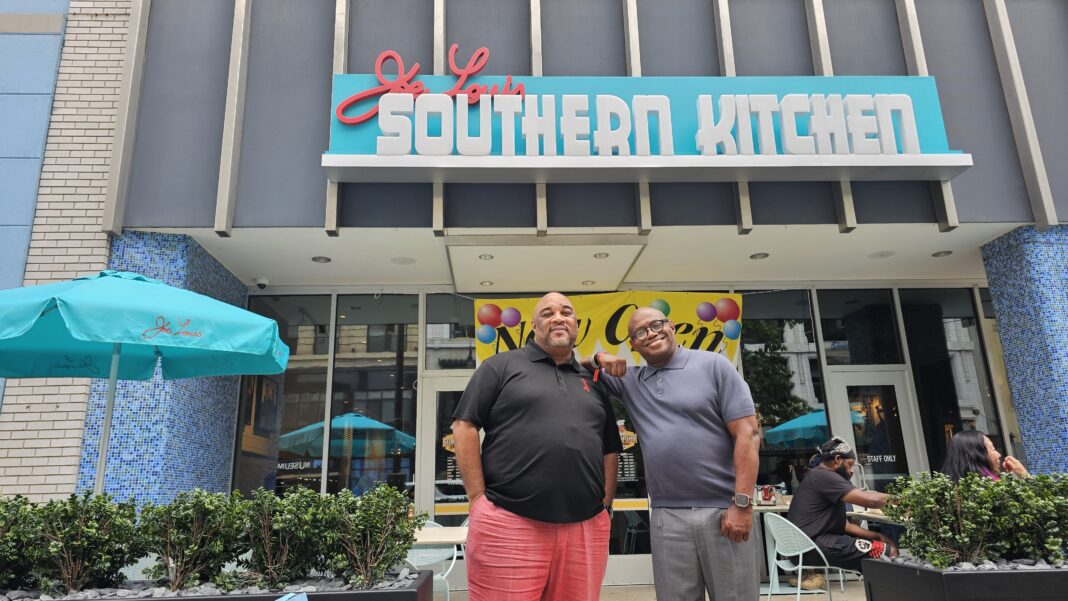
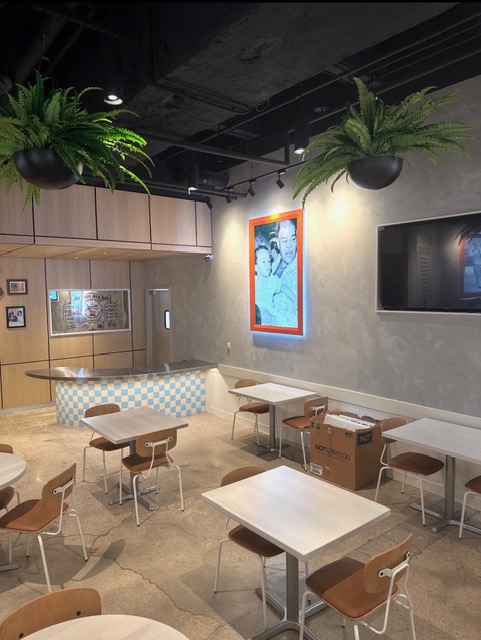
Joe Louis Southern Kitchen, the family-owned Detroit restaurant inspired by the life and legacy of the heavyweight champion, has opened its newest location at 1528 Woodward Ave., just blocks away from Comerica Park, Ford Field, and Little Caesars Arena. The approximately 4,000-square-foot space, which began its soft opening Aug. 13 ahead of an Aug. 27 grand opening, is the brand’s first location with a full bar and open-air patio.
For Joe Louis Barrow II, the champion’s son and co-owner of the restaurant, the downtown location represents something larger than another step in a growing restaurant business.
It is an opportunity to reconnect Detroit with a man whose name still appears throughout the city – on streets, landmarks, and buildings – but whose story, Barrow believes, has not been fully told.
“When Johnny and I met in 2018, I told him that I had a vision for reintroducing my father to a lot of people,” Barrow said. “Every person I talked to basically said, ‘Your father is a great American, but he’s irrelevant.’”
The response was painful, but Barrow didn’t accept it.
“Sometimes it felt so crushing,” he said. “But I just knew that wasn’t the case. I knew there was a lane to build the brands around what I wanted to do.”
The person who eventually helped him find that lane was Johnny Cannon, a longtime restaurant operator and now Barrow’s business partner.
Cannon knew Joe Louis as a name. He knew the boxer, the arena that once bore his name, and the mythology surrounding one of the most celebrated athletes in American history.
But he did not yet know the breadth of the man’s life.
Barrow asked him to watch a documentary.
“I went home to watch the documentary, and it gave me a different perspective and helped me understand who Joe Louis really was,” Cannon said. “I saw the value in the brand and the opportunity to really tell the story.”
What struck Cannon was how much of Joe Louis’ life existed outside the ring.
“I knew the story hadn’t been told in my lifetime – what this man had accomplished, being the first to do a lot of the things he did, from golf to the Army to integration,” Cannon said. “He was doing it so quietly.”
The next day, Cannon returned with an answer.
“Let’s do it,” he told Barrow.
The first Joe Louis Southern Kitchen opened in Detroit in 2021 at 6549 Woodward Ave. in Midtown, built around an all-day Southern breakfast concept and the food traditions associated with the champion’s Detroit story. A second location opened in Southfield in 2025.
Now, the brand has returned to the center of Detroit.
For Cannon, who has been in the restaurant business since 2003, the downtown opening is another chapter in a career that has grown alongside Detroit’s evolving food culture.
“To still be in it and to be a part of the development of what’s happening, and to see the culture of the restaurants developing in the downtown area alone, is prime time,” he said. “I’m proud. I feel privileged.”
The Woodward location also gives the restaurant a new role. Its patio and full bar are intended to make it a destination not only for breakfast and Southern comfort food, but for people heading to games, concerts,or just out enjoying the town.
“When the stadiums were being built down here and we started seeing so much foot traffic, it was night and day,” Cannon said. “For me, now it’s truly just to be a part of the scene and to be a part of something beyond the food – to have a place for people to come, enjoy themselves, and safely have a good time. It’s priceless.”
But the restaurant’s significance, Barrow said, can’t be measured by foot traffic alone.
He thinks about the people who supported his father when he was still a young boxer, long before Joe Louis became a national symbol.
“I walk into the restaurants every day and I get to see the people who mattered most to my father,” Barrow said. “The guy who struggled every day to put food on the table, never committed a crime, and continued to do it with dignity. To be able to serve them the way they served him, it’s just a privilege.”
That idea of service extends to the restaurant’s employees.
Barrow said many of the staff members are single parents, and he wanted the business to provide more than a paycheck, which is why the business is open daily from 7 a.m. – 3 p.m.
“I wanted to be able to provide people an opportunity to make a good living, but to get home and have dinner with the most important people in their lives,” he said. “People should have jobs so they can have a life.”
He doesn’t describe his relationship with employees in traditional terms.
“I don’t want to be that kind of employer,” Barrow said. “For me, they’re really partners. We’re less employers and more partners than we are anything else. I can’t win unless they win, and Johnny has that same philosophy.”
That philosophy also shapes how Barrow sees the restaurant’s place in a downtown that has changed dramatically in recent years.
He is particularly conscious of representation.
“Detroit is changing right in front of all of our eyes,” he said. “It is critical, in my estimation, that every Detroiter sees themselves in this context.”
The issue is personal for the family. Barrow remembers watching people who had remained in Detroit through its most difficult years struggle to participate in the city’s resurgence.
“When Detroit was falling apart, when everyone was moving out of the city and into the suburbs, there was a core group of people that were stuck here, and they weathered all of it,” he said. “So for us not to think about them when we reinvent Detroit, it’s really not only unfortunate. It’s incredibly unfortunate.”
His father, he said, belonged to all of those people.
“My father was a man of the people – not just African American people, but all people,” Barrow said.
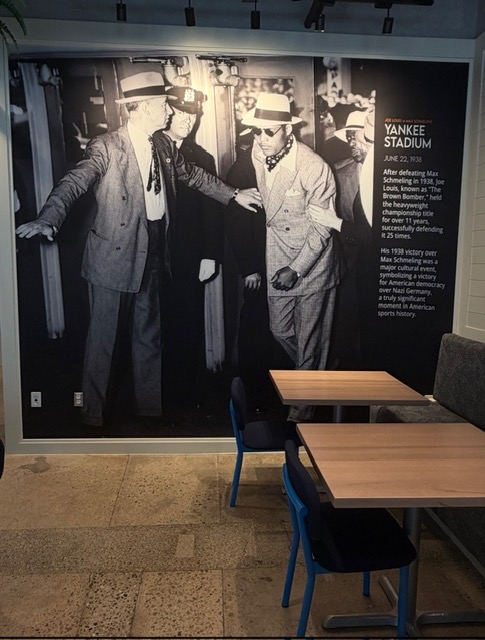
Inside the new restaurant, that idea is visible in another way. Archival photographs and milestones from Joe Louis’ boxing career are part of the space, allowing diners to encounter the man behind the name while eating the food inspired by his legacy.
“For so many people, Black excellence is a catchphrase,” Barrow said. “We have an opportunity to meet and reach a whole new segment of the population that hasn’t had an experience like this since Joe’s Southern Kitchen. And I think it’s important for them, and it’s important for us.”
Cannon sees the restaurant as the beginning of a much larger enterprise.
The immediate goal is more Joe Louis Southern Kitchen locations, followed by a franchise model that could include both corporate and franchise restaurants. The partners are also developing apparel, including a Brown Bomber collection and a higher-end Joe Louis Collection, as well as a cookbook and consumer products tied to the restaurant.
A film project is also in development with Detroit-connected production company Storyboard Entertainment.
The ambition goes beyond simply putting the Joe Louis name on more products. Cannon sees the brand’s possibilities in the same way he came to see Joe Louis himself: as a story that has already been written, but has not stopped evolving.
“Once the story has already been written, you just have to come back and re-shine it and tell it in today’s time,” Cannon said.
Barrow’s ambitions extend even further.
He envisions a hotel in Detroit built around the legacy of the Brown Bomber – a phrase that became synonymous with his father and with a generation.
“You mark my words – you hear it coming from my mouth first – there will be a Brown Bomber hotel in Detroit,” Barrow said. “It’s not about paying homage to my father as much as it is paying homage to an entire generation,” he added.
He points to Detroit’s history of industrial innovation and the women who entered factories during World War II, building bombers, and challenging assumptions about who could work in American industry.
“I think that we really need to start paying attention to our past so our future can be bigger and brighter,” Barrow said. “If we don’t know where we’ve been, we don’t know where we’re going.”
That may be the central idea behind the restaurant itself.
Joe Louis Southern Kitchen is selling breakfast, Southern comfort food, and, now, drinks on a Woodward Avenue patio. But Barrow sees the business as something more enduring: a way to keep a Detroit story in circulation.
His father died more than four decades ago. He has not entered a boxing ring in more than 70 years.
Yet the name remains.
“The idea that they’re still building monuments to him or the accolades are still coming, I think that has more to do with who he was as a human being than anything he ever did in the ring,” Barrow said.
For a son who once worried that his father had become irrelevant, the restaurant offers a different answer. The story is still being told. And in downtown Detroit, there’s a table, a stack of key lime pancakes, and a turkey leg smothered in gumbo rice just waiting for people sit down and hear it.