

As a young activist and a Black city mature together, an extensive travelogue tells a post-Civil Rights coming-of-age story
In February 1967, the Rev. C.L. Franklin was tasked with introducing Detroiters to a rising star whose name everyone in town should know.
By that time, this was a familiar practice for the pastor of New Bethel Baptist Church, whose stamp of approval could change minds and lives alike. It worked as he ushered his daughters – one in particular – into the entertainment world, and it worked when he put his reputation on the line four years earlier to convince skeptical Detroiters to gather en masse on Woodward Avenue to let a young preacher from Atlanta make his case for freedom. This time around, he’d be introducing an even younger associate of that preacher, who was also man of the cloth himself.
A brief mention in a February issue of the Michigan Chronicle previewed an upcoming visit by the Rev. Jesse Jackson, “a 25-year-old civil rights leader” – a verbatim descriptor from the Chronicle that lends to some amount of consensus that one could actually be a leader at 25 – who’d be delivering a talk on economic empowerment at New Bethel on a Friday evening, as well as talking about progress made with a new division of the Southern Christian Leadership Conference that was not yet a year old at the time.
It was the second time Jackson had been featured in the Chronicle. A few months prior in 1966, Jackson was highlighted in a Chronicle writeup after Operation Breadbasket, the name of the new SCLC division he founded in his hometown in Chicago, took action to demand better conditions and wages for Black grocery store clerks – and won. Those demands won notice in Black press outlets across the country and officially deemed Jackson, whose name was beginning to appear more and more alongside the SCLC’s first president, the Rev. Martin Luther King Jr., as one to watch.
King, a familiar name to Chronicle readers due to his frequent mentions in a recurring column penned by Horace Sheffield, was increasingly in demand and, as some Black press dispatches show, often deputized Jackson and other close affiliates in lieu of his absence or unavailability for speaking engagements, town halls and other appearances in front of Black audiences who were beginning to hang on to his every word. Jackson’s work targeting better working conditions for Black people in Chicago were of interest to Detroiters, who had long complained of being discouraged from career advancement and forced to accept poor wages, all while being asked to accept below-average living conditions in the slums or the projects.
The 1967 address from Franklin to New Bethel’s parishioners did not earn much ink in the Chronicle, nor is there a known copy of the speech. A religion column noted that while Jackson was in town, he delivered a sermon at one east side church’s early service and a second afternoon sermon at a different church. As brief as these summaries are, enough inference can be drawn to suggest the beginning of a lifelong partnership between Jackson and the city of Detroit.
Perhaps Franklin’s presence can be revised as a symbolic torch-passing from an elder statesman to a younger upstart, setting the stage for an unending debate about whether the younger would ever live up to the standards set before him. And as we reflect on the legacy of Jackson following his death on February 17, one could also argue the New Bethel visit — exactly 59 years to the date of his transition – is emblematic of the unsung labor Detroiters have always performed in making legends out of neophytes.
It wouldn’t be long before the Chronicle’s dispatches on Jackson became longer and took up more column space. With 90 years of archives to pull from, Chronicle journalists’ coverage and commentary from 60 of those years follow a journey to empower Black Americans that took Jackson everywhere from the South Side of Chicago to spitting distance of the White House, with countless trips to Detroit underscoring how this city became the reverend’s barometer for all of Black America.
It’s during this same timeline that as Jackson is stepping into the limelight, Black residents in many cities first began tipping the numbers to count for more than half of their population. Chronicle journalists exploring Detroit’s new status as a Black city, one whose residents are settling into new legislation allowing voting rights and desegregation, but still not that far removed from the Jim Crow south, show how Detroiters arrive at their own station.
Studying the parallels and intersections of the two makes a case for a new entry in the annals of Black history. Jackson’s activism over six decades is a familiar narrative of a freedom fighter’s journey of resilience and determination. A closer examination at the role of Detroit and its residents over the same 60 years looks at how demographics can increase not just in number, but in influence — showing not only how Black leaders were continually met with higher standards and new demands in a growing Black population, but what the consequences could be if they didn’t measure up.
The amount of time Jackson spent in Detroit working with advocacy organizations he founded, delivering speeches, stumping for candidates, speaking to students, joining protesters and picketers, attending celebrity birthday parties on Saturday nights and delivering Sunday morning sermons is immeasurable, even with volumes of archives. This timeline marks some significant events in Jackson’s life, such as causing a stir at a Democratic National Committee meeting in Detroit in his first presidential bid, as well as the routine, everyday gatherings sometimes lost to history, like judging a beauty contest with Detroit’s most senior congressman. While it is far from complete, the amount of available information to dissect here is a testament to the critical work of the Black press.
1960s: A King on Woodward, a kingmaker on Linwood, a kingdom in flames
Unbeknownst to Franklin or Jackson, that February, Detroit would transform into an entirely different city a few months after the Chicago resident came to Linwood to address the congregation. Jackson himself would undergo some unexpected metamorphosis soon after.
It’s safe to say that Jackson and Franklin hit it off after the February 1967 sermon. Later that July, the Chronicle reported about a well-attended anniversary banquet at New Bethel honoring Franklin’s years of service there. Before Franklin embarked on a three-week European vacation, more than 500 churchgoers wished him well at a lush affair that featured performances from Franklin’s daughters Carolyn, Erma and Aretha, and remarks from politicians and community leaders. UAW President Horace Sheffield took to the podium to introduce Jackson, who gave some extended remarks.
Throughout the years, Jackson would find himself in close proximity with a generation of Detroiters rising to new levels of prominence across all disciplines. Sheffield, whose granddaughter became Detroit’s mayor last month, frequently championed Jackson in several columns he wrote for the Chronicle over the years and defended any attacks on his stature among Black Americans. So did the Rev. Charles Adams, another legendary local leader with a side gig writing for this publication; in a 1972 essay, Adams wrote that Jackson might “help heal the wounds of Black America, that we might reach the third crucial stage of liberation, and from there to become effective agents in the healing of America and the world.”
Adams certainly had high expectations, but that’s because it seemed like if a Detroiter called, Jackson showed up, including as a featured guest at a benefit concert raising funds for a Black college tour organized by Detroit educator Alonzo Bates (1973); delivering remarks at the funeral for Berry Gordy’s mother, telling mourners that she was “the Lord’s miracle…of taking the ordinary and turning it into the extraordinary” (1975); and returning again and again to New Bethel over the years, most notably delivering a 20-minute address at the funeral for the Rev. C.L. Franklin behind the same pulpit where he was introduced 17 years earlier (1984).
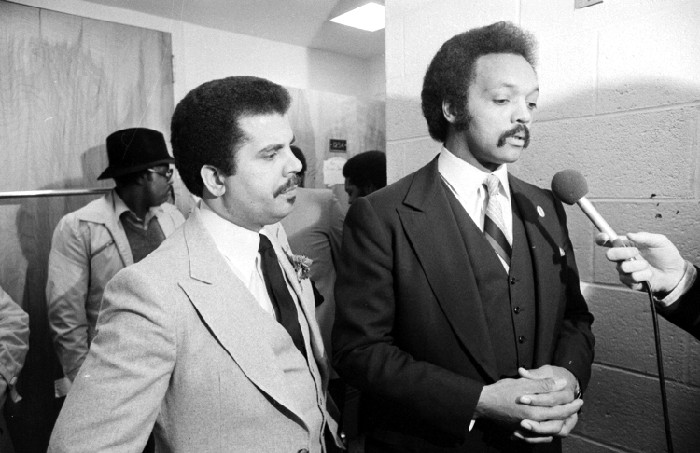
All this name-dropping has a purpose, which is to break down a possible reason why Jackson kept showing up, and kept in good graces with as many locals as he could. Whether he was prepared for it or not, Jackson faced the challenge of having to repeatedly convince Detroiters to get on his side and stay there, the same hurdles King had to overcome when it came down to convincing Northerners to listen to some ideas from Atlanta.
King having make a name for himself isn’t just a learned practice, however. His efforts of currying favor up North culminated in the largest civil rights demonstration in Detroit history, which doubles as a backdrop for Jackson’s early activity here.
As the Chronicle and fellow Black news outlets reported throughout the 1950s and 60s, civil rights organizations were at odds with each other over who commanded the most influence over improving the lives and outcomes of Black people, a feud growing so tense that it threatened division among the very population they were trying to protect. The NAACP, then presided over by Roy Wilkins, was fighting to preserve its reputation by relying on its status as the first and oldest advocacy, but some were attracted to the younger, more progressive activism from organizations like the newer Southern Christian Leadership Conference and the Congress of Racial Equality.
The tension over where to choose sides played out in Detroit, where residents were skeptical of the then-unproven King. Seeking to raise his profile, a newly formed coalition called the Council for Human Rights placed notice in a May 1963 Chronicle asking for 100,000 to come out for a rally at Cobo Arena for King the following month on June 23. The coalition was formed by Rev. C.L. Franklin. Weeks of promotion in the press, on the ground and in Sunday sermons, boosted by major endorsements from local elite, worked out: Franklin’s goal was beat with more than 125,000 in attendance (“the largest and most dramatic march to take place anywhere in the United States,” the Chronicle reported the following week) to hear King recite a speech that would later be tweaked and finessed into its final version years later under a new title, “I Have a Dream.”
In a number of pieces, the Chronicle called repeatedly for the feuding civil rights organizations to lay down their arms, while also recognizing not only King’s magnetism, but the influence of Detroit organizers and the amount of Black support in town. As Horace Sheffield wrote in his July 6 column, “Beyond a doubt, Detroit’s ‘March for Freedom’ convoked more negroes for a single worthy purpose than any other event in the memory of the oldest living man,” before going on to chastise the NAACP’s old guard and calling for new leadership. And aside from King, the most name-checked figure across coverage of the march was Clarence LaVaughn Franklin – the way Sheffield pronounced him in his column, but C.L. in all other instances.
Franklin and King’s forces coming together in Detroit elevated both of their stature, certifying the already influential Franklin as the ultimate unifier, while King earned much more notice and curiosity in the North as word spread of the Detroit march. Each of their individual influences would follow any aspiring leader, but Jackson’s affiliation with King boosted by a new alliance with Franklin would position Detroit as a natural setting for the young reverend to occupy.
Four months after the New Bethel sermon, rebellion gripped the city that July, the latest in a string of uprisings in urban centers that year. King and the SCLC called for Blacks in cities to engage in civil obedience as a non-violent alternative to rioting, the term used at the time. One method of this, King suggested, was following the lead of Operation Breadbasket, the program led by Jackson that won jobs for Black workers in Chicago by organizing an economic boycott among Black consumers and prolonging it until white businesses met demands to hire more Black workers.
The push to expand Operation Breadbasket ramped quickly and further elevated Jackson’s profile, but King did not live to see those aspirations materialize after his assassination on April 4, 1968. With no time to grieve, questions about who would be King’s successor – not as head of the SCLC, but as the guiding force leading the path to Black liberation – came immediately after, unwittingly pitting Jackson and his peers against each other in contention for that role the rest of their lives, whether they wanted to engage in it or not.
Jackson proclaimed several times over the last 58 years, including to Chronicle journalists, that King was King, and he was not the next King. But Jackson’s actions to secure somewhat of a leading role in carrying out King’s mission while advancing his own relied heavily on garnering support from Black strongholds, some of which were rudderless before King’s death. Ten months after the rebellion of 1967, Detroiters were mourning while still in recovery. The work to unify Black allegiance across geographic borders was quickly unraveling, and impatient local leaders were gradually turning back toward self-segregation.
Whoever would be the next great Black leader would have to know Black America inside and out, and where both its pulse and pain points are. Over the next 20 years after King’s assassination, Jackson and Detroit would become tightly intertwined and make indelible marks on each other’s trajectories as the definition of civil rights broadened to include more than voting privileges and union membership. As with any kind of labor, however, one can’t get too comfortable. In this same timeline, the question evolved from who would be the next MLK to where the next MLK, if one exists, is decided.
1970s: The Country Preacher in the Motor City
Very much like the tensions between Wilkins’ NAACP and King’s SCLC, corrosions among King’s associates appeared not long after his death.
The very public feud between Jackson and the Rev. Ralph Abernathy, who had assumed SCLC’s leadership, played out in the Black press like gossip rags. Rumors of a “rift” between the two blared a Chronicle headline in 1969, stating that Jackson’s growing popularity, his bookings for speaking engagements, and being the “far superior orator” between the two was irking Abernathy.
In Jackson’s more frequent visits to Detroit in the years immediately after the King assassination, it’s worth noting some of the more colorful word choices that appeared in the Chronicle’s pages in that time. The “burly, young preacher” (February 21, 1970) was the object of affection for at least one reader: “I think the Rev. Jesse L. Jackson is such a handsome man. Why doesn’t Hollywood cast him in a movie?” asked one reader to the Chronicle’s syndicated “Dear Nancy” column.
“What is Rev. Jesse Jackson like?” opens one column, discussing an October 1970 visit from Jackson to the University of Detroit Fieldhouse, “Well, once one gets over the impact of his incredibly good looks…one comes to the realization that here stands one amazing man.”
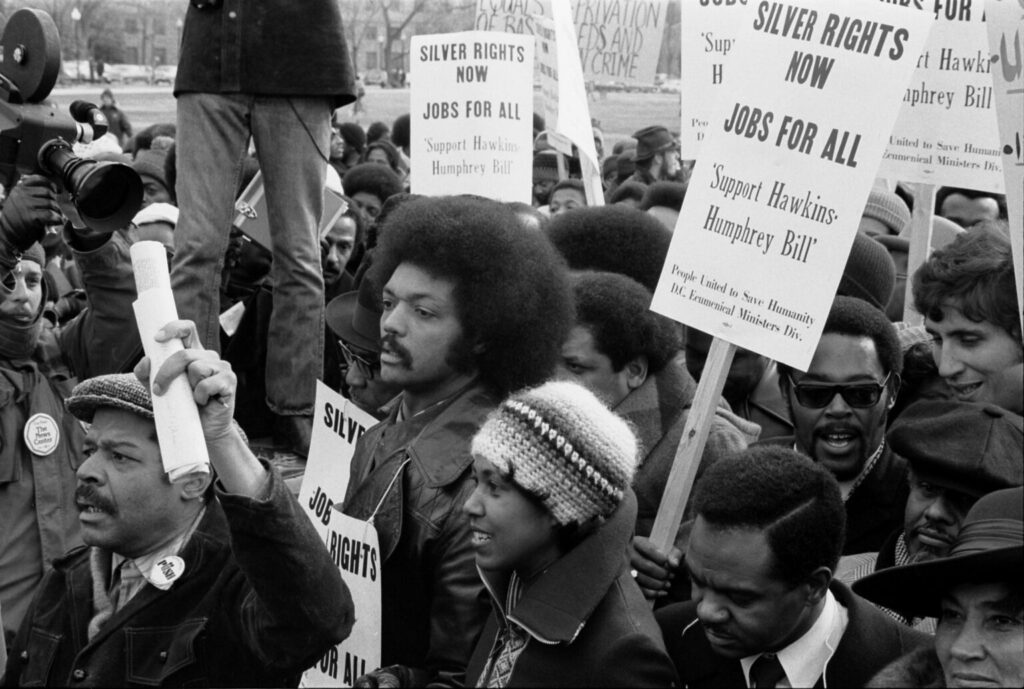
Looks aside, Jackson, now calling himself the “Country Preacher,” could undoubtedly draw an audience – both in person and on screen. The Fieldhouse visit was to launch an Operation Breadbasket initiative in the city, in which 2,000 locals attended. Jackson clocked at least a dozen speaking engagements in the city between 1970 and 1972, the beginning of a fruitful half-decade that also coincided with a rise in television appearances in households just getting their first color television. Jackson loudly proclaimed: “I am somebody!” on an episode of Sesame Street, dropped by “Soul Train” to discuss economic development, and appeared in conversation with John Conyers on an ABC News program. (The two also judged a Miss Black America pageant, speaking to how one’s charisma can transcend beyond politics.)
A noteworthy February 1970 address at Wayne State University spoke not only to Jackson’s ability to captivate a crowd, but the significance of using Detroit as a megaphone for his message. Jackson publicly decried President Richard Nixon, who “looks the whole nation right in the eye and tells a bold-faced lie.”
Jackson criticized Nixon for a number of measures affecting Black Americans, name-checking cuts to health care, increasing military ranks and a growing air pollution crisis. In that same address, however, Jackson folded in some criticism of Detroit political and economic leadership. Using the “big tire” on eastbound Interstate 94 as an example, Jackson said how big businesses like Uniroyal (the then-owner of the enlarged tire display) “is what Detroit is all about…rolling over people,” before then turning his remarks to what Black populations should demand from white leadership.
The Wayne State speech was an early citation of Jackson’s years-long frustration with Detroit, which had recently become a majority Black city, not having a Black mayor, which he publicly admonished as a failure. (“You’re not respecting yourself enough to have a Black man as mayor of your city,” Jackson remarked at the October 1970 Fieldhouse event.) In retrospect, it was also a hint at suggesting Jackson could do a better job at being president than one who’s currently in office. Eventually, these two ideas would merge – in some form or fashion.
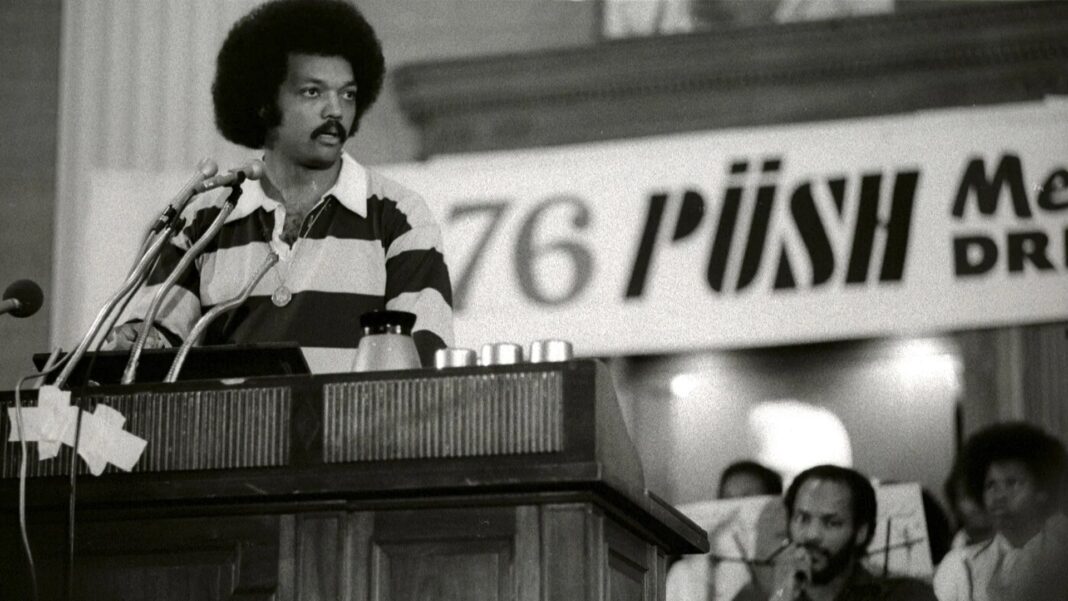
In 1971, Jackson stepped down from the SCLC, and in 1972, founded PUSH – People United to Save Humanity – at the top of the year. PUSH launched its Detroit chapter in July 1973, in which another Jackson address sternly admonished a lack of unity among Black residents in Detroit. “All blacks, negroes and colored people are in the lion’s den of racism. That’s our problem,” Jackson said.
1973 would prove to be a pivotal year for Detroit and Jackson. In November 1973, Jackson spent two days before local elections that year pounding the pavement and urging Black Detroit residents to vote. (He also was a featured guest at The Temptations’ tenth anniversary part that month.) After the ballots were counted on election day, Detroiters chose Coleman Young as mayor.
Over the next decade after Young’s election, Detroit would be besieged by a number of challenges the mayor sought to wrangle control of, including economic failures tied to the automotive industry and an increasing wave of violent crime. As Mayor Young focused on tackling local issues, Jackson continued building the national PUSH platform and remained a mainstay in Detroit, finally satisfied with having a Black mayor as noted in early reports from Young’s first year in office.
After PUSH launched its Detroit office, Jackson came back to the city soon after and launched a nationwide aid drive for African nations suffering from hunger with a press conference here. Results were mixed, and the effort underperformed. At the time, the Rev. Jim Holley told the Chronicle that a lack of media coverage was to blame. A current-day review, however, could point to the first fractures in Jackson’s foundation.
Jackson’s presence in Detroit gave way to an expansion of his scope, using local issues here as a reflection of what’s going on in Black households nationwide. In 1974, during a tour of some automotive plants, Jackson criticized automakers’ plans to downsize their factories amid a growing energy crisis, calling some of the demands for energy conservation a “hoax” that could threaten jobs for Black autoworkers. Jackson also took a stand for securing positions for Blacks in automotive sales, as part of a multi-prong push to get more Blacks in business and sales disciplines. At nearly every Detroit turn, Jackson mentioned Detroit’s Black political power in some variation and noted frequently that Detroit – if it wanted to – could be one of the most politically powerful cities in the nation. And at nearly every one of these local proclamations, Jackson spoke at length with the Chronicle, an extension of Jackson’s constant call for Black readers and Black businesses to support its local Black media.
By the late 1970s, not all of Jackson’s philosophies were popular with the public. Jackson devoted a significant amount of energy to push Black youth to take their futures in their own hands, warning of the dangers of drug abuse, gang violence and other behaviors he deemed a threat to the Black community. Some behaviors were clearly subjective, and people responded accordingly. Returning to Detroit, Jackson attempted to launch a nationwide effort to ban “sexually explicit” songs from the radio in 1977. Amid some of Jackson’s other targets, including pushes for equity at beer and soft drink companies, solidarity with the Jewish community, and even detours into Hollywood, the “sexy song” momentum quietly sputtered out.
Jackson entered the 1980s-decade flush with funds pouring into PUSH, a stature that seemed to escape but not eclipse King’s shadow, and more critical eyes on his motives. One visit to Detroit at the turn of the decade, however, resonates with new significance 46 years later. In an April 1980 Chronicle story, “Black-Arab Unity is Urged,” an address from Jackson to 600 Arab Americans at a Cobo Hall conference noted similarities between the two communities and called on both to find common ground.
Blacks and Arab Americans in Metro Detroit have long been at odds, a persistent standoff that only recently seems to be softening. In 1980, however, nuanced understanding of the Middle East – particularly the Israel-Palestine conflict – was not a priority for most non-Arabs in the region. At the same address, Jackson noted that “as a Black American, I grew up on the West Bank,” noting the parallels between Black Americans and Palestinians. “No one has the right to choose the leadership of the Palestinian people but the Palestinian people.”
1980s: PUSH comes to shove, Young pushes back
In the wake of some of his misfires, Jackson still had some supporters in the pages of the Chronicle. Rev. Adams, still a contributor in 1980, blasted Abernathy in a column that year for his endorsement of President Reagan, and name-checked Jackson as one of the many leaders he broke ranks with. The next year in another column, Adams wrote that “every time Jackson comes into Detroit, he turns the cold ashes of urban despair into live flames of abounding hope.”
Not even 15 years out from the rebellion, Detroit’s aches were exacerbated by the worsening automotive crisis at the top of that decade, a fiery new tradition during Halloween that seemed to grow worse each year, and youth gang activity peaking. Still, Detroit had the one thing Jackson hoped for years ago, which was Black leadership in the city’s political ranks.
Bolstered by this, Jackson again saw an opportunity in Detroit in 1983, when the Democratic National Committee was going to meet in the city that July. Amid calls for the DNC to consider a Black candidate, there had been speculation throughout the year that Jackson was lining up to seek the nomination.
Most Black politicians and civic leaders agreed that the main objective by 1984 was to remove then-President Ronald Reagan from office. None could agree on how to execute a strategy. None could agree on a Black candidate if they had to choose one. But some could agree that they’d rather support the Democrats they’d supported in the past – including Mayor Young, who threw a grenade onto any speculation regarding Jackson when he who announced his support for Walter Mondale’s nomination in June, a month before the July meet.
Young’s endorsement broke the dam on what some Black leaders were fearful of saying out loud: A Black candidate shouldn’t have automatic support just because they’re Black. And now that the quiet parts were amplified, residents started speaking their minds, too. A November 1983 Chronicle headline, “Jesse: Idol or Opportunist?”, put the debate among Black Detroiters front and center. Some residents questioned Jackson’s true aim; others doubted his political experience, or lack thereof. A sharp critique from one resident, “I think Jesse Jackson is all for himself. He’s not out to help black people at all.”
With nearly 20 years in the spotlight at this point, Jackson was no longer the dynamic 25-year-old orator who should be in movies. One might retroactively classify Jackson in 1983 as being at a midlife crisis. Jackson still attended the Democratic National Committee that July, where he was able to steer reporters into a conversation about voter registration and command headlines that way. That wasn’t enough to ward off the hard truth that Detroiters issued that year. If Jackson reminded folks that “I am somebody,” Detroiters needed to know exactly who that somebody is. Because at that point, Jackson had cycled through several identities: Protégé, country preacher, canvasser, organizer, music critic, car salesman. What many Detroiters didn’t see then was a future president.
Jackson continued seeking the nomination, even bringing the Min. Louis Farrakhan on board as a speaking partner. Nevertheless, Mondale won the nomination – and lost to Reagan’s re-election bid anyway. A bright spot for Jackson, however, was successfully raising voter registration rates in Black communities, Detroit being one of them.
Something else shifted after 1984. The perception of Mayor Young as either a dealbreaker, kingmaker, or a little of both, began to radiate wider beyond everyday Detroiters. It’s around this time that Chronicle reporting suggests that Young, now on his way to becoming Detroit’s longest-serving mayor, is key to earning support from Democrats on both a statewide and nationwide scale, eventually positioning Detroit as a Democratic battleground closely watched by political insiders for years to come, as well as setting a bar for future Detroit mayors and the party clout they command statewide.
Knowing that Detroiters and likeminded folks didn’t see a candidate the first time, Jackson would ensure they would the second time around.
Making it clear earlier on that he was serious about his presidential ambitions, Jackson took to Detroit again to telegraph his message, with an increased focus on unity this time around.
First, there was work to be done with unifying Black voters. Leaning on the strengths of successful voter-registration drives, Jackson used the strength of the Black vote and the efforts to reinforce it as a critical talking point. More than that, however, there was something to be said about uniting the Black vote on issues that affect Black people anywhere.
Jackson spent much of his time in the mid-1980s calling attention to apartheid in South Africa, calling on corporations and other entities to divest until Nelson Mandela was freed from imprisonment. In a 1985 sit-down with the Chronicle, Jackson explained his position on South Africa
Next, Jackson sought to answer criticisms of not being able to concentrate on multiple efforts at once, or the idea that his efforts were only to enrich himself. After Reagan’s re-election in November 1984, Jackson returned to the helm of PUSH and reinvigorated its efforts in its core cities – notably employing a young Greg Mathis at its Detroit branch.
If Black voters – or Black mayors — were going to go with the Democrats they know already, Jackson hypothesized that Democrats were too complacent in this philosophy and saw weakness. Jackson’s ideation of the Rainbow Coalition came to fruition at this time, an initiative to bring together voters regardless of race that could evolve into an independent party challenging the two-party system. In January of 1987, Jackson returned to Detroit – he’d make four trips to the city that month – to host a five-hour telethon for Rainbow Coalition fundraising on WGPR.
Jackson stayed busy in Detroit – and beyond — and in front of Chronicle camera lenses in attempts to rebuild confidence there, standing side by side with John Conyers and blasting General Motors’ most recent round of layoffs, disproportionately affecting Black workers (December 1986); or standing with Black students at the University of Michigan calling for an end to racist treatment on campus (April 1987).
“Jesse Jackson can’t be ignored” read the headline of an August 1987 Chronicle editorial. “Jackson message is important” reads another February 1988 headline. The tide was turning for everyone, it seems – except Mayor Young. Young, again, chose to back the establishment Democratic candidate, this time Michael Dukakis. That prompted another Chronicle headline: “Jesse’s already won.” (April 1988.)
What no one saw coming was that Jackson swayed enough delegates in Michigan to win the state going into the July convention at Atlanta that year. Jackson’s goal of unity – in some iteration – seemed within reach. But the momentum was short-lived.
Dukakis won the Democratic National Convention’s confidence and went on to challenge Republican nominee George Bush, and that was just as brief as well. Bush went on to win the election. Dukakis became a footnote. Jackson won redemption.
Unlike the 1984 election when Jackson fought a public identity crisis and a chorus of “I told you so’s,” there was no comeuppance or karma in 1988. There was possibility.
“Democrats must follow Rev. Jackson,” read an August 1988 Chronicle editorial, noting that while Jackson lost the nomination, emphasis on the Rainbow Coalition’s mission worked in his favor, as it showed Democrats there was a faction of voters who weren’t being addressed. And while Detroiters may have been oversaturated by Jackson’s presence just a few years ago, the Country Preacher’s oratorial skills came into full maturity at this time, something the Chronicle described as “spellbinding…charismatic genius.”
“The most consistent winners are those who fervently believe in their cause,” the editorial continues. “Their strength is in their boldness.”
1990s-present: From ‘I am somebody’ to ‘You know me’
Jackson continued living up to these words after the 1988 election. And he stuck around Detroit for the long haul.
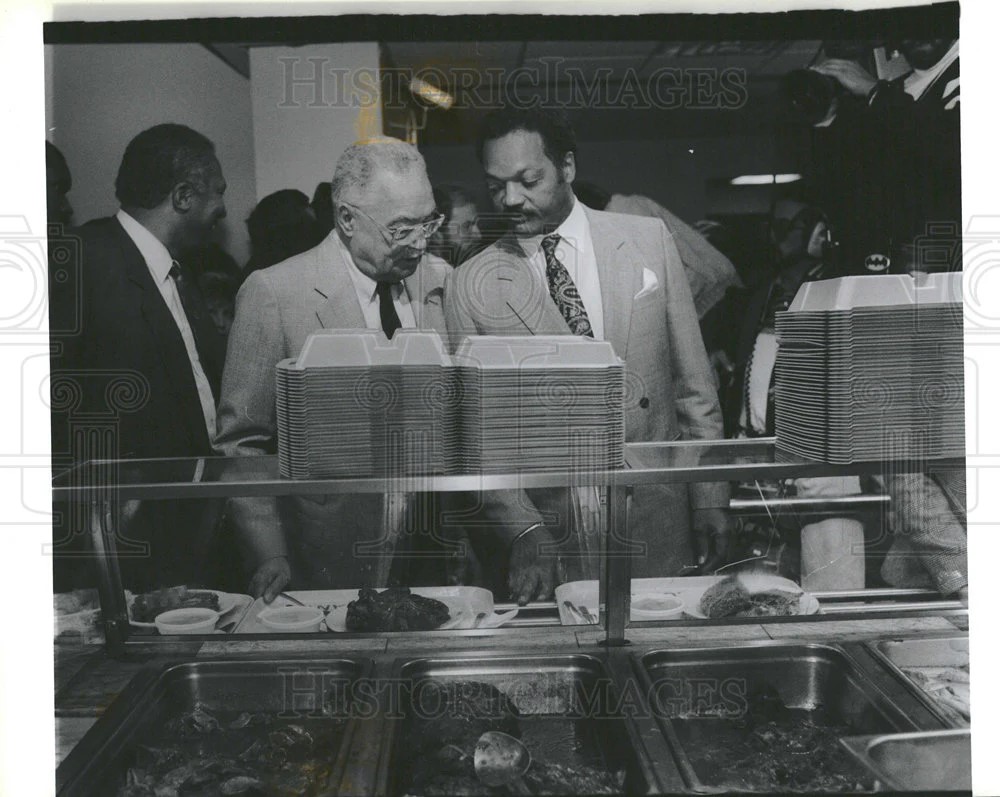
Going back to the idea of Black cities with Black leaders, one of Jackson’s first actions after that election was endorsing Mayor Young in his. Putting on a united front alongside Conyers, Jackson spoke of the importance of “sustaining Young’s legacy” at a well-attended luncheon at Steve’s Soul Food in October 1989 as he publicly endorsed Young for what would be his fifth and final term as Detroit mayor.
In 1992 – amid several, several other visits between then and the Young endorsement – Jackson visited Detroit again for a voter registration rally, targeting a registration tally of 125,000 with emphasis on Inkster, Ypsilanti and Pontiac. Concerned about the recent election of then-Gov. John Engler who was seeking re-election that year, Jackson told the crowd that “you have the power to change the course of Detroit.”
Jackson continued to show up in town and recognize Detroit as a political, economic and sometimes cultural nucleus of the Black experience – as well as not losing track of initiatives launched decades before. Operation PUSH celebrated its 25th anniversary in Detroit in 1995, the site of its annual convention. It was an opportune time for Jackson to call increased attention to the growing issue of systemic attacks against elected officials of color. Well into the 2000s, Jackson remained attentive to ensuring equal opportunity for Blacks in the automotive industry, from the factory floor to the sales floor, leading PUSH to launch a new division focused on that industry.
One would be remiss to point out that some of Jackson’s later efforts fell short, not all his stances were well received, and another public image crisis came to the forefront. For one, Jackson was still going after explicit lyrics, briefly turning his attention to rap in the 1990s; it did not last long. And while Jackson stood on the front lines with local activists in 2006 to push voters to defeat Prop 2, a ballot measure that would essentially ban affirmative action in the State of Michigan passed with a majority of voters that November. Frequent Chronicle editorials questioned if Jackson’s tactics worked with a new generation of voters, if he was too reliant on his own name as clout, and in one instance in 2010, wondering if he had lost his oratorial touch after a lackluster march down Woodward Avenue.
Although Jackson’s activities in Detroit didn’t end in 2010, this would be a full-circle year as Aretha Franklin, who had by now earned her own place among civil rights legends, aside from entertainment, was preparing to announce an illness she had been suffering. In a piece from the Chronicle at the time, Franklin noted that one of her most frequent visitors to her suburban Detroit home was none other than Jackson.
The amount of ink spilled in these pages over the years clearly demonstrate Jackson’s influence over Detroit, and how it will loom long after his passing. And though he spent considerable time in Detroit, this is not to minimize the impact other places – be it his Greenville, S.C., hometown, his base in Chicago, Atlanta, D.C., Johannesburg, it goes on – have had on his molding as one of the most ambitious, if flawed, Black leaders of our time.
Combing through thousands of Jackson’s stylish quips, instant catchphrases and oratorical wonders in the Chronicle archives, however, wasn’t an inspirational or affirming endorsement of Detroit from the reverend. No “Detroit is important because…,” not a single “Keep hope alive, get in your car and drive!” or something along that line. Nothing that rhymes with “Motown” or “Motor City.” What gives, Rev.?
To be clear, Jackson spouted on multiple occasions the importance of Black buying in Detroit, issued calls to action to elect Black leadership in Detroit, noted the rising voter registration in Detroit, and cautioned teenagers about gun violence in Detroit. All very important, but nothing that could go on a T-shirt or a campaign button.
But while Jackson didn’t have anything snappy to say about the city (and to be clear, this isn’t to say that kind of thing is owed, nor does it rule out the possibility of such a phrase never making it to print), there was simple phrase from his 1988 campaign that not only lent to the kind of confidence earned after more than 20 years in the front lines of the fight, but the familiarity that comes with being somewhere like home.
“You know me.”
During a series of Detroit-area campaign stops in March 1988, where reporters tailed him going everywhere from high school classrooms to a $100-a-plate reception and even – another full-circle moment – making time to visit a then-hospitalized Carolyn Franklin, Franklin greeted many of those audiences with a simple “you know me.” For at least one big crowd, a “you know me!” evolved into a “y’all know me!”
Jackson implored us all to remind ourselves that we are somebody. How comforting is it to know he’d been taking his own advice. “I am somebody.” Yes, we know you are.