

In 2025, the State of Michigan touted that its rate of recidivism – the term used for parolees re-entering the prison system after three years or less – had dropped to 21 percent, a historic low for the state that would place it on par with most other states across the country.
Calling it a “success rate,” the statistics emphasized that 79 percent of parolees did not return to prison, and that these newly reflected numbers were in line with the state’s overall prison population dropping. All those numbers dovetail with repeated reports from the City of Detroit about historic crime lows year to year in the city limits.
Still, numerous studies commissioned by nongovernmental organizations reflect that Michigan’s overall prison population, no matter how many people go in and out the system and when, remains disproportionately Black. Black people make up about 13 percent of Michigan’s population, yet roughly more than half of its prisoners. With Detroit being the largest and Blackest city here in the state, most of those incarcerated – or reincarcerated – at any time are likely from here.
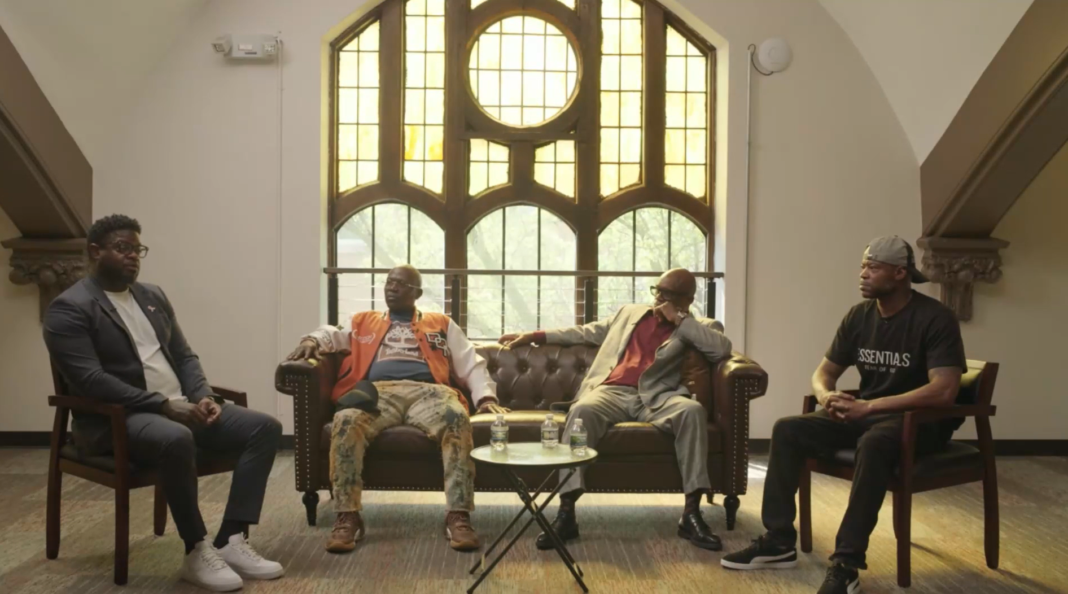
Recidivism begins with entry, a persistent crisis in Detroit. Anecdotal observations suggest that parolees are getting younger, their timelines aligning with when Detroit struggled the most with rising crime and declining economic fortunes. Chronicle Conversations: Episode 1 focuses on four men and their experiences.
“I was born during the crack epidemic…I was born in 1977 – I caught the end of it,” says Reginald Randolph, one of this episode’s participants. “But I can remember the recreation centers around my neighborhood going out in 1990 or ’91. After we got out of school, we would be playing in the park where the drugs were being sold, [and] people were being shot.”
“You know… a product of your environment. I wanted to get out as a kid,” he said.
Randolph grew up at Mack and Bewick, the east side intersection he describes as “the inner-city of America. A liquor store on every corner, a church right next to it, and a funeral home down the street,” he says.
“We didn’t have nothing to really help us. I played [Detroit Police Athletic League] PAL football…but my mother had to go to work and pay bills, so I had to get what I wanted to get on my own.”
With the help of mentorship on the outside, specifically from working with Mariners’ Inn, Randolph is now pursuing a career in commercial trucking. In recent years, several employers have relaxed their restrictions on hiring, be it “banning the box” – that is, removal of a checkbox on applications detailing whether someone has committed a felon or was once incarcerated – or working with institutions like Wayne County Community College District to move into disciplines that are boosting their workforces.
Often, however, being “home” doesn’t always equate to being “free.”
It would be easy to point formerly incarcerated persons to a waiting infrastructure, but those with experience within the system say that their time within the system can often determine their time outside of it – specifically if they do time in federal prison versus state prison.
“It’s a different form of a hierarchy in federal prison…that don’t really exist in MDOC,” DuJuan “Zoe” Kennedy says, speaking from his experience in the former and relating it to experiences from those he’s worked with who have spent time in the latter.
Kennedy, now the CEO of the community violence intervention group FORCE Detroit, points to what he says is a lack of motivating factors within Michigan’s state prisons, official or otherwise. There is more accommodation for federal prisoners to pursue education, or knowledge period, within those bounds than at the state level, he says, and that kind of environment can foster certain kinds of relationships that last on the outside.
During his time inside, Kennedy said he was guided by someone who was incarcerated who “was like a father, though I would never call someone that who’s not my father,” he said. “Mentorship is the secret sauce of everything. Mentors are going to show you everything you learned so you don’t repeat the mistakes.”
The full conversation will air next Wednesday on https://www.youtube.com/@MichiganChronicle.