

Photo Credits:
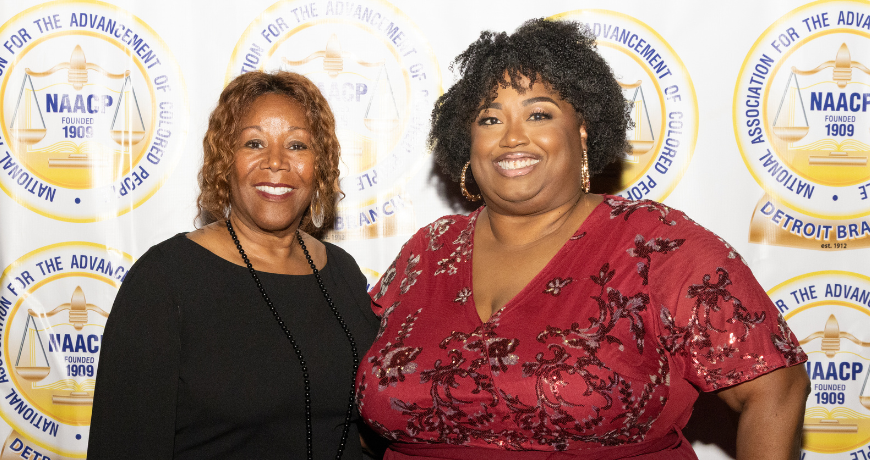
Ruby Bridges and LaToya Henry: Photographer Andre Smith.
In the span of about 15 minutes on the floor of Huntington Place, LaToya Henry has fielded dozens of inquiries from almost as many people.
Here in this controlled chaos, otherwise known as the Detroit NAACP branch’s annual Fight for Freedom Fund Dinner, Henry has an answer to everything thrown at her.
“Did that dignitary’s plus-one get their seat at the table?” “ Is the speaker that was MIA ever make it to the dais?” “N-A-A-C-P or N-Double A-C-P?” “Have you seen whatshername, because whatshisname is looking for them.” “Do you have a second?” “Do you have a minute?” “Where’s so-and-so’s plate of chicken?”
Henry, like other staffers working at this event, is one of the few in attendance wearing comfortable but still stylish footwear, as she and others every year are hardly ever stationary. They’re constantly scurrying in, out and across the banquet hall and all spaces in between addressing last-minute requests, fixing glitches the public will never know about, and otherwise maintaining the status of the most important and longest-running Black events in Detroit – if not nationwide.
This year’s Freedom Fund dinner was the local branch’s 71st outing. Henry has been communications director for Detroit’s NAACP for 21 of those years, making her not only one of the branch’s longest-tenured staffers, but one of the few who knows how to harness the power that both the chapter and its signature annual event hold.
“When you define social justice advocacy, and really start to understand public policy and how it impacts and shapes so many of the things that we have to do – on our life, [the NAACP] has a definite impact,” Henry says.
“And so when we say, ‘why is this this way? Or why does my neighborhood get this, and another neighborhood doesn’t?’ At the end of the day, the majority of the time, it’s connected to some public policy in place that keeps things the way that they are. I’m a big believer in working on public policy to make change.”
With thousands of guests each year, the Freedom Fund dinner is unquestionably one of Detroit’s most well-attended events and is one of the most historic regular convenings of Black people anywhere. It would not be wrong to say that a distinguished guest list and a bevy of honorees puts this local NAACP event in league with the national organization’s annual Image Awards. Both events even have a red carpet in common, yet both events are intimate enough to feel like a family reunion.
But while the Image Awards will always be in the same conversation with other televised awards shows, the challenge for the Freedom Fund dinner each year is making sure it remains a conversation topic at all. The event has never left the calendar, but it has had to grow and adapt with Detroit over the last 70 years, a timeline that shows long, winding changes in the region’s racial, economic and cultural identities, to short, almost overnight switches that can have just as much impact – building names, for one.
Henry notes that long before Detroit’s renewed interest in marketing itself as a convention destination as of late, age-old Cobo Center marketing materials boasted to event organizers their ability to stage three large-scale events annually: The North American International Auto Show, the Society for Automotive Engineers’ world congress, and the Freedom Fund dinner.
Many years and two branding exercises later, Cobo isn’t Cobo anymore. The Auto Show – and if we’re keeping it real, much of the industry behind it as well – is a fraction of its former self. And while other big-name events have come and gone from the city’s calendar – TasteFest, we miss you – the Freedom Fund dinner is still served every year.
Some could argue, however, that while attendees and speakers recognize the significance of the event and the ticket sales to back it up, the Freedom Fund dinner somehow doesn’t have the same reverence as, say, Movement, the Fireworks, or the Thanksgiving Parade – the kinds of events elected officials and tourism agencies, whose words travel further than Cobo’s old media kits ever could, tick off when they’re trying to sell Detroit.
“It’s one of the things we talk about,” Henry says. “If you are from here, you might not necessarily all the time understand the commitment that people have to the dinner. You know how you hear some things are ‘Black famous?’ We want it to be more than Black famous.
“Every year,” she adds, “we get somebody who messages us and says ‘oh, it was my first time, I never knew.’ It’s not like we’re trying to bridge a gap. It’s more like bringing that awareness up.”
The media (“but not your publication,” Henry tells this editor) could do better in “not taking this for granted,” she says, noting that while the big, headline-grabbing names in the crowd can make themselves a news item within the event (see: the Rev. Wendell Anthony, president of the Detroit NAACP branch, choosing this year’s ceremonies to publicly endorse former Detroit Mayor Mike Duggan for governor, for instance), there’s a reason why this dinner itself is able to attract those big names in the first place.
“We’re not just meeting and doing all this stuff to have dinner. It has a purpose.”
In her time with the Detroit branch, Henry has had a front-row seat to Detroit’s ever-evolving social and political identities while simultaneously working behind the scenes with an organization that can influence said identities. Along the way, she’s dealt with several folks in power and has learned to recognize who’s poised to lead, who’s better suited in another position, and who’s going to crash and burn, all before these folks know it themselves.
“I always say don’t ask for primetime when you’re not ready for primetime,” Henry says. “A lot of times I notice that when people are out in front, they aren’t really ready for it because you have to know your stuff.”
She acknowledges the Rev. Anthony as an example of enduring leadership because “he is a student. He studies, he knows, and knows history, and he makes my job easy because he’s not just a face. This really is his thing.”
And it’s been a privilege, Henry says, to work alongside executive director Kamilia Landrum, who was president of the Detroit NAACP’s youth council when they were both teenagers – Henry at Renaissance, Landrum at Cass Tech, “but that’s OK,” the Phoenix laughs, noting she and the Technician both ended up becoming Rattlers. “She went to FAMU, so she made up for it.”
Having to interface with executives and elected officials year-round, but especially in the ramp-up to dinnertime, Henry says she’s dealt with her fair share of big egos. “I can’t remember who said it, but they said you have to have a certain amount of ego to want to run or be in those positions.”
But surprisingly, conflicts are minimal behind the scenes. There may be some public spats or jabs over disagreements over ideology, but “they’re doing those things to generate attention,” Henry says. “You may see people, and it looks like they are not in agreement with somebody, but most of the time, people are really getting along.”
Unsurprisingly, before this year’s festivities even wind down, an agenda for an event of the Freedom Fund dinner’s scale is already in the planning stages for the year ahead. A date has been set for 2027’s affair, Henry says, and the rush for booking speakers is already underway.
There are some action items that never change even if the venue doesn’t, such as double-checking accommodation for attendees who are differently abled. And then there are the decisions the public may not even think twice about, such as a food tasting well before each dinner to determine the year’s menu.
There’s always the underlying significance of the event itself, which began in 1954 as a challenge to raise as many funds for the NAACP as possible. In recent years, as more and more new things – and people – come to Detroit, there is the added significance that the dinner isn’t just a reflection of the organization, but the city and the population it represents. It has to look good.
It’s a good thing, then, that Detroiters themselves make looking good seem effortless. Per the Chronicle’s archives, the first-ever Fight for Freedom Fund week kicked off with a fashion show, and attendees have been on the runway ever since. Now whether everyone is on the same runway is another question, because although it’s largely understood that the Freedom Fund dinner calls for dressy attire, everyone’s definition of dressy isn’t the same.
Henry points out why brocade, bodycons and baby-shower Burberry might all show up on the same red carpet. “When I first started, I was intrigued because the tickets for the dinner were a split ticket; you could not buy a single ticket, you had to buy the ticket with somebody. And it used to say on there ‘semi-formal.’ And so yes, everybody was dressed to the nines. When I look at the old photos, I love that.”
The split-ticket practice ended, and individuals have long been able to go solo, but somewhere down the line the “semi-formal” language dropped off.
“Times have changed. And we do occasionally get questions [about attire], and we always say, ‘dressy,’ ‘dressy-after-5,’ ‘cocktail hour.’ Now there are some people that are going to come in a ball gown, there aresome people that are going to come in a tuxedo. We always say, ‘dress up because you never know who you might meet or what might happen – make an impression,’” Henry says.
That said, “We don’t stop anybody at the door if they have on jeans.”
In 2020, there was no suggested wardrobe. Amid the COVID-19 pandemic, the Detroit NAACP chapter moved all Freedom Fund festivities online, something Henry said was a turning point in the dinner’s history since every year since has had an added directive of restoring and maintaining pre-pandemic attendance numbers. 2020 was also a life-changing year for Henry herself, after almost succumbing to the virus that put her into a coma for five days and several more on a ventilator.
“I used to want to be this super career-driven person,” Henry says. “[COVID] made me really appreciate time and doing things with intention. I spend time with the people I want to spend it with and do things with intention, because you never know.”
That sentiment extends to her role with Detroit’s NAACP: Taking on the public responsibility in helping preserve one of the city’s oldest surviving traditions while recognizing that, like any good leader, taking responsibility in preserving oneself is just as necessary.
“It’s exhilarating. It’s stressful. But then once it happens, it’s always a magic moment. It’s always something majestic,” Henry says. “But, you know — I say, ‘I ain’t gonna be doing this forever.’ One day I want to be a guest and just sit down eating my plate of chicken.”