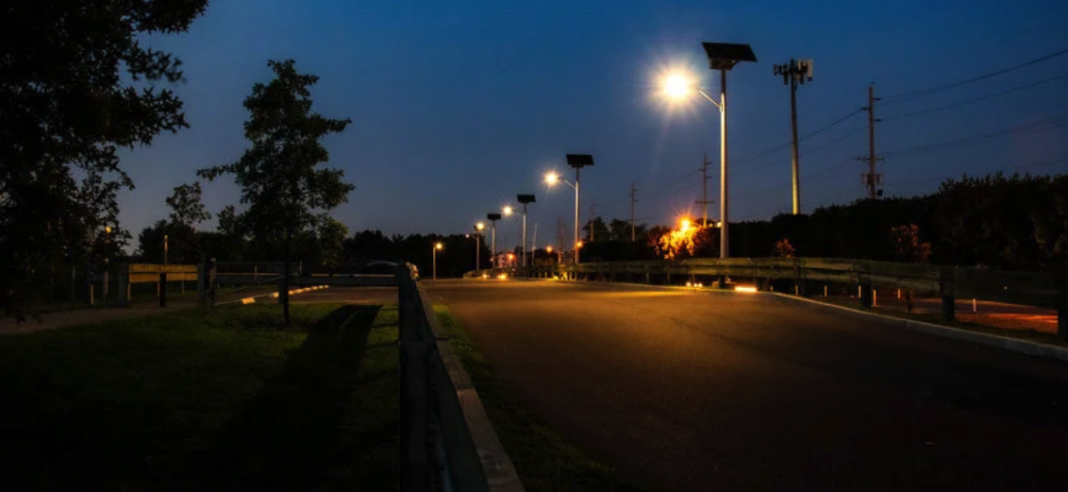

Porch lights don’t reach the corner.
Plenty of Highland Park families already know that feeling — standing at the window once the sun drops, checking the street before you step out, walking a child from the car to the door a little faster than you want to admit.
City leaders say they’re trying to change that.
Highland Park announced the installation of 48 new solar-powered streetlights across residential corridors, part of a city-backed effort aimed at restoring basic infrastructure, improving neighborhood safety, and raising day-to-day quality of life. The project is expected to begin this month in March 2026 and run through July 2026, with crews taking about three days per block to complete the work.
The city is partnering with Solartonic and Soulardarity, using state funding to expand on last year’s installation of 10 solar streetlights along Florence and Louise Streets. City Council voted to approve the project on Oct. 20, 2025, according to the city’s announcement.
During installation, “No Parking” will be enforced on the south side of each block being serviced, with advance signage posted for residents. Soulardarity will also distribute informational flyers to households on streets receiving the lights.
Residents with construction questions can contact the City of Highland Park Engineering Department at 313-865-1876. For background on the solar streetlight initiative, Soulardarity can be reached at max@soulardarity.com.
Why solar streetlights hit different in Black communities
When people talk about solar, the conversation can get wrapped up in buzzwords — “green,” “sustainability,” “innovation.” For Black communities, the need is usually simpler and more immediate: reliability, safety, and not getting priced out of basic living.
Energy costs already hit Black households harder. The U.S. Department of Energy has reported that Black households typically carry a higher “energy burden,” meaning a higher share of income goes toward utilities than white households. That’s the kind of pressure you feel in real time — choosing between a bill and groceries, stretching the thermostat settings, hoping the next shutoff notice doesn’t come when your paycheck is already committed.
Solar isn’t a miracle fix for that, and Highland Park’s streetlights won’t lower everyone’s DTE bill overnight. Yet solar does offer something Black cities have been denied too often: a way to build services that don’t collapse every time the grid, the budget, or the politics get shaky.
Solar streetlights generate power during the day and store it in batteries to light streets at night. That means the lights can keep working during outages and don’t depend on the same infrastructure that has failed residents before. In a place like Highland Park — where the memory of thousands of removed streetlights still sits in people’s bones — that independence matters.
Safety that doesn’t come with a badge
Every community wants safety. Black communities also know what it means when “safety” becomes a reason for over-policing.
Streetlights are different. They’re one of the most basic public safety tools a city can provide, and they don’t come with a stop-and-frisk attitude. Lights help elders feel comfortable walking from the car to the porch. They help parents breathe easier when teens come home after practice. They make it easier to see who’s outside and what’s happening, which strengthens the kind of community watchfulness that doesn’t require law enforcement to be everywhere.
This is the part that matters: light is dignity. Light says the city sees you.
The bigger point behind the bulbs
Soulardarity’s work grew out of Highland Park’s streetlight crisis, when more than 1,000 streetlights were removed, leaving blocks dark and residents demanding solutions. The organization has spent years pushing for energy justice — not simply “clean energy,” but the right of a community to control and benefit from the power systems it relies on.
That’s why this project lands as more than an installation schedule.
It’s a statement about what Black cities deserve.
Black communities have been living with infrastructure gaps for generations — aging utility systems, delayed repairs, neglected public spaces, and the kind of “temporary” hardship that somehow becomes permanent. Solar projects, when designed with accountability and community input, are one way to stop waiting for permission to have basics.
Highland Park’s 48 new solar streetlights won’t solve every challenge the city faces. They won’t erase the years residents spent navigating dark blocks. Yet they will do something concrete: put dependable light back where people live.
And for families used to making a plan around the dark, that’s not a small change.