
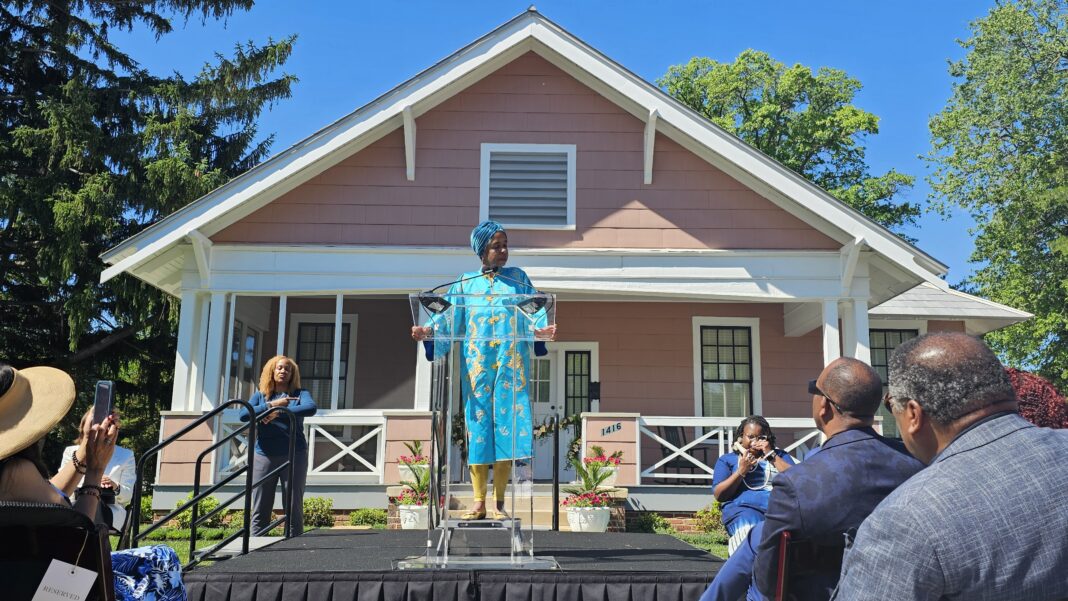


The Jackson Home is now open to the public at Greenfield Village, part of the larger campus of The Henry Ford, and it arrived from Selma, Alabama, in the way memories often do – carefully reconstructed, but impossible to fully contain.
The home itself is historically significant because it served as a private residence that became a key strategic and gathering space during the Civil Rights Movement of the early and mid-1960s. Inside the home, civil rights leaders met with local organizers and strategists to plan efforts that contributed to the Selma-to-Montgomery marches and the national push that led to the Voting Rights Act of 1965.
What makes the Jackson Home especially important is that it was not a formal headquarters or public institution. It was a working family home, where ordinary daily life overlapped with extraordinary historical events. According to family members, including Jawana Jackson, the daughter of Richie Jean Sherrod Jackson, conversations about organizing, strategy, and the future of democracy took place around the same tables where family meals were shared.
The home is described by its former owner Richie Jean Sherrod Jackson in her memoir, The House by the Side of the Road, which reflects on how the house functioned as a space of refuge, planning, and reflection during one of the most consequential movements in American history. Today, it’s a living historical site meant to connect past civil rights work to ongoing questions about democracy, voting rights, and civic responsibility today.
Now at Greenfield Village, part of the larger campus of The Henry Ford, its meaning still points south, and to the years when Rev. Dr. Martin Luther King Jr. moved in and out of the house as the civil rights movement pressed toward what would become the Voting Rights Act.
During the official ribbon-cutting ceremony for the Jackson Home at The Henry Ford on June 12, 2026 – as Jawana Jackson joined hundreds of history buffs, civil rights advocates, elected officials, and her personal friends – that history was spoken as something still in motion.
The morning opened with Amber Mitchell, founding curator of Black history at The Henry Ford, setting the tone. On behalf of the cross-departmental team that spent years restoring and interpreting the home, she spoke with a kind of grounded urgency that matched the weight of what was being unveiled.
Then she turned to the words of Richie Jean Sherrod Jackson, reading from her memoir: “I can walk through any room with this house,” Mitchell read, “and in my mind’s eye, remember and see activity.”
The line lingered because it refused to treat the house as static. It described something still moving through memory, still alive in recollection. Mitchell’s reading continued into a reflection that felt almost like a warning and a charge at once: “We cannot all be a Martin Luther King Jr. but each and every one of us can make a positive difference in the lives of our families and the people we meet each day… the dream is still alive.”
That idea that the dream is not concluded was carried through every voice that followed.
Patricia Mooradian, president and CEO of The Henry Ford, framed the opening in institutional terms, but never detached it from meaning. She welcomed guests to Greenfield Village and acknowledged what it took to get to this moment: four years of coordination, care, and reconstruction, and a historic relocation effort that brought the house more than 1,000 miles north.
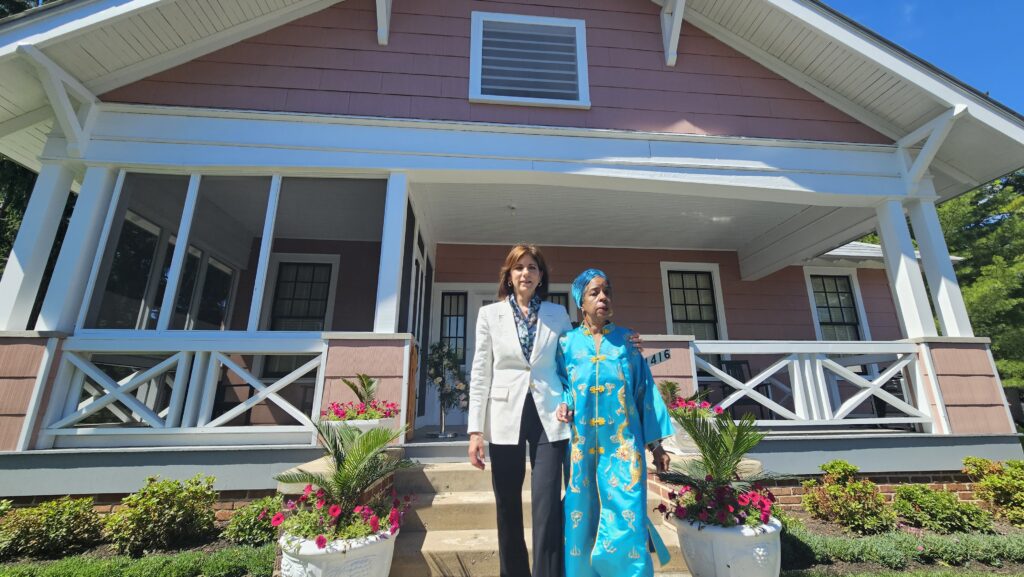
She also marked its significance plainly: this is the first home added to Greenfield Village in 40 years.
But Mooradian’s remarks were about intention, not about how rare it is for the institution to add such a historic monument. The Henry Ford, she suggested, does not simply preserve history; it activates it. The Jackson Home is not meant to be observed from a distance but entered physically and intellectually as a space where history insists on engagement.
For Michigan Sec. of State Jocelyn Benson, that responsibility was inseparable from the fragility of democracy itself. She traced her own path through Montgomery, Alabama, where she spoke about her early career of investigating hate groups, and described standing on the Edmund Pettus Bridge, the site synonymous with the Selma to Montgomery marches.
“I just want to be used, however I can,” she said, recalling her prayer at the foot of the Edmund Pettus Bridge some 30 years ago.
“Now millions here in Michigan and beyond can come here, walk through this house, see the table where the voting rights act was begun to be drafted,” she said, connecting the domestic space directly to legislative history and civic struggle.
And while Benson spoke in the language of systems, Jawana Jackson spoke in the language of inheritance.
As the last living heir of the Jackson family and daughter of Richie Jean Sherrod Jackson, she did not describe the home as a monument but as a living witness. Her voice returned again and again to the same question: “If the walls of the Jackson house could talk, what would they say?”
Her answers came from specificity born of memory.
“They would tell a story of our family,” she said. “A family that was committed to community. A family that was committed to education. A family that was committed to healthcare. All of the things that we hold dear as a society.”
Then she grounded the abstraction in lived experience.
“They would tell a story when I lived in this house with my parents, and they helped plan the Selma to Montgomery march. I stand here today, over 50 years later. And we are still on that journey.”
That journey, in her telling, never fully left the house. It simply expanded outward.
“We are still trying to protect democracy,” she said plainly.
And when she spoke about what visitors should take with them, her language shifted from memory to instruction. “When you leave this house and go back to your selected communities, try to make the world a better place. Touch others. Talk to people that are different, but that are alike.”
One line, repeated in slightly different form throughout her remarks, became the center of gravity for her entire message: “It is not about the I. It is about the we.”
That philosophy extended into how she described the house’s presence in Michigan. When people ask why the Jackson Home belongs in the Midwest, she pointed not to geography but to mission. Greenfield Village, she noted, was created by Henry Ford in 1929 to tell the story of America. “Now this Jackson House is part of that story.”
The home, she said, now rests on “great soil” – a phrase that carried both literal and symbolic weight. It is rooted in Michigan, but its origins remain unmistakably in Selma.
Between those two points – origin and arrival – other voices filled in the meaning of what had been moved.
Mayor Abdullah Hammoud of Dearborn spoke of responsibility as something passed down and actively practiced. He described walking through the house and encountering its final interpretive question: what will you do when you leave here?
He spoke as a father imagining how he would explain the home to his daughters. “We will respect this home,” he said, “and we will teach them to speak out, to organize and to continually fighting side by side with each and every single one of us.”
From Selma, Mayor Johnny Moss brought a kind of reflection shaped by distance and familiarity at once.
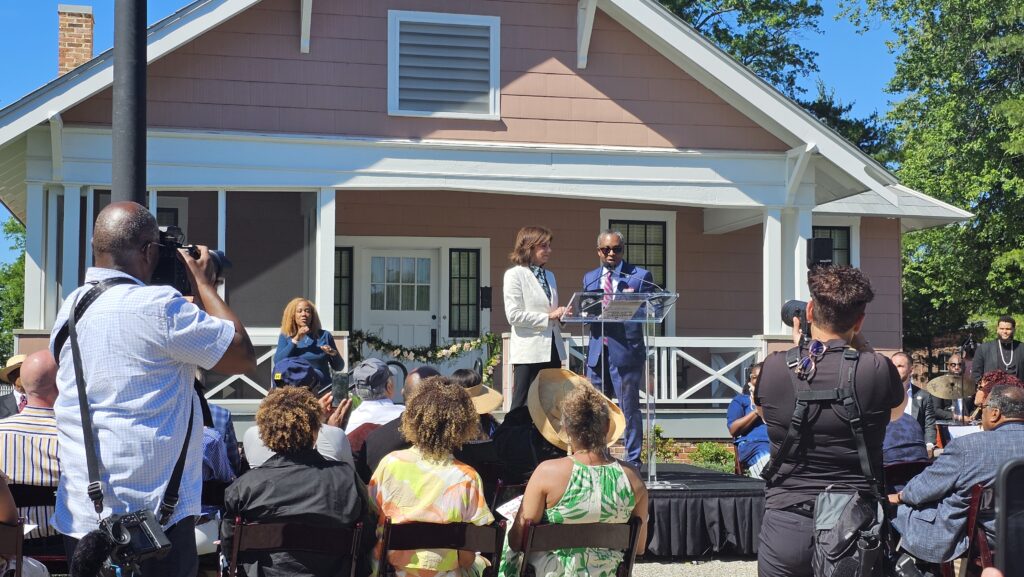
“Peace by peace, board by board,” he said, describing how the home had been dismantled in Alabama and rebuilt in Michigan.
Then came his framing of what that process represented: “Rights are really not lost all at once. They are often weakened piece by piece. Decision by decision.”
The implication hung over the ceremony without needing to be restated: preservation is not neutral. Neither is erosion.
The origin of the project itself was rooted in a moment of personal urgency. Mooradian recalled a phone call in February 2022 from Jawana Jackson. The question was direct: “Can you help save my family home?”
That call, they said, set in motion a four-year effort to relocate and interpret the house. When Mooradian first traveled to Selma, she met Jackson in person and received a handkerchief that belonged to her mother, Richie Jean Sherrod Jackson. It became a symbolic object carried into the opening as a reminder that the story being told is also a story being entrusted.
When Jawana Jackson spoke again near the end of the ceremony, she returned to a memory that seemed to collapse time entirely.
“When I was only 4 years old, my Uncle Martin asked me to make him a promise,” she said. “I said okay, I promise. I was 4. I just wanted the cookies he was going to give me. But his words never left me.” The promise was to touch someone with the work she would do, and to not forget the gravity of the things going on around her, just as the weight of the plans made at her mother’s dining room table still touch people more than 60 years later.
Then came the line that tied childhood instruction to public responsibility: “As you grow, you will touch others.”
Her final reflection turned toward the visitors about to enter the home. “The people that will walk through its door will come back and touch others,” she said. “And the light will continue to shine. In our darkest moments, the light always shines over hate. And peace will always win over war.”
What the Jackson Home carries into Michigan goes well beyond a physical structure of a house once central to the civil rights movement, but it’s the accumulated insistence that history is not finished with those who inherit it.
In Selma, it was a home where decisions were made that shaped national policy and protest alike. In Dearborn, it is a space asking what those decisions require now.
The house may be rebuilt, but the question it carries has not changed. What will you do with what you learn inside it?
The Jackson Home at Henry Ford is open to the public. More details are available at thehenryford.org.