
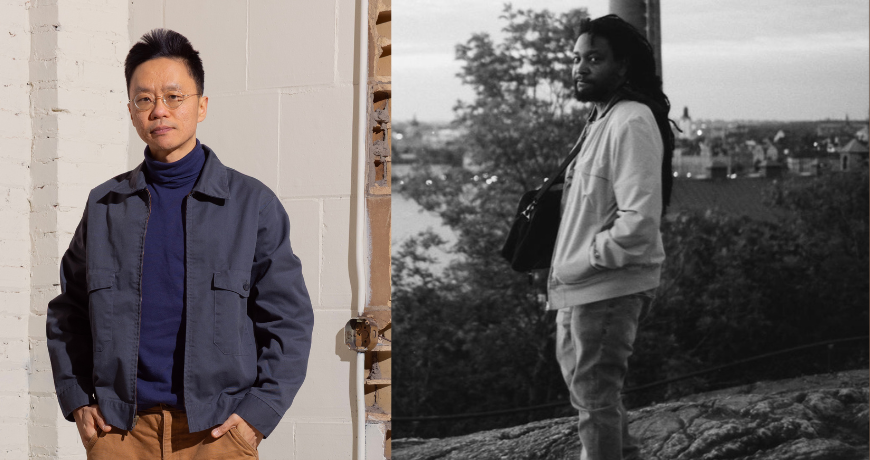

Two Detroit-based artisans were awarded one of the art world’s most prestigious fellowships this month, earning a grant that will allow them to perform at the intersection of tradition and innovation.
United States Artists announced five overall fellowships to a new class of Knight Arts + Tech Fellows, an annual initiative that supports artists with unrestricted grants of $50,000 to further their disciplines, practices and new approaches in technology and media.
Wesley Taylor and Taeyoon Choi are the dual Detroit fellows, alongside Miguel Novelo and Rhonda Holberton, both of San Jose, and the collaborative duo LIZN’BOW of Miami.
“Through the Knight Arts + Tech Fellowship, we aim to not only strengthen the arts and technology ecosystem through long-term investment in the individuals and artistic practices that fuel innovation, but also foster a community among artists and cultural workers and continued growth across the field,” said Kristina Newman-Scott, Vice President for Arts at Knight Foundation.
“Working across various disciplines and mediums, this year’s Fellowship class offers an examination of how evolving technological systems shape our environments, behaviors and forms of connection. Their work inspires consideration for innovation as a site of relational and communal possibility. We are thrilled to support each of these artists and we welcome their arrival and participation within our community.”
Taylor is a multidisciplinary artist whose practice combines installation, video art, and sound to make a world. His decades-long practice hones the lessons and sharpens sensibilities learned from Detroit artists who came before him, shaping his craft of sampling, referencing and recontextualizing to demonstrate themes of placemaking, histories of entanglement with the present and the future, and the necessity of Black imagination.
“This is a crucial piece to moving some objectives and agendas that I have going,” Taylor told Michigan Chronicle. “I’m fully appreciative of this, and it’s a major relief for me. This is a crucial piece to moving some objectives and agendas that I have going. I’m trying to work on some ambitious projects, and this is aiding that at the right time.”
Taylor is working on what he calls the Black Portal Project, which is a vacant theater he’s renovating near Detroit’s Conant Gardens neighborhood on the east side.
“The space is dedicated to tech-based, experimental performance work,” he says. “At the moment, the theater is completely condemned, so it needs a lot of work. At the same time, in this state of disrepair, I’martistically engaging with the building, trying to figure out ways on how a condemned building can be useful.”
Choi is an artist, writer, educator who explores the poetics of technology and human relations. Currently teaching at Wayne State University, he works with images, text and code oftentimes in collaboration with fellow artists, experts and community members.
“You know, it’s really sign of support from the community because it’s nominated anonymously,” Choi told the Chronicle. “And it’s a really good welcome sign to the city and the area because I’m relatively new toDetroit.”
He will use this time to make “capital-A arts,” conducting research around technology, society and the relationship between computers and art in human life.
“I really also spend a lot of time thinking about education and community service and different ways of sharing the research with a wider audience,” Choi says.
“I’m an outsider and I think I’ll never feel like I’m from here — I think you need at least a couple of generations of embedded living to call yourself a true Detroiter,” he adds. “But at the same time, the city is wide enough and generous in a way that it welcomes newcomers, and people who don’t really fit into boxes, or people who are in between genre or identity.”