
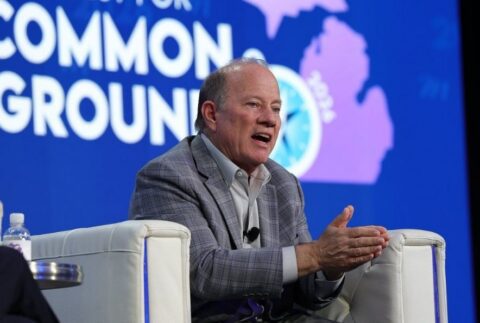

Mike Duggan may have just become the most overqualified unemployed man in Michigan.
Only a few weeks removed from ending his independent run for governor, Duggan now occupies a strange and unfamiliar political space: available. For the better part of three decades, Michigan has always known where to find him. He’s been a prosecutor, a hospital executive, “the mayor,” a crisis manager, and a self-billed (although, likely, well-earned) turnaround artist. He’s been the person powerful people call when the room is on fire and nobody else can stop the panic.
And right now, two of Michigan’s most powerful institutions are dealing with exactly that kind of instability.
The University of Michigan is searching for a president after Santa Ono’s abrupt departure saga spiraled into national political theater. His replacement Kent Syverud suffered a most unfortunate brain cancer diagnosis in April 2026 shortly after he was hired to replace Ono in January.
Michigan State University is again beginning another search after Kevin Guskiewicz announced he was leaving East Lansing for Clemson barely two years into his tenure, citing dysfunction and infighting among trustees as an “unsustainable situation.”
That means Michigan’s two flagship universities – institutions with multibillion-dollar budgets, global brands, massive athletic empires, political landmines, and deeply fractured governing cultures – are simultaneously looking for stabilizing leadership.
Which raises a question that would have sounded absurd a decade ago but feels surprisingly plausible now: What if Mike Duggan became the president of either Michigan or Michigan State? He wouldn’t just be a ceremonial figurehead or a fundraising mascot. (He cited an inability to fundraise nationally for his gubernatorial bid, but fundraising at one of these institutions is a whole different ballgame than getting donations for a political career.) He would be an actual institutional fixer.
At first glance, the idea sounds unconventional because Duggan is not an academic. Michigan State has a history of not always choosing true academics as president, but Michigan doesn’t.
But Duggan doesn’t come from faculty ranks and he’s never been a provost or dean or department chair. He doesn’t carry the traditional résumé markers that higher education still pretends are indispensable.
But the presidency of a modern flagship university increasingly resembles the management of a major American city more than the stewardship of a faculty senate.
These jobs are now part governor, part CEO, part fundraiser, part crisis communications specialist, part political negotiator. University presidents spend as much time navigating donors, legislators, trustees, lawsuits, media storms, and athletic controversies as they do discussing curriculum or scholarship. The romantic idea of the university president as purely an intellectual shepherd has largely disappeared. Under these pretenses, Duggan’s résumé suddenly becomes more relevant.
Detroit was effectively a broken institution when he became mayor in 2014. The city had just emerged from bankruptcy, as public trust had collapsed and basic services were unreliable. Entire neighborhoods felt abandoned and Duggan inherited a city that was both dysfunctional and exhausted civically, emotionally, and financially.
What followed was undeniable stabilization. (Whether it was equitable and miraculous like Duggan supporters try pushing is debatable.)
Under Duggan, Detroit regained fiscal footing, rebuilt municipal credibility with portions of the business community, reduced blight in visible ways, improved city services, and projected competence after years of national humiliation. Critics can and do argue that the revival disproportionately benefited downtown and corporate interests. But even many of those critics acknowledge that Duggan brought operational order to chaos.
Michigan and Michigan State are still wrestling with institutional trauma, so Duggan bringing order matters most in this conversation.
Michigan State has spent nearly a decade trapped in the aftershocks of the Larry Nassar scandal, one of the greatest moral failures in the history of American higher education. The scandal exposed catastrophic institutional cowardice and systemic protectionism across multiple levels of leadership. Lou Anna Simon resigned in disgrace in 2018. Since then, the university has cycled through a dizzying succession of interim and permanent leaders, with Guskiewicz becoming effectively the seventh presidential figure in eight years depending on how one counts interim appointments. Instability has become part of the institution’s identity.
And then there is the board itself. Guskiewicz’s departure has not been subtle. He openly suggested trustee dysfunction had become corrosive enough to undermine governance. Reports surrounding his exit described public infighting, leaks, personal agendas, and factional behavior severe enough that even a major salary increase could not persuade him to stay.
That kind of environment practically begs for somebody with political toughness and institutional discipline.
Meanwhile, Ann Arbor has its own version of turbulence.
Ono appeared headed to become president of the University of Florida before conservative backlash there detonated his candidacy. Critics targeted his past support for diversity, equity, and inclusion initiatives, and Florida’s Board of Governors ultimately rejected his appointment despite support from Florida trustees. The spectacle turned Michigan’s presidency into another casualty of America’s ideological wars over higher education. Then came U-M’s gutting and erasure of everything the university had built to promote DE&I for the past decade.
And before that came years of scandal and reputational bruising at Michigan itself: the fallout from the Robert Anderson abuse scandal, controversies over campus protest responses, debates over DEI, donor pressure, athletic investigations, and constant political scrutiny from Lansing and Washington, D.C.
Neither university should be interested in “just” hiring an academic anymore. They need to hire someone capable of surviving institutional combat. We know Duggan has experience in that department. And he’s not necessarily a perfect fit, but the concept of President Duggan becomes…interesting.
There are similarities between Duggan’s career path and the increasingly nontraditional routes universities now embrace for leadership. Higher education has already shifted toward executives with backgrounds in medicine, business, politics, law, and large-scale administration. Some of the most successful modern university presidents have operated less like scholars and more like coalition builders and public executives.
Duggan’s years running the Detroit Medical Center may actually matter as much as his mayoralty. Before he became mayor, he rebuilt the DMC financially and operationally, turning around an institution that had become synonymous with instability. Academic medicine and large research universities already overlap heavily in structure, bureaucracy, fundraising, and political influence. Duggan understands how sprawling public-facing institutions work. And he understands Michigan.
That may sound simplistic, but it matters. Both universities increasingly operate under national scrutiny while simultaneously remaining deeply tied to state politics, state funding battles, donor networks, labor tensions, and regional economics. Duggan knows every major power center in the state. He knows business leaders. He knows organized labor. He knows Lansing. He knows how to negotiate with difficult boards. He knows how to survive public controversy. And knowing how to survive public controversy may matter most because there are also compelling reasons why Duggan would be a risky choice.
University communities are not cities and faculty governance matters more than, say, reporting to a city council. Shared governance is what makes universities work, and intellectual culture matters. Many professors would likely recoil at the idea of a hard-nosed political executive leading an academic institution. Duggan’s managerial style of disciplined, centralized, and transactional decision-making could easily clash with the slower, consensus-oriented culture of academia.
And then there are the moral and political questions that inevitably follow him.
Duggan leaves office with high approval numbers, but not without controversy. Critics have long accused his administration of prioritizing development interests over neighborhoods. Others question the depth of Detroit’s comeback beneath downtown optics. The city’s demolition program generated years of scrutiny and federal investigation over bid-rigging allegations involving contractors and city officials. Duggan has not been charged with wrongdoing, but his name inevitably hovers around conversations involving the “dirt scandal” and broader concerns about political favoritism in Detroit contracting. In higher education, optics and ethical credibility carry as much, if not more, weight than in politics.
A university president does so much more than just managing systems. They embody institutional values and they become symbolic figures. Every unresolved controversy becomes campus conversation, and every perceived ethical compromise becomes a faculty petition. Duggan would almost certainly encounter skepticism from students and faculty who already distrust corporate-style leadership in academia.
There is also a racial dimension worth acknowledging honestly.
Duggan built deep political support among Black Detroiters despite being a white mayor leading America’s largest majority-Black city. That coalition was real and politically durable. But it was also complex and occasionally fragile. University campuses operate under different cultural pressures and different ideological expectations. Some would view Duggan as a pragmatist uniquely capable of navigating racial politics. Others would see him as emblematic of establishment governance that prioritizes order and development over transformational equity.
Still, it is difficult to ignore how naturally his skill set aligns with this moment. Michigan’s universities need steadiness and vision right now. They need presidents who can lower the temperature in rooms full of competing egos and people who understand budgets, politics, media pressure, institutional trauma, and public trust. They need leaders capable of surviving modern America’s endless outrage cycle while keeping billion-dollar organizations functional. Duggan has spent most of his adult life practicing those skills, and perhaps there is something fitting about the possibility.
Duggan’s gubernatorial campaign ended with speculation, but no clearcut scandal or collapse. Instead, he and his supporters said it ended with political reality. He concluded there was no viable path forward as an Independent candidate in an increasingly polarized climate. The irony is that higher education may actually offer him something politics no longer can: a place where competence still occasionally outweighs ideology. At least in theory.
Whether Michigan or Michigan State would ever seriously consider him is another matter. Search firms tend to prefer conventional candidates until desperation changes the equation. Faculty blocs would likely revolt early alumni reactions would probably be mixed. Trustees might either love the idea or fear the controversy it would ignite.
But if these institutions are truly looking for stability instead of symbolism, Duggan’s name probably deserves more consideration than people initially think. Because after years of scandal, turnover, political warfare, trustee dysfunction, and public distrust, both universities may eventually realize they are no longer searching for traditional scholars. They should probably be searching for people who can walk into chaos with a clear vision, take the inevitable punches that will come along the way, and institute measurable change in sentiment and results. Duggan can prove that he’s done all those things.