
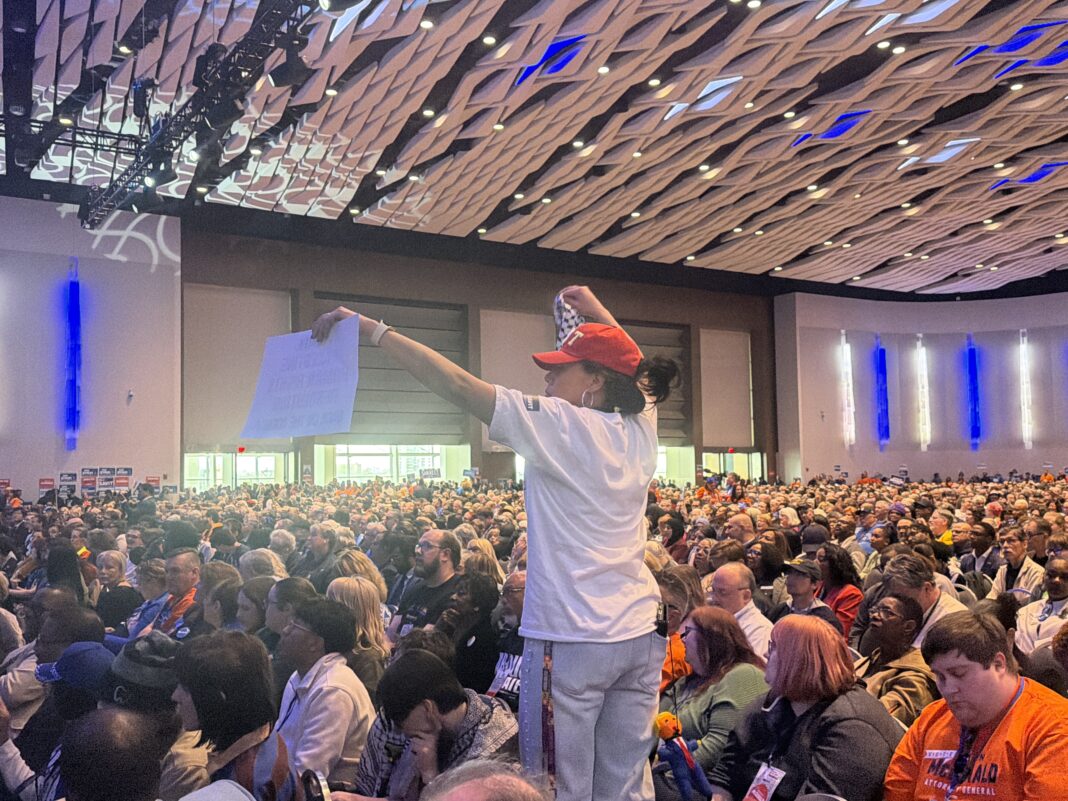


U.S. Rep. Haley Stevens and Jordan Acker were booed by party delegates Sunday at the Michigan Democratic Party Convention.
The outbursts illustrated the major divide between Democrats as leaders attempt to unite ahead of the 2026 midterms.
13th Democratic Party Congressional District chair Jonathan Kinloch, who read the nomination of Acker, an incumbent candidate for University of Michigan regent, addressed the boos on stage while they happened, and criticized progressive Democrats for vocally opposing members of their own party.
“Acker was one of the reasons the encampment was persecuted the way it did,” Alex Rodriguez, a 20-year-old co-chair of the Ann Arbor based Workers Against Oppression coalition. “What we saw today, what happened to Haley, what happened to Acker, was consequence of ignoring the people who’ve been fighting against the genocide we’re complicit in abroad.”
Acker was ousted by civil rights attorney Amir Makled, whose endorsement from the SEIU Michigan was rescinded after reporting revealed he previously reposted social media posts critics called antisemitic.
In 2024, several University of Michigan students who camped out on campus were charged with charges that were later dropped by Attorney General Dana Nessel, who initially brought the charges. Ann Arbor police arrested a group of 40 protesters after students and activists camped on campus for weeks.
Makled was the attorney for the student protestors who camped out on campus demanding the university divest any and all investments in Israel over the war with Hamas and the alleged persecution of Palestinians in Gaza.
The legal fallout from the protests in Ann Arbor made national headlines.
Nessel was criticized by left-wing Democrats and other groups like the ACLU Michigan that argued the student protesters were practicing free speech. Nessel was also booed by pro-Palestine party members during a caucus meeting at last year’s February convention.
Kinloch on Sunday commented on the jeers as they came during his remarks, saying Democrats who didn’t vote for Kamala Harris in 2024 never learned their lesson.
“The enemy is not in this room,” Kinloch said. “We are dealing with the consequences of actions like this from November 2024. Obviously, some folks haven’t learned that fat meat is greasy.”
Acker, who opposed students seeking divestment from Israel, ran on what him and the regents were able to accomplish during his prior term, including reforming how sexual misconduct cases are handled on campus, a neutrality policy on union organizing, and the expansion of the Go Blue Guarantee to Michigan residents whose household incomes are under $125,000, The Michigan Daily reports.
Acker’s reelection campaign was endorsed by Gov. Gretchen Whitmer.
Kinloch read off Acker’s credentials as delegates supporting Makled shouted in opposition to his candidacy.
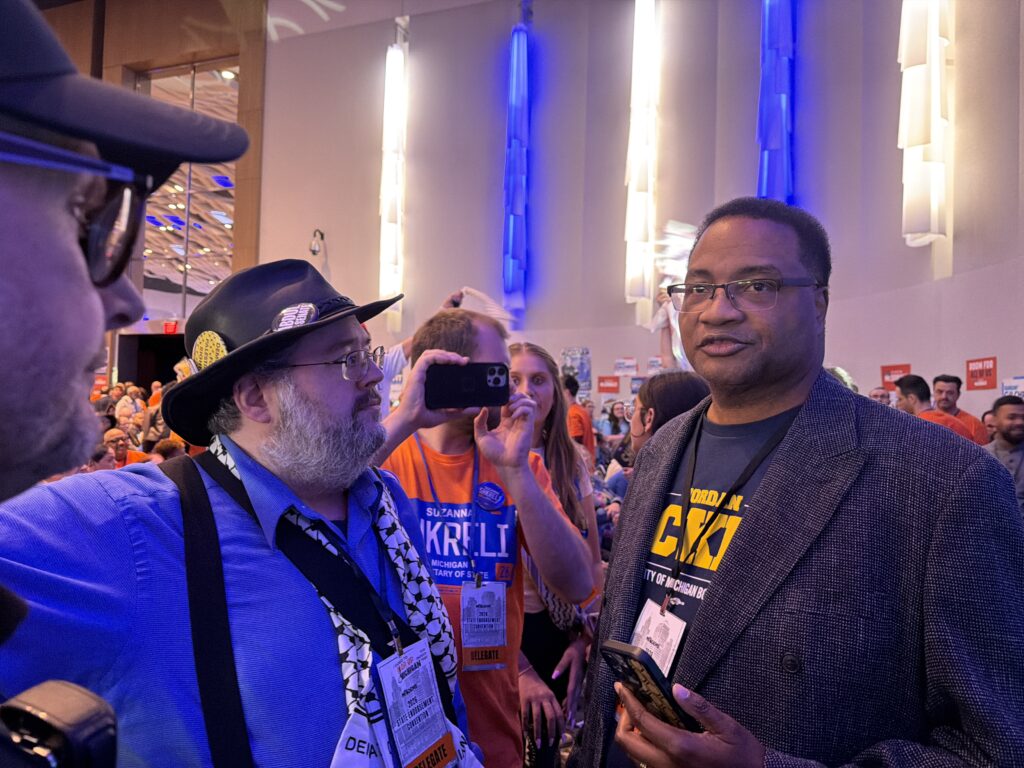
Makled told Michigan Chronicle in an interview Sunday said he’s running to support students and shake up the status quo.
“I want to make sure we’re not lost in the outside noise that’s happening around the outside issues here,” Makled said. “When we saw free speech, DEI, academic freedom and issues of gender affirming care being trampled on, we recognized our liberties were at stake.”
The dynamics that propelled Makled’s win over Acker was felt on the convention floor Sunday, where pro-Palestine members unsuccessfully demanded a point of order over Michigan Democratic Party leaders didn’t allow them to amend a resolution about Palestine in front of party members.
Katybeth Davis, an activist and a former state Senate candidate, shouted insults at Michigan Democratic Party chair and others on stage who refused to recognize the progressive caucus’ demand to amend a resolution.
“We’re attempting to make sure they let us have the minority report from the resolutions committee because they have been blocking for a year resolutions on Palestine our members want to have a vote on,” Liano Sharon, a member of the group, told Michigan Chronicle on the convention floor.
Sharon, a longtime progressive activist, was part of a group that was escorted out of Biden’s speech during the 2024 Democratic National Convention.
Since the attacks against Israel by Hamas on Oct. 7, 2023, the rift between pro-Palestine Democrats and pro-Israel Democrats has been one of the key issues analysts say may have tanked former Vice President Kamala Harris’ defeat to Trump.
In Michigan, some Democrats supported an anti-war effort called “Uncommitted,” during the February, 2024 presidential primary election.
Party delegates booed U.S. Senate candidate U.S. Rep. Haley Stevens throughout her remarks as she spoke on the convention stage. Stevens has been criticized by supporters of her U.S. Senate opponents, Abdul El-Sayed and Mallory McMorrow.
While Stevens has embraced the controversial AIPAC lobby, the largest political action committees in the country dedicated to supporting Israel, McMorrow and El-Sayed have pledged against taking money from the group.
Michigan Democrats say they are closer together ahead of the midterm elections despite the existing divisions within the party over foreign wars and corporate power.
“Utterly despicable and terrifying today,” said West Bloomfield Democratic state Rep. Noah Arbit, who is an outspoken supporter of Israel. “The extreme, far left has taken over the Michigan Democratic Party.”
Israel has consistently for more than two decades held double-digit polilng leads in Americans’ Middle East sympathies, but the war in Gaza has changed that.
The gap began narrowing in 2019, several years before the Hamas attacks in 2023, according to Gallup, the nation’s leading public policy polling firm. Polling from last year revealed 41% of Americans now say they sympathize more with the Palestinians in the Middle East situation, while 36% sympathize more with the Israelis.
Jessica Overa and Tony DiMeglio of the Michigan Democratic Party Progressive Caucus told Michigan Chronicle in an interview the caucus went further left in the most recent election.
DiMeglio said turnout from different student groups across the state propelled candidates sympathetic to Palestinians in Gaza to take seats in the Progressive Caucus.
“It was mainly the student movement from Wayne State, U of M and Michigan State that came together and said ‘If we have any hope of changing how the party thinks and allowing the party to recognize our voices, we need to take some sort of structural power,” DiMeglio said. “One of the avenues we saw to do that was the Progressive Caucus.”
He said there’s a greater number of young party members who feel like the next generation of Democratic leaders will be judged by voters on their views on wars in Iran, Venezuela or the Middle East.
“I think there’s a divergence of what progressive means to different people,” DiMeglo said. “There are some who view themselves as progressives on many social issues, but there are additional axis, and one is whether you’re complicit in U.S. imperialism or you stand against it.”