
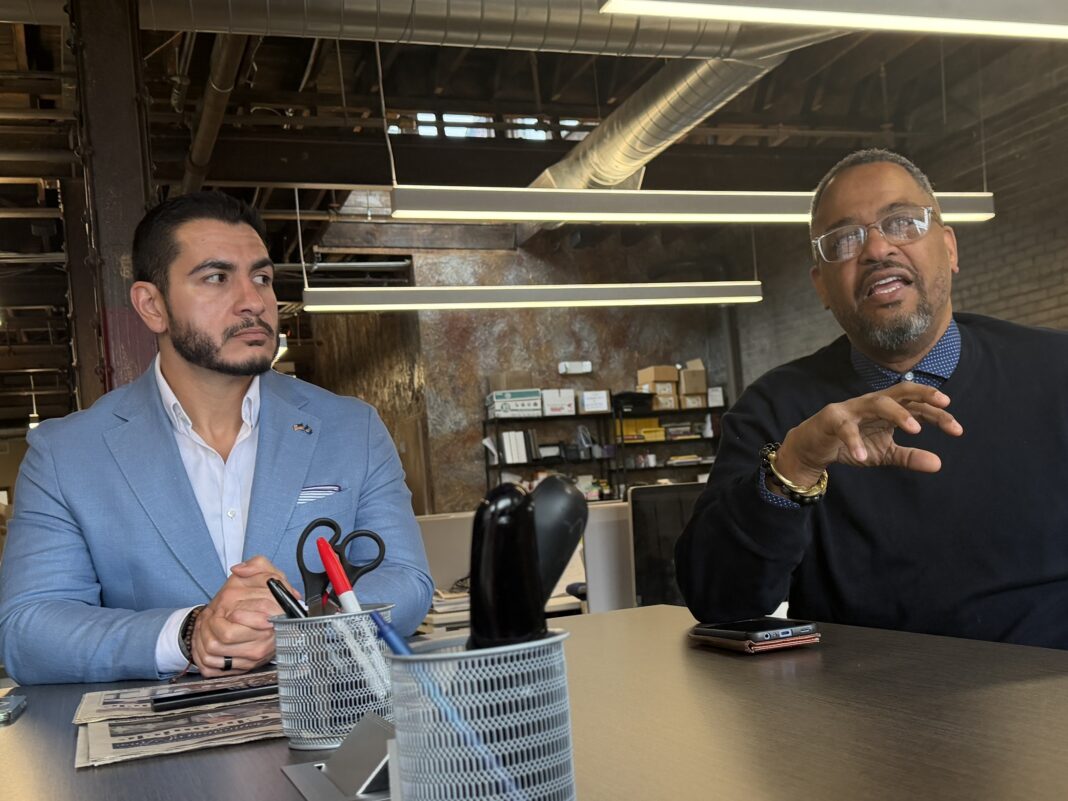


The Black Slate Inc. announced Tuesday it has endorsed former Wayne County health director Abdul El-Sayed for Michigan’s opening U.S. Senate seat.
It’s a notable endorsement for El-Sayed, who is running against U.S. Rep. Haley Stevens of Birmingham and state Sen. Mallory McMorrow, D-Royal Oak for U.S. Senate in the Democratic primary race. The election is Aug. 4, and absentee ballots will begin to be sent to voters starting at the end of next month.
U.S. Sen. Gary Peters is retiring at the end of his term, leaving the seat open and giving Republicans another chance to deepen their U.S. Senate majority.
The Black Slate is made up of members of the Shrine of the Black Madonna, a historic Detroit church whose activism in the 1960s and 70s helped Detroit elect Coleman Young, the city’s first Black mayor in 1973.
A Michigan Chronicle reporter on Tuesday spoke to members of the Black Slate about why they decided to endorse El-Sayed, when many local Black leaders have endorsed his opponent, U.S. Rep. Haley Stevens.
Kandia Milton, the chairman of the Black Slate, said members of the group were in complete agreement to pick El-Sayed over Stevens and McMorrow.
“As an organization that has been at the forefront of change in our community, at the forefront of activism in our community, when it comes to issues relating to Black people, the decisions we make are through that lens,” Milton said. “And so this was an easy decision for us. Abdul has been serving our community for a number of years.”
Milton said El-Sayed’s background in public health makes him uniquely able to tackle the problems facing Black Detroiters and residents in urban communities across the state.
Black Slate director Tene Ramsey, a community liaison with Wayne County, said she’s seen El-Sayed’s work at the Wayne County health department and Detroit health department from up close. Ramsey has alsone3w been working as a consultant for El-Sayed’s campaign, according to publicly available finance records.
“I’ve been doing this since the John Conyers days, for over 60 years,” Ramsey said. “Those years when I worked with him at the county, I respect him so much because he says it, he does it, he executed. He took care of business, and that’s what we need.”
Ramsey’s role at the county assists the area’s senior population, “but I get calls from every walk of life,” she said.
El-Sayed was part of the group of officials that retooled Detroit’s health department after the city abandoned the Herman Kiefer public health complex after the 2008 financial recession. Under former Mayor Dave Bing in 2012 as the city prepared for municipal bankruptcy, the department handed over their work to a nonprofit called the Institute for Population Health.
The move was pitched as an alternative to closing the Department of Health and Wellness Promotion as the City of Detroit was facing bankruptcy. The organization ended up taking on all of the city’s health services.
“To watch it fall and then try to resurrect it, it was a big lift,” El-Sayed said of the Herman Kiefer building. “We worked alongside Detroiters of all stripes to try and bring it back. And I’m proud of what that department is doing now, whether it’s on the environmental justice front or it’s on the infant mortality rate, or that we have signs in the windows the quality of the restaurant you’re going to.”
El-Sayed also worked to increase support for a former Wayne County juvenile facility in Hamtramck where inmates reported experiencing violence and sexual assault.
Elizabeth Hertel, director of the Michigan Department of Health and Human Services, directed state investigators to monitor the facility in March 2023. Some children at the facility reported not being offered clean clothes or the ability to take a shower.
A Detroit Free Press investigation into the facility found overcrowding and understaffing troubles that led to poor conditions for the youth inmates.
“We are relying on Wayne County to run the facility in the way that they have committed to running it,” Hertel said at the time. “It does not appear to be happening.”
Wayne County executive Warren Evans declared a public health state of emergency inside the facility as state oversight brought attention to the conditions. Evans largely blamed the state for not adding more facilities.
“We worked with the county executive to declare a public health state of emergency. For three months we rebuilt from the ground up the operations in that facility. A lot of that was imposed by state level leadership that had created a circumstance where there were not facilities for children to go for long term rehabilitation,” El-Sayed said.
“In the juvenile system, you’re not sentenced to time, you are adjudicated to treatement. If you shut down all the treatment facilities, then those kids get warehoused in our facility. This was during the height of the post-COVID era when it was very, very difficult to hire. And so you had more kids with less staffing. And the response was, we’re just going to warehouse these kids in their cells for most of the day, and that was deeply inappropriate.”
El-Sayed was part of the team that helped open up a new wing of the former facility, which meant children there weren’t spending 23 hours locked in a cell.
“We upgraded the food quality three times over,” El-Sayed said.
Today, Wayne County has a new Juvenile Detention Facility, where accusations of crowded cells and incidents of fighting have led to protest, the Detroit Free Press reported in September 2024.
“Now, it is not nearly where we’d want to be but it is so much further than where it had been,” El-Sayed said.
Milton, the leader of the group, said Black Detroiters are concerned with the affordability of food and healthcare, access to jobs, equity and education. Milton acknowledged that the group’s endorsement is out of step with many Black elected leaders who are supporting Stevens.
Read more: Stevens Lands Black Caucus Endorsements
A group of Congressional Black Caucus members, along with former Rep. Brenda Lawrence, D-Southfield, has endorsed Stevens’ U.S. Senate campaign. She was also endorsed last year by Keith Williams, the chair of the Michigan Democratic Party Black Caucus and Michigan’s first Black House Speaker Rep. Joe Tate, D-Detroit.
Black Slate fundraising director Aminata Sow, who has worked with the group since 2022, said that Black voters should show up to the polls this August and November voting based on their principles and their values.
“Black thought choices are not monolithic, Black people are multi dimensional at the core,” Sow said. “There’s this belief that if you go with the person supported by the establishment, that’s your best bet, but it’s important to look at their principles, their morals, their values, what they stand for and what they’ve done in our community.”
Milton acknowledged the belief among some Democratic voters who see El-Sayed as a riskier candidate to run against Republican former U.S. Rep. Mike Rogers, given Stevens is the more politically moderate candidate.
“This notion of playing it safe is an interesting concept, because we’ve been quote unquote playing it safe, and look where it’s gotten us. There’s nothing safe about the way we’ve been playing things,” Milton said. “We continue to do the same thing over and over.”
El-Sayed pushed back on the idea that there’s a generational divide among Black voters supporting or opposing his campaign, pointing to Black leaders across the state who’ve endorsed his campaign like Wayne County executive Evans, or the mayor of Flint, former state Rep. Sheldon Neely.
“The difference is these are people who have actually worked with me,” El-Sayed said.
Members of the Black Slate group supporting El-Sayed also said they’ve heard some of the criticism he has received for not backing former President Joe Biden, whose name on the ballot appeared without an opponent when Arab and Muslim Michiganders led the “Uncommitted” campaign, during the February 2024 presidential primary which saw more than a hundred thousand voters circle the “uncommitted” option on the ballot.
El-Sayed publicly endorsed former Vice President Kamala Harris days after Democrats announced she would be the party’s nominee instead of Biden — a move that drew criticism from some Arab and Muslim voters.
“I endorsed Vice President Harris because I understood that whether you saw this election from the eyes of a child in Detroit, or Wayne County where I was responsible, or you saw from the eyes of a child in Gaza, that Trump would have been worse, and we’re living through that now,” El-Sayed said. “I also endorsed Uncommitted because at the end of the day, it’s a pretty crazy thing to ask a community to support a candidate who is using their tax dollars to drop bombs on their cousins.”
El-Sayed pointed to the coalition among African Americans and South Africans for the reason public perception and policy shifted when it came to standing up to apartheid South Africa.
“I stood up to the Democratic Party establishment when I endorsed uncommitted. I took it on the chin,” El-Sayed said. “I stood up to a lot of folks in the Arab-Muslim community when I endorsed Vice President Harris. For me, it’s about principle. Always has been, always will be.”