
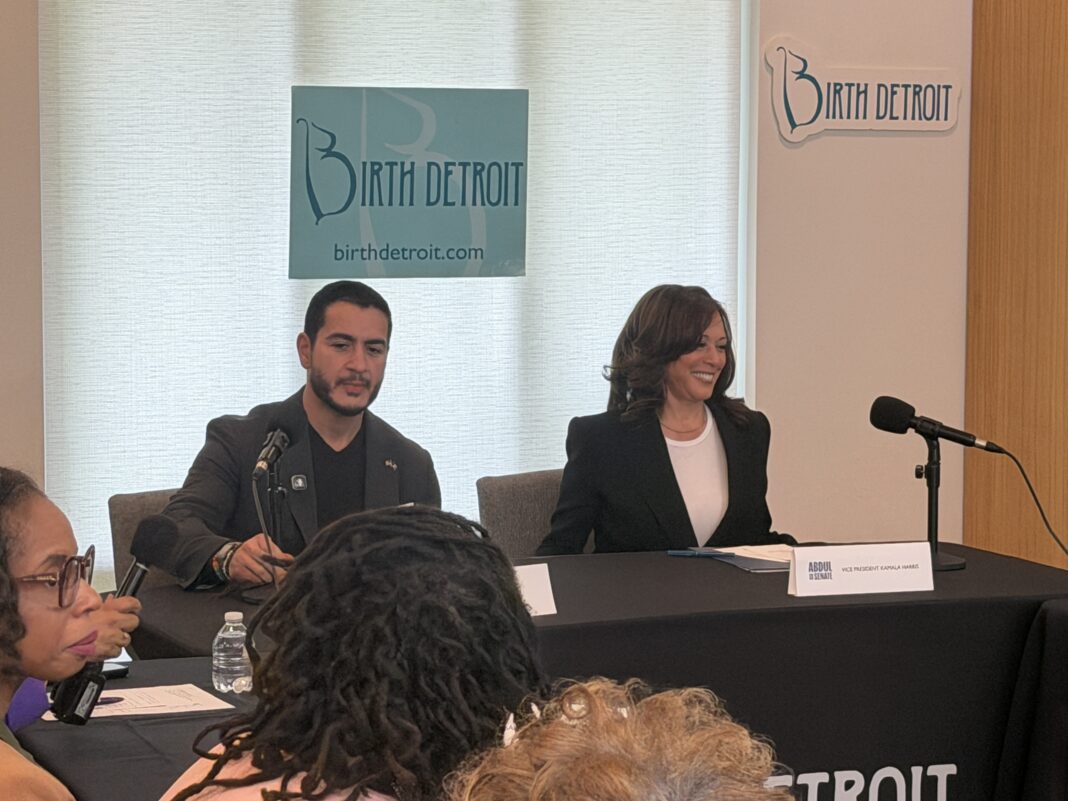


Michigan’s Democratic U.S. Senate nominee Abdul El-Sayed was viewed as a far-left progressive during his primary campaign but he’s winning over mainstream members of the Democratic Party ahead of the general election.
He’s gained support from his primary opponent, U.S. Rep. Haley Stevens and some of her primary backers: Sens. Gary Peters, Elissa Slotkin, Attorney General Dana Nessel, Gov. Gretchen Whitmer, former Vice President Kamala Harris and President Barack Obama.
El-Sayed will need Detroit, the Democratic Party’s largest voting bloc in the state, to defeat former U.S. Rep. Mike Rogers on Nov. 3.
Harris came to Detroit last month, while Obama is set to appear with El-Sayed and Democratic gubernatorial nominee Jocelyn Benson, the party announced Monday. The details of Obama’s expected Oct. 24 visit have yet to be announced.
El-Sayed, who has been critical of aspects of Obama’s presidency while also describing him as an inspiration, called the announcement of Obama’s visit an “honor and a privilege.”
The popular former president’s support of El-Sayed is another sign the party is working to bridge skeptical older Black voters who have expressed opposition to El-Sayed’s campaign over his support of the February 2024 Uncommitted vote against former President Joe Biden.
Harris, who visited a birthing center in Detroit in support of El-Sayed last month, thanked the Michigan Democrat for endorsing him the day after he defeated Stevens in the primary.
Many pro-Israel Jewish American residents were upset over El-Sayed campaigning with controversial Twitch streamer Hasan Piker. El-Sayed put distance between himself and Piker after the primary, saying that he has no plans to campaign with the streamer again.
El-Sayed traveled to Washington D.C. last month to win over the Democrats’ main Senate super PAC, the DSCC.
“He’s a great candidate. He’s going to win, and we are all united,” Sen. Kirsten Gillibrand of New York, the DSCC chair, told reporters.
The Democratic Party in Michigan are holding events in the spirit of unity after divisions over Israel divided the party in the lead-up to the Aug. 4 primary.
There are still two notable holdouts, U.S. Rep. Hillary Scholten of Grand Rapids and state Rep. Noah Arbit of West Bloomfield. Scholten has pointed to El-Sayed’s refusal to condemn Twitch streamer Hasan Piker in her explanation why she won’t endorse her party’s nominee. Arbit has pointed to his disagreements with El-Sayed over his positions on the state of Israel and its war in Gaza.
State Sen. Jeremy Moss of Southfield, running to replace U.S. Rep. Haley Stevens’ seat in the 11th House District, has also yet to endorse El-Sayed.
El-Sayed has long described the killing of innocent women and children during the war in Gaza as an intentional genocide, which some Jewish Americans say is inaccurate and antisemitic.
Jewish Democrats interviewed as part of an MSNOW focus group released this week said they wanted to vote for El-Sayed, but his statements critical of Israel make it impossible for some.
Michigan Attorney General Dana Nessel, who is Jewish, explained her support of Abdul El-Sayed on Distill Social podcast last month, saying, “There is no choice.”
In a joint interview with MSNOW’s Morning Joe, Slotkin and El-Sayed said what brings them together as Democrats is larger than differences over their stances on Israel.
“I think, frankly, for the state of Michigan, people want to see a Jewish woman and a Muslim man being able to get along, debate, push and pull on each other, and move the state forward,” Slotkin said. “I think it’s good for Michigan. I think it’s good for the country to see that.”
Slotkin and El-Sayed agreed that there’s an opportunity for Democrats to upgrade their strategy in Congress, suggesting that the U.S. Senate many members grew up in no longer exists.
“I’ll tell you that the thing that neither Senator Slotkin nor I will ever budge on is that you ought to be safe in your place of worship, whether you are Jewish or Muslim or Christian or Hindu or you’re Sikh,” El-Sayed said. “And we all believe that this is a place that is better because of our diversity, and we want to fight to protect that.”