
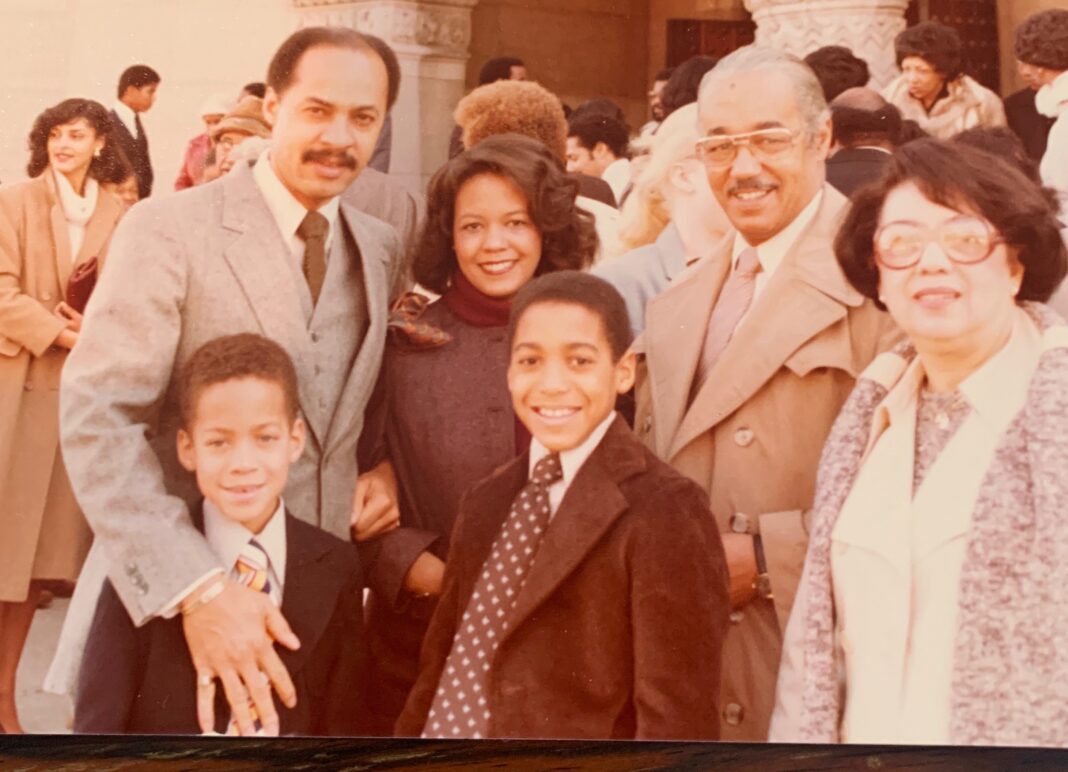

“She was my little sister, and I always adored my little sister. As we got older, we became very close. We shared everything, and I relied on her opinion so much – and of course, that will be missed.”
For the Honorable Judge Trudy Archer, memories of her younger sister C. Beth DunCombe don’t show up just in the milestone of the firsts that she accomplished or as the trails she blazed. For Judge Archer, those memories show up in moments. Conversations, shared routines, and the kind of closeness that doesn’t need explanation.
“It was just the two of us, and we shared life together,” she said. “We traveled together, dined together at different restaurants – we were just very close. We just shared a life together. Even as I was writing her obituary and trying to decide whether I wanted to word something one way or another, my first thought was to call her. But I couldn’t.”

That bond, formed in a Detroit household where expectations were high and love was constant, stretched across a lifetime, and it ultimately framed the way those closest to C. Beth DunCombe remember her.
DunCombe, a pioneering attorney, civic leader, and one of the quiet architects of Detroit’s modern economic landscape, died March 2, 2026. She was 77.
“It’s kind of difficult at this time putting that relationship into words,” Judge Archer said.
Born April 26, 1948, in Detroit to James Vincent DunCombe Jr. and Eleanor DunCombe, Beth DunCombe grew up in a family where education was non-negotiable and ambition was encouraged.
Her father, a World War II veteran, rose through the ranks of the United States Postal Service to become superintendent at the Linwood Station. Her mother made history as the first African American teller at the Bank of the Commonwealth.
“Our parents always instilled in us that we could do anything that we wanted to do,” Judge Archer said. “They stressed education. I mean, we never thought we weren’t going to college. That was a given.”
DunCombe attended Roosevelt Elementary and Durfee Junior High before enrolling at Cass Technical High School, where she pursued the demanding chemistry-biology curriculum and graduated with honors. Initially, she was interested in pursuing medicine.
“I don’t know if it was the sight of blood that she couldn’t stand, but she just couldn’t stay in it,” Judge Archer said with a smile.
DunCombe eventually found her way to law, and it was a path that defined her career and reshaped opportunities for countless others who followed in her path.
“She was thrilled when I decided that I was going to law school. She went straight through to law school and I waited until my children were in school full time. And we laughed frequently, especially when she became a lawyer and then I became a lawyer, because our grandfather was a lawyer and he thought we would never, ever be lawyers,” Archer said.
After earning undergraduate and graduate degrees from the University of Michigan, DunCombe attended Georgetown University Law Center in Washington D.C., where she was active in the Black Law Students Association. She graduated in 1974 and returned home to Detroit, joining Dickinson Wright at a time when the firm had never hired a Black woman attorney.
She would go on to become the firm’s first Black woman partner, building a practice centered on commercial transactions, real estate, insolvency, and corporate restructuring. Her clients included major financial institutions and corporations such as Chase Bank, Aetna, Fannie Mae, Chrysler, and Campbell Soup Company.
But DunCombe never saw her success as something to keep to herself. She actively recruited young Black lawyers to the firm and mentored them as they navigated a profession that had historically excluded them.

Former Detroit Mayor Dennis W. Archer Sr., DunCombe’s brother-in-law and Judge Archer’s husband, recalls how her presence at the firm set a standard – one that eventually pulled him to work at the same firm.
“At first, she was a sister-in-law, which kind of grew into more of a natural sister kind of relationship. One of the things that I found very first about her professionalism is that she was a very focused person on wanting to do her best. She was just outstanding by reputation and by what she did as a person,” Mayor Archer said.
“She was highly respected for her intellect, in terms of her knowledge of the law, in working with her client base, and in her ability to expand her client base. She was very influential in helping her law firm to expand the number of lawyers of color and women who were invited in and became lawyers and partners. She earned her reputation by the quality of her work.”
Those who encountered her professionally often came away struck by her intelligence, but also by her fairness. Real estate developer Chris Brochert met DunCombe during the savings-and-loan crisis in the late 1980s.
She represented the lender while he was trying to navigate financial trouble in a development partnership.
“She could have turned the screws on me,” Brochert recalled. “Instead, she worked with me. She was extremely intelligent, but she was also fair and empathetic.”
That interaction eventually led to a friendship that lasted decades. DunCombe even introduced Brochert to Archer Sr., who was preparing to run for mayor of Detroit at the time.
That balance – measured in truth and fairness, but grounded in principle – would come to define her approach.
“She was truthful in her beliefs… and if people thought she was being fair, it was because she was just being truthful in how she felt,” Judge Archer said.
In 1996, DunCombe stepped away from private practice to take on one of the most consequential roles of her career: President and CEO of the Detroit Economic Growth Corporation. The city was at a crossroads, searching for ways to attract investment, stabilize its economy, and reimagine its future.
“I see the revitalization of this city as a method to create job opportunities for our citizens,” DunCombe said at a Feb. 6, 1996, press conference announcing her appointment. “This is an exciting challenge – one that I take with great enthusiasm.”
Over the next six years, the DEGC helped attract more than $5 billion in commercial, industrial and residential development and finance hundreds of millions in additional projects. DunCombe personally negotiated some of the most significant deals in Detroit’s modern history – deals that helped reshape Detroit’s modern skyline.
Those agreements were tied to two stadiums, three casinos (MGM Grand Detroit, MotorCity Casino Hotel, and Greektown Casino), and major corporate headquarters developments, which helped establish a new entertainment industry in the city. Those casinos would later become one of Detroit’s most reliable sources of municipal revenue.
“She negotiated some really, really big deals… and she always was going to negotiate in the best interests of the city of Detroit,” Judge Archer said. “She was very firm in what she wanted to do and let everybody know.”

Developers who worked alongside her saw that same focus.
“She was one of the architects of putting together this entertainment gaming district,” said Chris T. Jackson, who was involved in the Greektown project. “But she also made sure the casinos committed to hiring Detroit residents and working with minority businesses. For her, the city always came first.”
Her presence at the negotiating table became legendary. Colleagues dubbed her the “Militant Midget,” a nickname that never fully captured the scope of her impact, but one her sister said spoke to her stature and her tenacity.
“She was not only a bright person, but a very thoughtful person who would answer questions of younger lawyers,” Mayor Archer said.
Her work extended beyond individual transactions, Mayor Archer added, because it helped shape systems, expectations, and access.
“There’s no question about it – she helped pave the way,” Archer said. “By her own nature, she opened up a lot of doors for other lawyers of color.”
The developments she helped bring to life – from Detroit’s casino industry to major corporate investments and the early phases of the now-award-winning riverfront – remain as gold stars on a resume that still impacts the city’s economy today.
“Everybody learned about what she was able to do when she moved into the corporate sector and was directly involved in making sure that we built new stadiums and developments that we now enjoy,” Mayor Archer said. “We’re benefiting today from all the things that she and so many others started.”
Gary Torgow, chairman of Huntington Bank, will deliver the eulogy at Duncomb’s memorial service. He said her leadership came at a critical moment for the city.
“Beth Duncombe was a brilliant, astute, and remarkably ethical leader,” he said. “At a time when Detroit was confronting a number of major issues, Beth used every talent that she had – including her legal acumen, her transparency in leadership, her ability to bring people together, and her creativity – to help change the trajectory of Detroit.”
Even as her professional responsibilities grew, DunCombe remained grounded in the relationships that mattered most.
“Her husband made her glow. Hearing of her nephews and great-nephews, and spending time with them, made her glow. And what made her happy is when she closed a big deal – that’s when she’d glow,” Judge Archer said.
She married Joseph Nuttall Brown in 1986, and their life together was marked by shared routines and quiet joys – music, evenings at home, and time spent with family. Motown classics often filled the background, a soundtrack that connected her to the city she never stopped working to improve.
The closeness she shared with her sister never faded, even as their lives evolved.
“We were raised in a very loving, caring family. There was no competition between us, even though she’d say I tried to boss her around from time to time. We were just two little girls who became two adults who always enjoyed being in each other’s company,” Trudy Archer said.
That connection remained tangible every day.
“I’m looking at a chair right now and I can see her sitting in it in my living room. We lived in the same building. Even when we lived in Florida, we lived in the same building. I’d just call her and say, ‘come on up, let’s have happy hour,’ and she’d come up a few floors. We’ve been emotionally close all our lives and physically close for most of our lives,” Judge Archer said.
DunCombe’s influence was both personal and professional. Mayor Archer said her influence was so intentional that it helped shape both people and outcomes.
“I felt fortunate that I learned so much from her, just by listening to the challenges that she faced,” he said. “It was a joy to know her, to watch her work, and to learn from observing what she did.”
He added that her legacy is one that extends far beyond titles or recognition.
“She was a person to be very proud of and respected,” Archer said.
Across Detroit, her legacy is visible in projects, institutions, and opportunities that continue to push the city forward. But for those who knew her best, her legacy is defined just as much by the way she lived as by what she accomplished.
“I want people to remember her as the bright, brilliant person that she was, but also the very caring person that I know her to be,” Judge Archer said. “She was just a wonderful human being.”
And even now, with a lifetime of memories to draw from, the loss of C. Beth DumCombe resists an easy explanation.
“It’s kind of difficult at this time putting that relationship into words,” Judge Archer said. “It’s just – we shared everything and her opinion means so much to me in everything I do. I miss her.”