
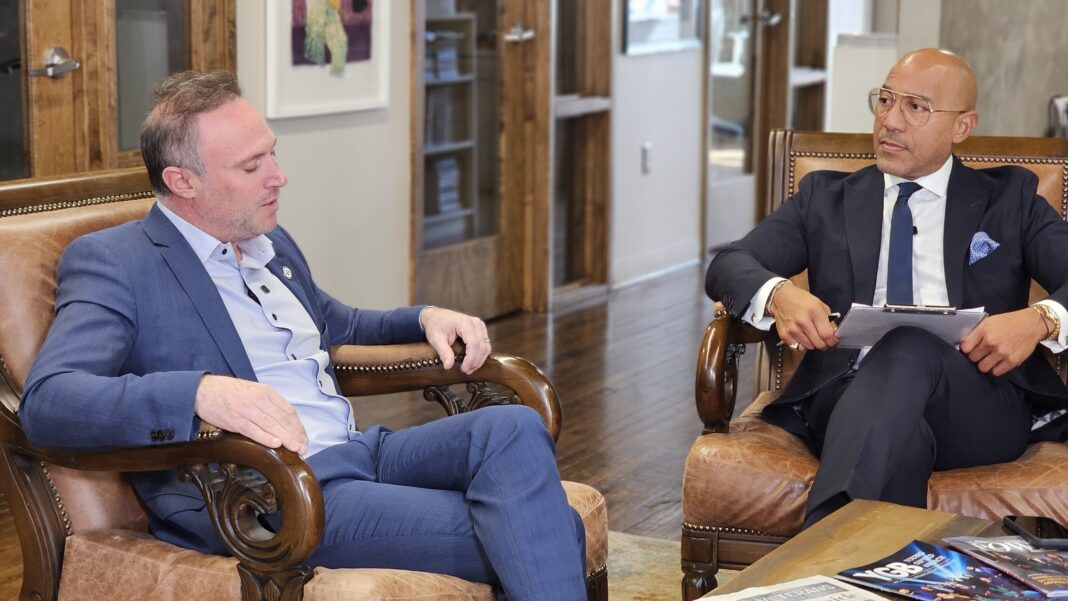

See the full video here:
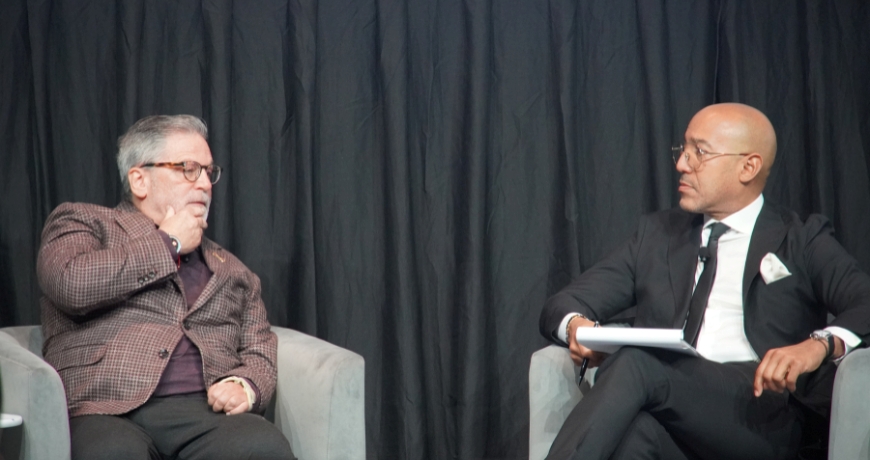
Detroit’s future, the redevelopment of its riverfront and the role of private investment in shaping the city’s next chapter took center stage during a recent edition of Pancakes & Politics Overdrive, featuring Bedrock CEO Jared Fleisher and moderator Dennis Archer Jr., president and CEO of 1642 Ventures.
The conversation examined Detroit’s economic transformation, the influence of billionaire businessman Dan Gilbert, the future of the Renaissance Center and the increasingly important debate over how major development projects can benefit the city’s residents.
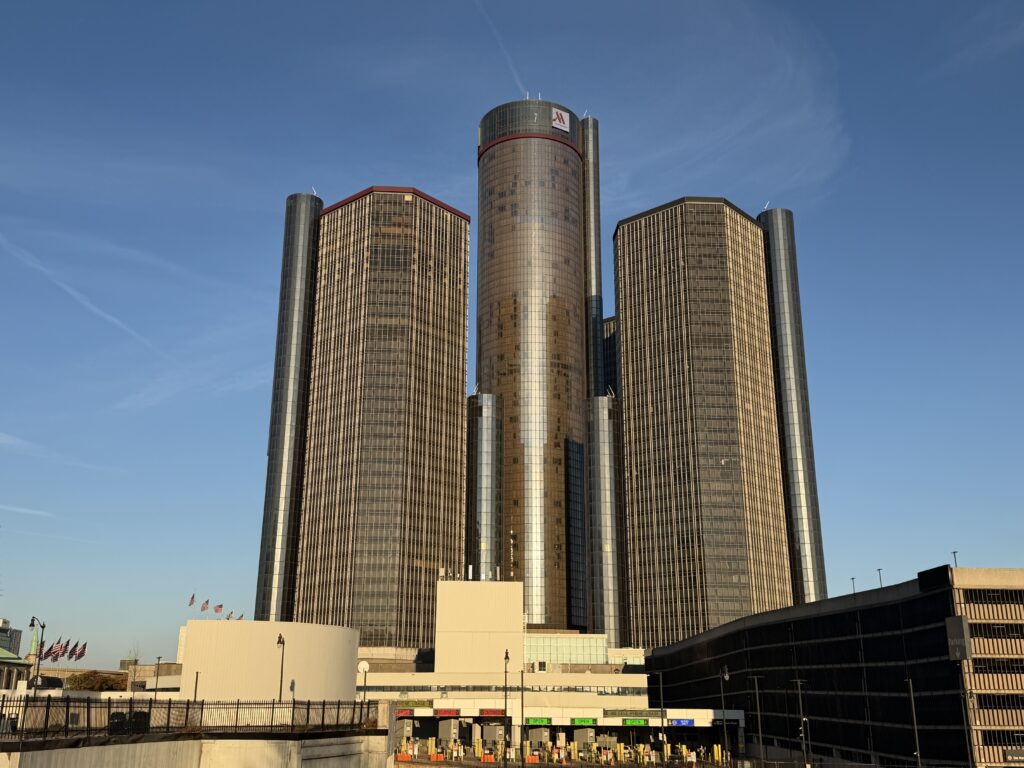
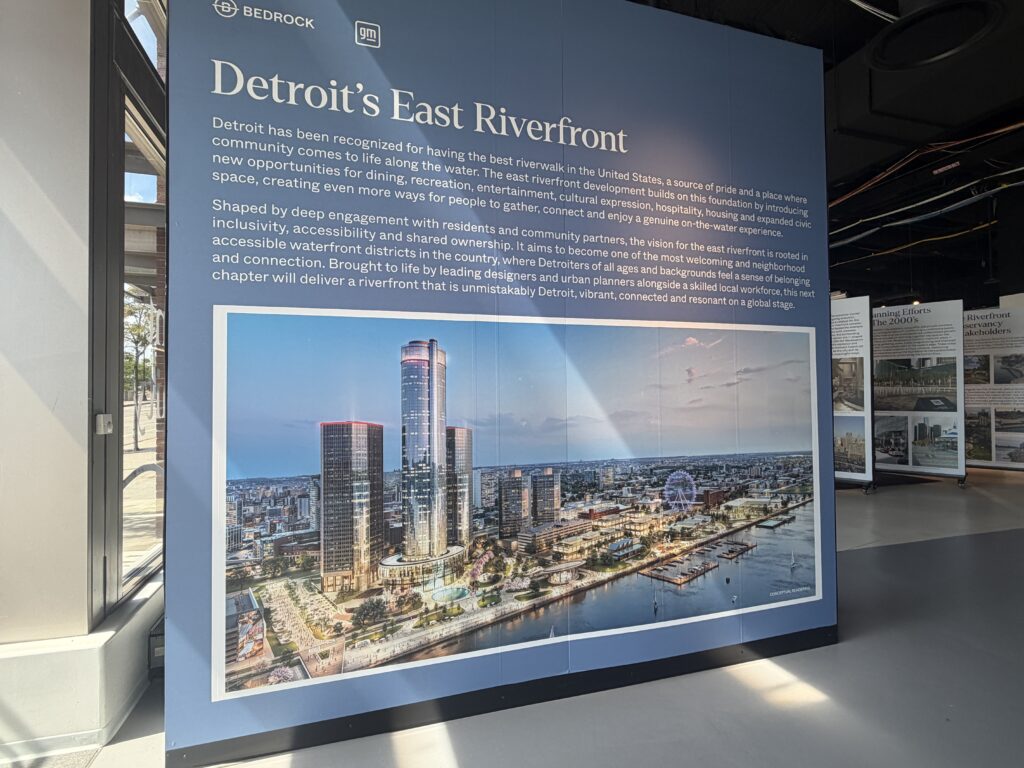
At the heart of the discussion was the proposed redevelopment of the Renaissance Center and the adjacent 35-acre River East District — a project Fleisher described as an opportunity to fundamentally reshape Detroit’s relationship with its waterfront.
But before looking ahead, Fleisher reflected on how far Detroit has come.
He pointed to the city’s population losses between 2000 and 2010, its historic municipal bankruptcy and decades of economic challenges as important context for understanding its current trajectory. He said Detroit’s recent population growth represents one of the clearest indicators of progress.
“People are staying here, choosing to live here,” Fleisher said, describing that trend as evidence of the city’s changing direction.
Fleisher credited Gilbert’s decision to move his companies to Detroit in 2010 as a major catalyst for that transformation. He cited the company’s investment in more than 60 buildings and the creation of approximately 20,000 jobs in the past 15 years as significant contributors to renewed confidence in the city’s downtown business district.
He was careful, however, to acknowledge that Detroit’s progress has required contributions from multiple administrations, elected officials, businesses and community organizations.
Fleisher also said that the benefits of downtown investment extend beyond the central business district. He described downtown as an economic engine that generates revenue and helps support citywide services, including public safety, infrastructure and transportation.
Still, he acknowledged that neighborhood investment must continue and that progress has not been evenly experienced across Detroit.
Among the city’s most significant unresolved challenges, Fleisher identified four priorities: property tax reform, improving public education, maintaining public safety and expanding access to capital for neighborhood developers.
Property taxes, in particular, emerged as a recurring concern. Fleisher argued that Detroit’s high property tax burden makes it more difficult for residents to remain in their homes, attracts fewer new residents and creates obstacles for businesses and developers.
He also discussed efforts to address property tax foreclosure, which he identified as a major contributor to displacement and neighborhood blight. According to Fleisher, a coordinated effort involving legislative changes and community organizations helped reduce tax foreclosures by 94%.
But he said broader tax reform remains necessary if Detroit wants to sustain its growth.
A different vision for the Renaissance Center
Much of the conversation focused on the proposed transformation of the Renaissance Center.
Fleisher said the current redevelopment vision is an effort to address what he characterized as “longstanding problems with the complex,” including its isolation from surrounding neighborhoods, excessive office space and design that made it feel disconnected from the city.
The proposal would remove portions of the existing podium structure, eliminate office space that developers do not believe can realistically be refilled, and maintain the recognizable skyline of the complex’s three towers.
The plans also envision restoring the hotel, introducing residential units, creating an observation deck and establishing more accessible public spaces that reconnect the property to Jefferson Avenue and the Detroit Riverwalk.
The adjacent 35-acre development would become an entertainment and recreational destination featuring a movie theater, water park, music venue, housing, waterfront dining and shopping, a marina and approximately 18 acres of public space.
Fleisher compared the concept to Chicago’s Navy Pier, while emphasizing that Detroit’s version would be designed around the city’s own identity and culture.
He repeatedly stressed that accessibility and inclusion must be central to the project.
The goal, he said, is to create a destination that attracts millions of people while remaining affordable and welcoming to Detroit residents across different backgrounds and income levels.
That commitment also extends to how the redevelopment would be structured.
Fleisher said the Renaissance Center and the broader River East District would be owned and operated by a nonprofit organization whose legal mission would be civic betterment rather than commercial profit.
He said Gilbert has committed $1 billion in personal philanthropic support to help make the redevelopment possible.
Fleisher argued that without that contribution, the economics of the project would not work and the Renaissance Center could face a future similar to Detroit’s abandoned Packard Plant.
He also emphasized that Gilbert has no legal obligation to undertake the project and does not currently own the Renaissance Center or the adjacent land.
Explaining the financing — and who pays
One of the most consequential portions of the conversation centered on how the redevelopment would be financed and whether Detroit taxpayers would be responsible for supporting it.
Fleisher outlined two primary components of the financing structure: the state’s brownfield reimbursement program and property tax incentives.
He explained that brownfield financing allows developers to recover a portion of eligible costs through future tax revenue generated by a redeveloped property. He said the proposed arrangement would rely on state resources rather than direct contributions from Detroit’s municipal budget.
He also explained that property tax abatements are commonly used to make large development projects financially viable in Detroit, given the city’s construction costs and high commercial property taxes.
However, Fleisher said the proposed arrangement would go further than a traditional development agreement. Under the plan he described, the nonprofit would voluntarily pay the city’s property tax millage rather than simply benefit from a tax abatement.
He argued that the structure would allow Detroit to receive approximately $300 million in fiscal benefits, along with thousands of construction and permanent jobs.
Fleisher estimated the project could generate approximately 8,000 construction jobs and 3,000 permanent jobs.
He also said the financing arrangement was designed to direct benefits to neighborhoods rather than allow all the resulting tax revenue to remain concentrated downtown.
“There’s no question that it’s a both-and,” Fleisher said earlier in the conversation, referring to the need for both a strong downtown and thriving neighborhoods.
The financing proposal has not been without controversy.
Fleisher addressed several criticisms, including calls for public ownership of the property, revenue sharing for the city and greater disclosure of the project’s underlying financial projections.
He said Detroit’s Law Department had determined that public ownership would not be legally permissible under the proposed arrangement. He also argued that municipal ownership would expose the city to liability without providing a meaningful financial benefit.
Regarding financial transparency, Fleisher maintained that detailed development projections are not typically released publicly because doing so could expose commercially sensitive information. He said the Detroit Economic Growth Corporation reviews the financial information and provides its conclusions to the public.
Fleisher strongly defended the proposal, characterizing the criticisms as largely unfounded and urging Detroit City Council members to recognize what he described as an unprecedented opportunity.
His comments reflected the position of Bedrock and the project’s supporters, while also underscoring the ongoing debate over public accountability, private development and the appropriate role of government incentives.
Community benefits and the question of inclusion
Archer also pressed Fleisher on how the project would ensure that Detroit residents, particularly those in historically underserved neighborhoods, would have a meaningful stake in the redevelopment.
Fleisher pointed to the project’s community benefits agreement, which he said was developed through a 10-week process and approved 8-1 by the neighborhood committee.
The agreement includes $10 million for affordable housing in Detroit neighborhoods and another $10 million for small businesses throughout the city.
He said those commitments would be in addition to the broader economic and recreational benefits expected from the project.
Bedrock also conducted a separate citywide engagement effort to gather input on what residents wanted to see along the riverfront.
Fleisher said the process involved more than 90 meetings and approximately 8,000 Detroit residents.
Feedback helped shape the proposed attractions, including a water park, movie theater and activated public spaces.
“We can’t build a riverfront for Detroiters by Detroiters without Detroiters,” Fleisher said.
The discussion also touched on the responsibility of major developers to support Black-owned businesses and entrepreneurs.
Fleisher acknowledged the importance of ensuring that Black businesses are not simply spectators in Detroit’s development but active participants in its economic growth.
He cited Bedrock’s longstanding relationship with Hot Sam’s, the historic Detroit retailer, as an example. He described efforts to accommodate the business’s potential expansion without charging it for additional space.
He also discussed plans to bring more Black music, cultural programming and entertainment into Bedrock properties, including the historic State Savings Bank.
Fleisher said the Gilbert Family Foundation has supported Black entrepreneurs and developers through initiatives such as the Motor City Contractor Fund, while he wants Bedrock to carry that commitment into its own real estate operations.
Detroit’s political environment and the challenge of building consensus
As the conversation shifted toward politics, Fleisher offered a candid assessment of what he considers one of Detroit’s challenges: building broad support for major development initiatives.
He said he regularly hears from leaders in other cities who are impressed by the scale of Gilbert’s proposed philanthropic contribution and the community benefits attached to the riverfront project.
Yet, he argued, Detroit’s development environment has become increasingly difficult to navigate.
Fleisher pointed to organized opposition to major development proposals, saying critics have often been more effective at shaping the public conversation than supporters of investment.
He referenced opposition to previous development initiatives and the debate surrounding the proposed Henry Ford Health expansion as examples of the political challenges facing large projects.
His argument was that business leaders, labor organizations, faith leaders, Black developers and residents who support responsible investment need to become more organized and engaged in explaining how economic development can benefit the entire city.
He also emphasized the importance of educating residents about how investments in downtown Detroit can generate revenue and opportunities that extend into neighborhoods.
Archer agreed that public debate is necessary but stressed that it should be grounded in facts and a clear understanding of the potential costs and benefits.
Gilbert remains closely involved
Near the end of the discussion, Archer asked Fleisher about Gilbert’s health following his publicly reported stroke and whether he remains actively involved in the company’s Detroit projects.
Fleisher said Gilbert remains deeply engaged, regularly meeting with him and communicating his observations about developments throughout the city.
He described Gilbert as someone whose attention to Detroit extends beyond major developments, noting that even the leasing activity of a small doughnut shop had caught his attention.
Fleisher also recounted how the Renaissance Center project originated. He said a previous mayor approached Gilbert and asked him to take on the challenge of redeveloping the property and the surrounding riverfront.
Gilbert agreed.
For Fleisher, that decision reflects the same commitment that initially brought Gilbert and his companies to Detroit in 2010.
The conversation ultimately returned to a central question: What does Detroit want its future to look like, and what role should private investment play in making that future possible?
For Fleisher, the Renaissance Center and River East District is an opportunity to preserve an iconic Detroit landmark, reconnect residents to the waterfront and create an economic and recreational destination that can serve generations.
But the discussion also highlighted the broader questions that will continue to shape Detroit’s development: affordability, neighborhood investment, equitable access to economic opportunity, transparency and public accountability.
As Detroit continues to navigate its next chapter, the success of the riverfront vision may ultimately depend not only on the billions of dollars being committed, but also on whether residents across the city believe they have a meaningful place in the future being built.