


By: Jasmine West
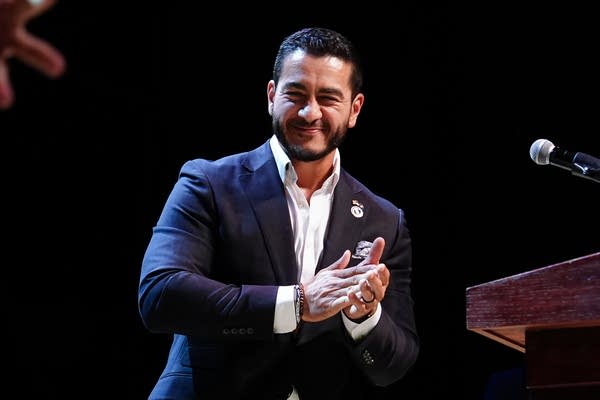
Dr. Abdul El-Sayed secured Michigan’s Democratic nomination for U.S. Senate on Wednesday, emerging from one of the most expensive and closely watched primary contests in the country.
El-Sayed defeated U.S. Rep. Haley Stevens after a race that remained narrowly divided into Wednesday morning. With approximately 96% of the vote counted, El-Sayed led Stevens 48.5% to 47.5%, according to results reported by the Associated Press.
“I want to congratulate Abdul El-Sayed on winning the Democratic nomination for U.S. Senate,” said Stevens in a statement. “He is a doctor, a community health official, a Rhodes Scholar, and a dedicated Michigander. I am proud to offer my support as he takes on Mike Rogers in the general election.”
The victory sends El-Sayed into the November general election against former Republican U.S. Rep. Mike Rogers, who ran unopposed in the Republican primary. They are competing for the seat being vacated by Democratic U.S. Sen. Gary Peters, who is not seeking reelection.
The Michigan contest attracted national attention because it became larger than a race between two candidates. It was closely watched as a measure of the Democratic Party’s direction, the power of outside political spending and whether a progressive candidate could win in a battleground state that will be central to the fight for control of the Senate.
El-Sayed, a physician and former Detroit health director, ran on lowering costs, expanding health care and reducing the influence of corporations and wealthy donors in government. His campaign called for Medicare for All and an end to corporate political action committee contributions. He also criticized U.S. military support for Israel, an issue that helped place the Michigan race within a growing national debate inside the Democratic Party.
His campaign received support from prominent progressive leaders, including U.S. Sen. Bernie Sanders and U.S. Rep. Alexandria Ocasio-Cortez. Stevens was supported by establishment Democratic leaders, including Senate Minority Leader Chuck Schumer, and centered her campaign on manufacturing, the auto industry and her ability to win a difficult statewide general election.
The primary also drew tens of millions of dollars in outside spending, much of it from organizations supporting Stevens or opposing El-Sayed. Groups connected to the American Israel Public Affairs Committee spent heavily in the contest, making Michigan a national test of whether that level of outside investment could determine the outcome of a Democratic primary.
El-Sayed’s victory showed that he could survive that financial opposition while building support around a working-class economic message focused on lowering costs, expanding health care, and frustration with money’s influence over politics.
It does not mean Michigan Democrats are united around one political philosophy. The close margin revealed a party nearly divided between voters drawn to El-Sayed’s progressive campaign and those who believed Stevens’ congressional experience and more moderate profile offered Democrats a safer path in November.
“We must elect Democrats up and down the ballot,” Stevns said. “We need to flip some important House seats. We need to re-elect my friends Hillary Scholten and Kristen McDonald Rivet. We need to win this Senate seat, because Elissa Slotkin deserves a partner like Abdul in the U.S. Senate.”
Michigan Democratic Party Chair Curtis Hertel congratulated El-Sayed and made clear that the party would now turn its attention toward defeating Rogers.
“On behalf of Michigan Democrats across the state, I’d like to share my congratulations to Dr. Abdul El-Sayed on earning our party’s nomination for U.S. Senate,” Hertel said.
“Abdul has fired up Michiganders across the state with his fight to lower costs for working families, expand healthcare, and fight for a government that works for every Michigander, not just the wealthy and powerful,” he continued. “We’re proud and excited to support him as he takes that fight and commitment to rooting out corruption with him to the U.S. Senate.”
Hertel also acknowledged Stevens and the issues her campaign placed before Michigan voters.
“I also want to express my deep gratitude to Haley Stevens and her supporters for the critical issues they elevated in this race: fighting for our state’s manufacturing and auto industries, lowering costs for working families, and standing up to Trump’s abuses of power,” Hertel said. “Michigan Democrats are grateful for her years of service to our state, and we know she will remain in this fight to ensure we win in November.”
The statement points to the immediate challenge facing El-Sayed. Winning a closely divided primary required defeating Stevens. Winning statewide will require bringing many of her voters into his coalition while expanding support among Black voters, union households, suburban residents, young voters and communities outside Southeast Michigan.
Rogers, a former congressman and former chair of the House Intelligence Committee, narrowly lost Michigan’s 2024 U.S. Senate race. Republicans are expected to present El-Sayed as too progressive for the state, while Democrats will attempt to connect Rogers to President Donald Trump, corporate interests and Republican policies affecting health care and household costs.
“Michiganders deserve a senator who will fight for working families, lower costs, and always put Michigan first, not a corrupt multimillionaire like Mike Rogers who only serves himself, Donald Trump, and the corporate special interests writing him checks,” Hertel said. “Democrats are fired up and ready to kick Mike Rogers to the curb for the second time. Let’s win this.”
The November election will test whether the movement that carried El-Sayed through a nationally watched primary can become a broader statewide coalition.
His victory is consequential for progressives who have argued that Democrats should respond to rising costs, corporate power and voter dissatisfaction with a clearer economic message rather than moving toward the political center. But Michigan remains a closely divided state, and the narrow primary result leaves El-Sayed with little time to bring the party together.
The primary settled who will carry the Democratic nomination. It did not settle the larger argument over the party’s future or determine whether El-Sayed’s message can travel from a Democratic primary electorate to voters across the state.
That next test begins now.