


Anyone with WiFi remembers the collective groans that reverberated across Metro Detroit in April 2024, when the much-ballyhooed “Hollywood sign” that wasn’t made its underwhelming debut on eastbound I-94 crossing into Detroit from Dearborn. And without getting too deep into revisiting why that chaos unfolded the way that did – let’s just say there was a lesson there about A.I. that many of us still haven’t learned yet – there were a few queries and theories about how the Detroit Sign, which is now what we call it, could have made a bigger splash.
Among some of the feedback from the crowd at the time: Nobody thought to tap in with Trice Clark?
Back in 2024, Clark had gone all in on building herself up as “Detroit’s Handy Woman,” after having spent years building, well, almost everything else. A self-taught craftswoman, Clark at that point had earned a reputation among event planners as a go-to for constructing sets, backdrops and other interactive displays out of wood, metal, or both – on the side, as she had a primary career in event production herself. In May of that year, with a growing following and increasing requests for her services, Clark was able to leave her day job to become a full-time artisan.
The stars weren’t aligned for Clark’s entrepreneurial efforts to have solidified in time to bid on an RFP for the I-94 sign, but that’s not to say that a project of that scale won’t ever come her way in the future.
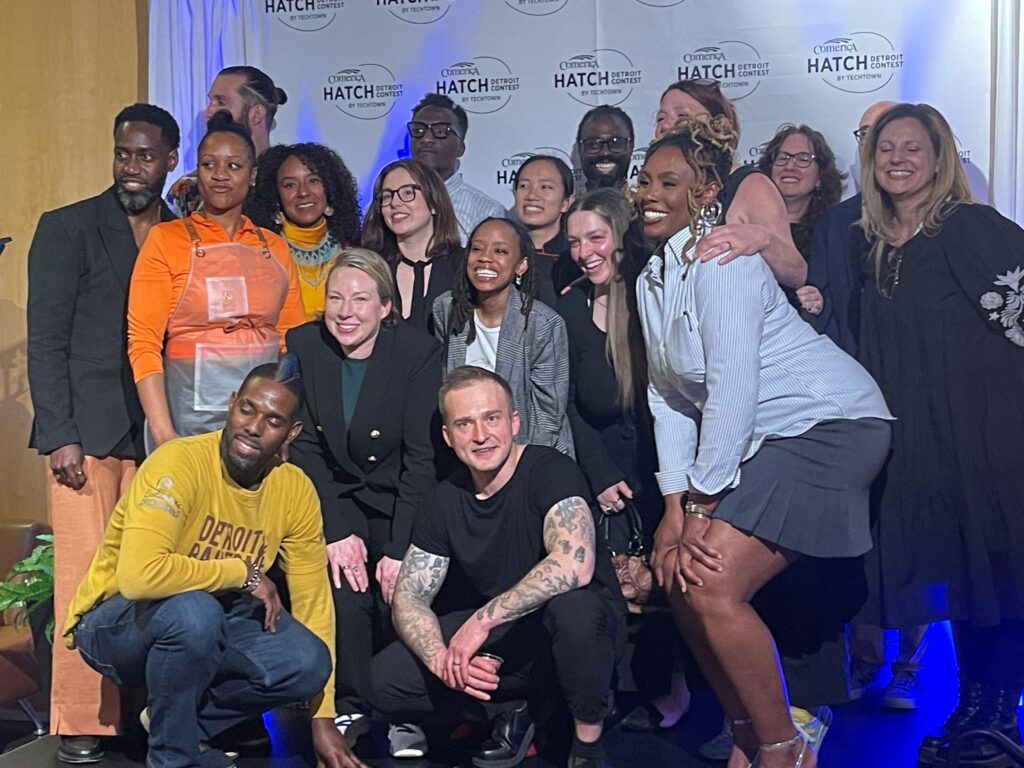
Last week, Clark’s profile was raised even higher after winning this year’s annual Comerica Hatch Detroit contest, a rigorous competition among local startups vying for a $100,000 prize.

With the big check in hand, Clark will use the funds toward opening a community space, Kraftologie, where she plans to educate future artists of all ages through workshops and other classes, while retailing kits and patterns for fellow DIY-ers.
“I feel like I had to put it all out there, and I was stretched in different ways that I’m not normally used to performing under,” Clark tells the Chronicle in the afterglow of her Hatch victory, which was announced in front of a crowd of supporters at TechTown.
“I had to do a whole campaign, and I’m not normally the biggest social media girl.” (We’ll challenge that assertion later.) “But I was also in the streets in real life, putting flyers on people’s cars at Pistons games, so I feel good.”
The blueprint for Kraftologie was first drawn on the east side off E. Warren, where Clark grew up the only girl in the family. Her mother was an only child, but there were plenty of great uncles and cousins, some of whom babysat her. “And whatever they were doing with their sons is what I had to do,” Clark says.
“So if they were on the roof, I was down at the bottom picking up the shingles,” she adds. “I like to call myself a ‘backyard carpenter,’ because everything that [my uncle] taught me is how I learned. All of those things – all of the carpentry, all of the woodwork. We made treehouses growing up, go-karts…that’s how I got into it, just in the backyard.”
Detroit has always been a city that appreciates its painters and photographers; whether their work hangs at the DIA or covers a wall of a beauty supply store, there’s no hesitation in labeling it as art. That vocabulary isn’t as freely applied when it comes to work produced with harder materials, where there are firm delineations on who can wear what title. The carpenter without an art degree wouldn’t readily call themselves a woodworker, nor would the welder at the plant frequently use a more academic term like metalsmith.
There’s room for new thinking there, Clark says, especially considering the uncle who initially showed her the basics of making something worth looking at. “He is an artist, and he doesn’t consider himself an artist, because it’s political on who gets to call themselves an artist,” she says. “He is a craftsperson, but he’ll tell you that he’s a Ford man who worked in the glass plant for 30 years. But he knows how do to everything, and he passed that on to me.”
For the Hatch Detroit competition, Clark was one of four semi-finalists whittled down from more than a dozen entrepreneurs and startups all pitching how they’d add to Detroit’s economic landscape with a funding boost, an intensive process that involves weeks of pitching to both the public and the contest’s panel of judges. During the final round at Techtown, Clark noted to the panel that she hadn’t taken a required – emphasis on required – art class since fifth grade, one of many anecdotes supporting a larger idea of making art and craft more communal and accessible without the pretense.
“I grew up going to Arts and Scraps – I’m a scrappy girl,” she says, referring to the longtime eastside nonprofit that collects reusable materials for use in community art education. “With Kraftologie, I hope that people are introduced to arts and crafts early, and they can pick their job trajectories from there.”
Woodwork has been Clark’s calling card, but she’s also skilled in metalsmithing and blacksmithing. The list of Black women in those trades is short but not entirely blank, partially due to the recurring question of where labels and titles apply.
“When I look up Black women metalsmiths and blacksmiths, the first thing that comes up is slavery, because we did every craft. But they’re looking at it like a sense of utility and need, and not ‘this person does this gorgeous work,’” she says. “Craft has always been communal with things that you need first. I’m carrying on for the women before me who didn’t get acknowledged for this work, but we’re definitely doing this work.”
Clark points to hometown heroine Tiff Massey, the internationally acclaimed metalsmith who became the first Black woman to earn a BFA in the field and the youngest artist to be exhibited at the DIA with “7 Mile & Livernois.” (“Blacksmithing, metalsmithing, welders…we’re all sistas,” Clark says, highlighting the technical differences between these similar disciplines.) That’s one permanent name on the list. Still, Clark herself finds herself the only one or one of a few in some spaces – the only woman, the only Black woman, the only Black person period, any one of those descriptors has come to be the usual.
That’s played into Clark’s attempts to boost the ranks, which is demonstrating to others that it can be done. While honing her many crafts over the years, Clark would occasionally livestream herself at work or in studio to a digital audience, giving instruction along the way. Then she started teaching workshops and classes in person around town, sometimes coming full circle with sessions at Arts & Scraps, where she’s now a board member.
One of Clark’s star pupils is her 14-year-old son, who’s keeping with tradition by doing whatever the older relative does. “He edits videos for his friends, but he won’t let me see them. He’s an artist. He’s sensitive about his stuff. He will not let me see his videos,” she said while laughing.
There’s also the entrepreneurial gene that’s revealing itself: “He’s my event photographer – he charges me. He sends me an invoice; he’ll say, ‘you have to buy me snacks, you have to feed me. I’m not paying for that.’”
Now, Clark said that she’s not the social media type, but there’s evidence to the contrary. Occasionally Clark does go viral in Detroit digital circles whenever she posts some of her elaborate creations, and a number of supporters just now helped in her Hatch campaign with reposts and awareness. A memorable, more widespread moment came a few years back by way of her son when, in a lighthearted display, Clark tweeted a screenshot of a text exchange with him while she was out on the town and he was waiting up with a babysitter.
Forgetting that she and her son share each other’s locations on their respective devices, Clark was caught off guard when her son clocked that she was at Delmar, the now-defunct hotspot known for its rooftop debauchery formerly located in the “Greektown area” – which is where Clark said she was after immediately cutting off her side of the location sharing.
“Yes, I was in the Greektown area,” Clark said after the Hatch win. It was retweeted more than 10,000 times, and for a brief time on the Detroit internet, “I’m in Greektown area” became shorthand for letting followers know you’re about to have – or in the middle of having – the time of your life. (And maybe being somewhere you ain’t supposed to be in the process.)
For Clark, it was an inside look at the balance between parenting and adulting. “He still checks my location, all the time,” Clark says — which years ago felt more necessary than it does lately.
“He saw me growing from working 12- and 14-hour days in event production, to being at home now, having dinner with him or bringing him along to jobs with me because he can come,” Clark says. “He sees that flexibility, and he does tell me that ‘you look happier now.’ Because I am.”