


By: Jasmine West
Detroit’s jazz legacy has long been built by musicians who learned the craft in the city, found their sound here and, in many cases, returned to teach the next generation.
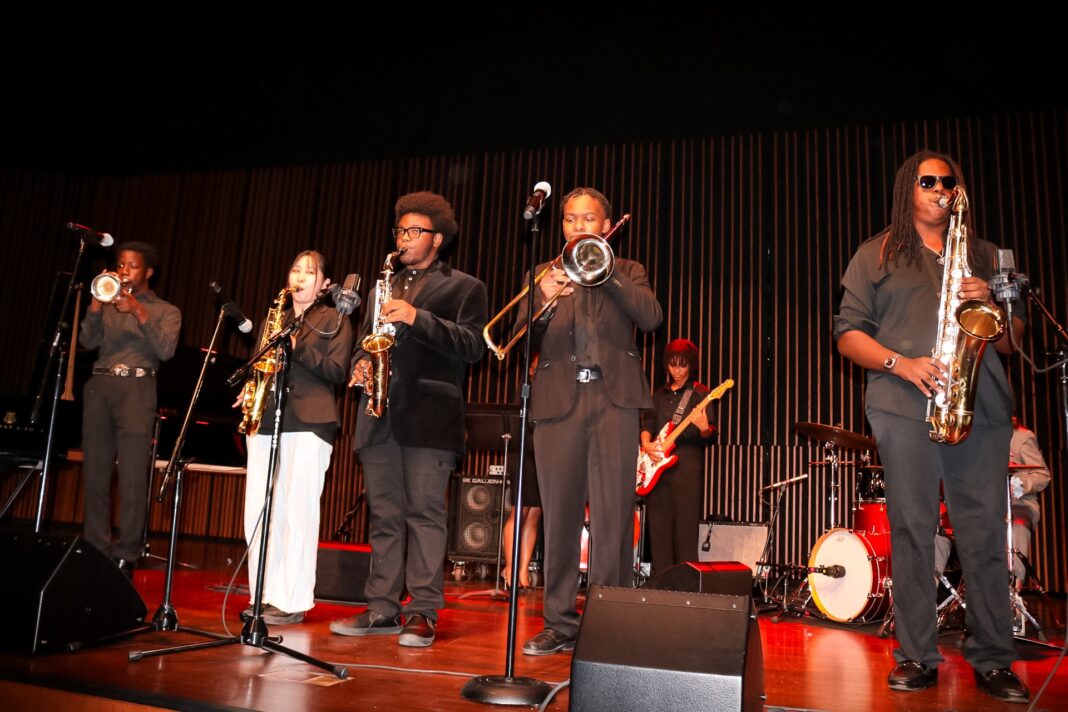
That cycle is continuing inside Detroit Public Schools Community District classrooms, where students are learning from professional musicians through the Detroit Jazz Festival Foundation’s New Jazz Infusion program and getting opportunities to perform on some of the same stages as the artists mentoring them.
The program, supported by the Barbara and Erb Foundation, pairs students with working musicians while giving young artists a closer look at what a career in music can actually require.
For students at Detroit School of Arts, that connection comes with history.
Under former DSA Director of Bands Ed Quick, the school’s jazz program built a reputation that extended well beyond the classroom. The late Aaliyah, a DSA alumna who became an R&B singer and actress, once performed alongside students in the school’s jazz program. The ensemble also worked with artists including Aretha Franklin.
Today, DSA Director of Bands Victoria Fernholz said that legacy matters, but so does giving students access to the musicians working in jazz right now.
“The partnership with the Detroit Jazz Festival is really important because a lot of our students are looking to be part of that scene. They want to be professional jazz musicians,” Fernholz said. “It gives them an opportunity to connect with professionals who are already in the field.”
That exposure includes seeing their own mentors perform professionally.
“Even getting to see one of their mentor teachers, Allen Denard, performing on stage at the Detroit Jazz Festival is really special for them,” Fernholz said.
Students also get their own chance to step onto the festival stage through a showcase included in the Detroit Jazz Festival lineup.
For DSA senior Toni Hobdy, music was not originally the plan.
Hobdy entered DSA through visual arts before trying an instrument and discovering another creative ability.
“I didn’t start off as an instrumental major. I was actually in visual arts, but once I tried playing an instrument for the first time, everybody was super welcoming,” Hobdy said. “The staff at DSA didn’t even have to try hard — they’re just naturally so nice, welcoming and helpful.”
That support, she said, also comes with expectations.
“They always push me to do better without making me feel bad,” Hobdy said. “I stress myself out about practicing, but I’d honestly rather be under a bunch of intentional, happy stress than to be lazy with my instrument, so I practice daily.”
Senior Nathan Bates found his instrument after arriving at DSA.
Bates began with piano before picking up the tenor saxophone during his freshman year. Three years later, he said the decision changed the direction of his life.
“I found a passion for piano and I was into it, but once I came to DSA, I decided to try a saxophone,” Bates said. “My passion for music really skyrocketed, and I knew music is what I wanted to do.”
New Jazz Infusion reaches students beyond DSA. The program is also housed at Cass Technical, Northwestern, Cody, Martin Luther King and Renaissance high schools, as well as the Edward Duke Ellington Conservatory of Music and Art at Beckham Academy.
For Pershing High School band teacher Kevin Moore, the value of giving students access to instruments and instruction is personal.
Moore was introduced to music in fourth grade by teacher Deborah Scales, who allowed him to experiment before settling on the saxophone.
“She gave me a variety of instruments to choose from. I went with the saxophone, and from then on, when I went to high school at DSA, it just built my skills,” Moore said. “It took me all around the world. I wouldn’t be the musician I am today if it wasn’t for DPSCD.”
His time as a student at Duke Ellington and DSA eventually brought him back to the district as a teacher.
“Because I had so much influence from all of my band teachers, I knew that I wanted to teach again,” Moore said. “Coming back home just felt right.”
Now, he is standing on the other side of an experience that helped shape his own life.
“I know the city and what comes with it — all the ups and downs,” Moore said. “I just wanted to get back to my community, really. It warms my heart that I’m able to give students the same opportunities that I had when I was in school.”
For students considering music beyond high school, that kind of example makes the pathway less abstract. They can learn an instrument in a DPSCD classroom, work alongside musicians already making a living through their craft and then step onto one of Detroit jazz’s biggest stages themselves.
And for teachers like Moore, the opportunity comes full circle: Detroit students learning from Detroit musicians, with another generation preparing to carry the city’s sound forward.