

This post was originally published on Word In Black.
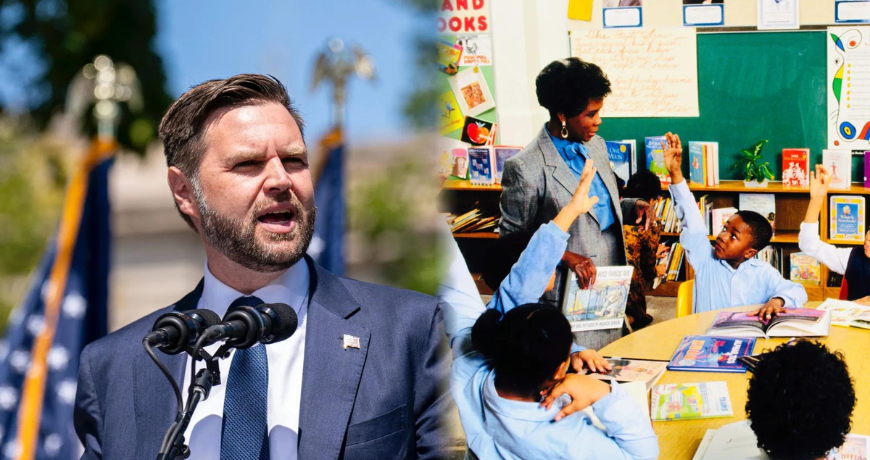
In newly uncovered audio from 2021, Senator J.D. Vance (R-OH), now the Republican nominee for vice president, criticized educators like Randi Weingarten, the president of the American Federation of Teachers, who does not have biological children. Vance suggested that childless teachers are less qualified to educate students. They “brainwash the minds of our children,” Vance said, and this notion “disorients and disturbs” him.
“If they want to destroy the minds of children, they should have some of their own and leave ours the hell alone,” he added.
Vance’s comments have sparked controversy, particularly within the education community, and raise concerns about how this viewpoint could impact the recruitment and retention of teachers, as well as academic outcomes for Black students, who already face significant educational disparities.
“The assumption that a teacher’s value is tied to their parental status undermines the professionalism of educators and ignores the training, experience, and passion we bring to the classroom,” Hilary Wilson, a doctoral student studying education in Louisiana, tells Word In Black.
“Teachers without children often invest extra time in professional development, volunteer work, and mentorship programs, all of which enhance their ability to connect with and educate their kids. This dedication is crucial, particularly for our students already facing systemic education barriers.”
According to the 2021 National Center for Education Statistics (NCES), more than 75% of public school teachers in the United States are women. However, according to an analysis by the Brookings Institution’s Michael Hansen and Diana Quintero, only about half — 48 % — of all public school teachers have children, meaning more than 50% of teachers do not.

The National Impact On Black Students
Black students are disproportionately affected by teacher shortages and high teacher turnover rates. A 2022 report from the National Center for Education Statistics indicated that 58% of public schools with higher percentages of Black students experienced teacher shortages compared to predominantly white schools. These shortages have resulted in larger class sizes, less individualized attention, and lower student achievement.
Vance’s comments could worsen this by discouraging childless individuals from entering or remaining in the teaching profession. If school boards and district hiring staff or committees begin to judge a teacher’s effectiveness based on whether they have children, it could decrease the pool of qualified educators.

“I don’t have biological children, but I pour everything into my students,” Jessica Barnes, a middle school teacher in Detroit with over a decade of experience, says. “I see them as my kids and care deeply about their success. To suggest that I’m less qualified because I don’t have my own children is not only insulting but dangerous. It devalues our work and could push other passionate educators away who are needed now more than ever.”
Mark Thompson, an elementary school teacher in Atlanta, also disagrees with Vance’s comments. “Just because people don’t have biological children doesn’t mean they don’t care about the challenges students face,” he says.
Where Do We Go From Here?
Vance’s comments, if ever allowed to influence policy or public opinion, could further impact qualified educators, teacher diversity, and Black students who are already at a disadvantage in today’s educational system.
“We can’t afford to allow these kinds of comments to slide. Thompson says. “It might sound far-fetched that it could influence anything, but we have to be careful and prepared to always push back on this kind of rhetoric and support our teachers regardless of parental status.”