

By Biba Adams, Staff Writer and Report for America corps member
By Biba Adams, Staff Writer and Report for America corps member
Family-owned Umoja Fine Arts is celebrating 30 years of elevating Black art, with founder and CEO Ian Grant and his wife, Tanji Grant, looking toward a legacy that extends beyond the gallery walls: helping families see Black and African art as a path to generational wealth.
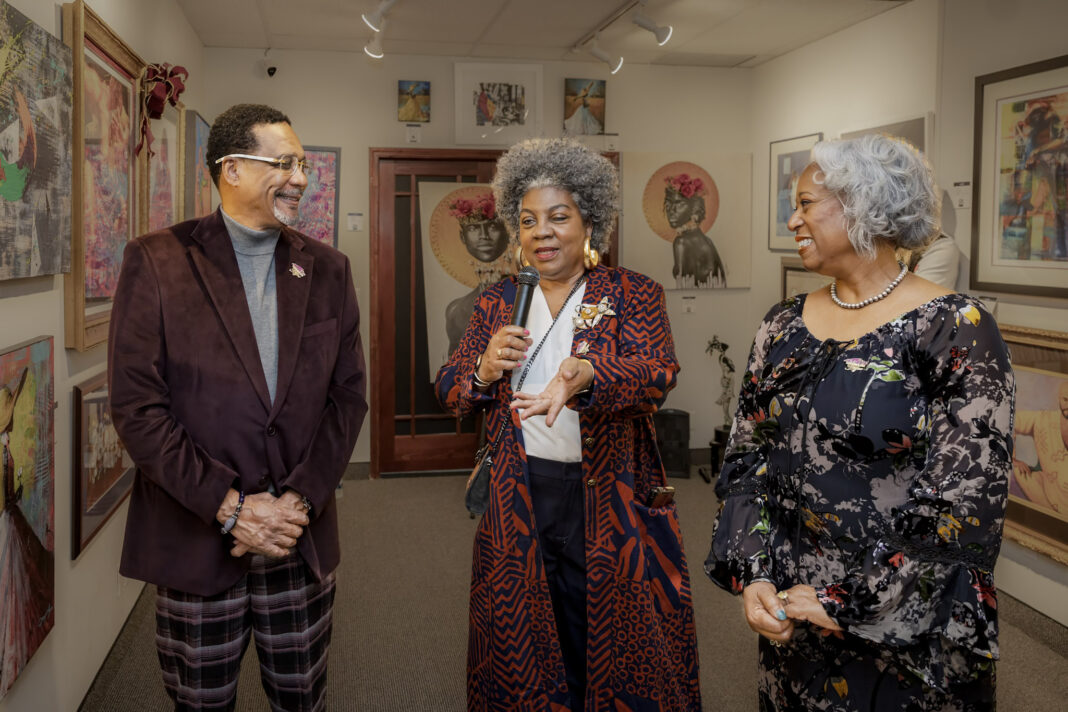
The gallery recently hosted its 30th Anniversary. The gathering brought together collectors and community members to celebrate the artists whose work has helped shape Umoja for three decades.
Umoja Fine Arts is more than just a gallery, they are a “teaching” art studio. Even a casual visit will likely result in a learning experience, not just about art, but about how acquiring unique African American art can appreciate over time and become something of a legacy for families.
“We believe in educating our consumer, because once they know about art, they tend to appreciate it a lot more,” explains Tanji, “So, for example, if I’m showing you a limited editon piece, you will see the number. So, for this one,” she shows a piece where in the corner the artist has recorded several numbers. “The first number is 507 and the second number is 2,500.” She explains, “The lower the numbers, the higher the value.”
Largely, Umoja Fine Arts specializes in the sale of limited-edition prints. “Unlike unlimited edition prints (also known as open editions) that can be reproduced an infinite number of times, limited editions are made in limited amounts and could be any number from two to several thousand depending on the technique and intention of the artist.”
Umoja offers a unique experience with original paintings, bronze sculptures, serigraphs, archival pigment prints on 100% cotton rag paper, lithographs, and figurines. Art images range in price from $45 to $1,500, and original art may range in price from $1,000 to $100,000.
As a teaching gallery, the Grant’s gave an art collection demonstration highlighting Chicago-native and acclaimed painter, Annie Lee.
Known for her depiction of African-American everyday life. Annie Lee’s work is characterized by images without facial features. She used body language to show emotion and expression in her work. Her most popular paintings are Blue Monday and My Cup Runneth Over.
“She actually became our mentor. And by her mentoring us out of Chicago, she opened the door and gave us one of the first chances because Annie Lee, at this time was a millionaire, But she let no one distribute her work. She was the only distributor. I went and talked to her, and we sat down and talked, and I told her what we felt we could do, and how we could help her, with her business and everything, and she just basically didn’t answer me. She says, ‘You know what? I’m gonna send you a letter in one week.’ And then one week, she sent us that letter. Of course, I was a little nervous to open it, and when we did, basically, it said that you have been given exclusive distribution rights to my work. And so when Annie opened the door for us…the floodgates just opened, other artists said, ‘Well, if he’s handling Annie’s work and she’s given him an opportunity, it must be something there. So why don’t you give him an opportunity?’
“So it took one person like that, Annie, to open that door. And with her opening that door, then after she was my 1st mentor.”
Lee passed away in 2014, but her work continues to be licensed by Umoja Fine Arts through their publishing arm.
Art publishers produce books, prints and posters which feature artworks as well as crafts. This has become a major component of the Umoja Fine Arts portfolio. “African American art, particularly limited-edition prints, are becoming of the fastest ways to build wealth,” Ian Grant explains, “I might meet a customer wearing an $800 pair of shoes, and then I explain to them that for the same price, they could buy something that could be worth thousands or tens of thousands in a few years.”
The Grant’s wrote a short, but concise book called “A Guide to Collecting African American Art,” the book, which is less than a dozen pages, but is full of information.
Even if you missed the Umoja Fine Arts anniversary events, here are some ways that you can collect art that increases in value.
*Buy something you love: You should want to have it on your walls and enjoy looking at it, otherwise, you’re buying it for the wrong reasons.
*Signed by the Artist: Be aware of forgeries, verify your piece because signed works are always more valuable than unsigned.
*Originals: Originals have a higher value price point than reproductions.
*First Editions: The Grants recommend acquiring the first in an edition from an artist or a printers proof.
*Deviations: Another tip for spotting a rare print is to look for one in a different colorway or on that’s been hand finished by the artist. While the print might already be a limited edition, these deviations will make it more unique.
*Iconic: Does the piece reflect an iconic figure or image?
*Controversial/Political: Does the piece have historical significance?
*Notoriety: Purchasing the work of a notorious artist is gnerelaly a safe bet for investment, however, if the artist has already gained widespread attention, you’re like to pay top money for their work.
*Proof: Certificates of authenticity and/or proof of purchase are like receipts or certificates for authenticity.
*Emerging Talent: Up and coming artists, find out that’s selling and getting attention.
Collecting art is not for the faint of heart, but Umoja Fine Arts—with 30 years in the game—is prepared to assist and educate you.
“Art is innate to many people. Even at a young age, the artistic side of a person can be discovered. Our role as adults is to teach, guide, and help our younger generation come out to the open and use their artistic abilities in many ways.”
The Grants’ explain in their book that, “Regardless of where you are in the world, there is an art school nearby. Enroll your child and let them discover the beauty of life through their artwork. A few more options are taking your child to art social groups, local exhibitions, or workshops. Let them explore their inner self by doodling, painting, and creating stuff from nothing but their creativity.”
You can reach Biba at Biba.Adams@MIChronicle.com