
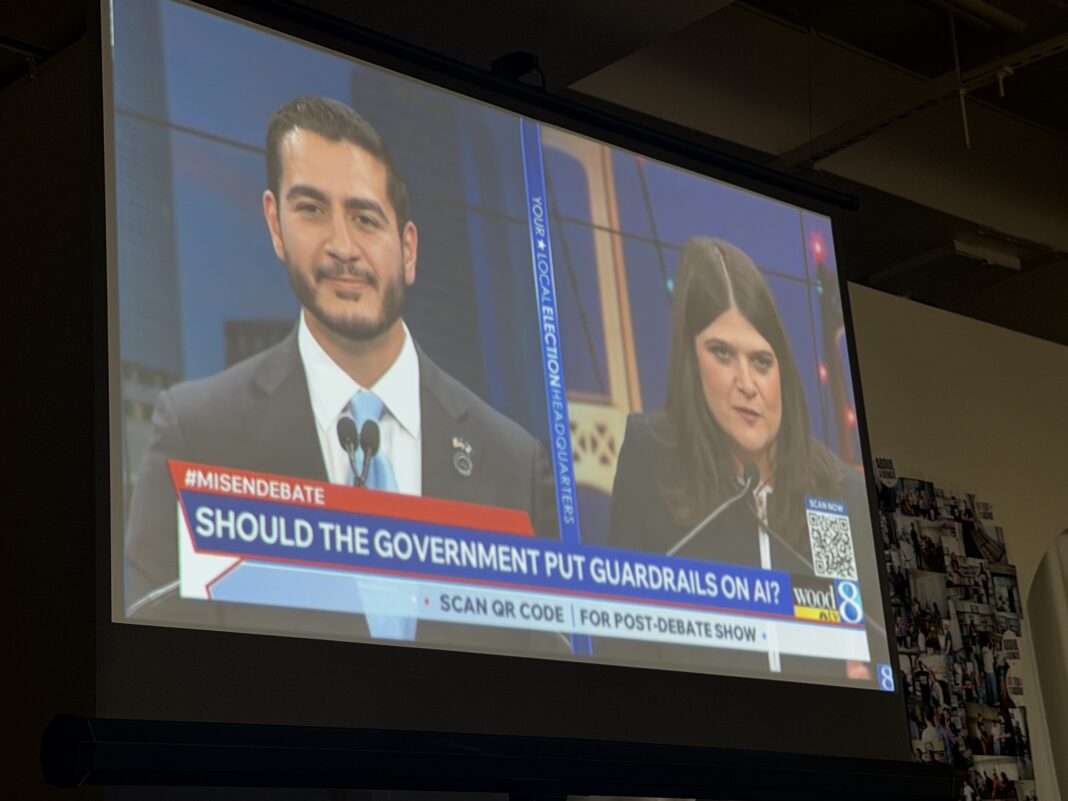

Black voters were barely mentioned during the first two-way debate featuring Michigan’s polarizing Senate candidates, U.S. Rep. Haley Stevens and Abdul El-Sayed.
Hosted by WOODTV 8’s Rick Albin, topics like healthcare, corruption and corporate influence, AI regulation and the Israel-Palestine conflict dominated the discussion.
Stevens was the only candidate to make direct mention of Black voters during the debate.
While answering a question about how to protect residents from potential effects of artificial intelligence, Stevens said she’s supported protections for consumers, particularly for small businesses who need equitable investment.
“Black-owned businesses, like the ones I visit on the regular, who oftentimes are getting the short end of the stick. And they certainly are from Donald Trump,” Stevens said. “
Targeting Black seniors has been an overt part of her campaign strategy. Groups supporting Stevens have spent millions airing TV ads highlighting her time working with former President Barack Obama.
Stevens has been endorsed by dozens of Black pastors, the Michigan Democratic Black Caucus, Detroit legislators like Helena Scott, Joe Tate and Tyrone Carter. El-Sayed has his own Black supporters, including the Black Slate, Wayne County Executive Warren Evans and the Council of Baptist Pastors.
On Monday, July 6, El-Sayed’s campaign launched a TV ad airing in the Detroit media market highlighting his support of former Vice President Kamala Harris’ presidential campaign. While the February 2024 Uncommitted movement was a protest against former President Joe Biden, some Black leaders and political rivals to El-Sayed have said anyone associated with the effort should receive blame for Harris’ November election loss to Trump.
At El-Sayed’s campaign office in Detroit, Black voters supporting him spoke about why they believe more Black voters feel represented by his brand of politics.
Brandon Totten, an academic advisor at the College for Creative Studies, told Michigan Chronicle he believes El-Sayed’s campaign has momentum with older Black voters.
Michelle Jackson, who lives near Chandler Park on Detroit’s east side, told Michigan Chronicle that El-Sayed is approachable and “comes out to the community.”
“He likes to come out to the community and have fun when he can, so why not?” Jackson said. “Medicare for All, I’m not there yet, but my parents are. We need to make sure we have healthcare for all. It’s inevitable, we need it.”
Jackson said she’s heard some close to her criticize El-Sayed for supporting the Uncommitted movement, but she said she wasn’t familiar with the effort.
“I heard some of that, but I don’t play into that,” Jackson said. “We have to start moving forward.”
The debate Tuesday night was watched by politicos across the country. Michigan’s U.S. Senate race is one of the most interesting in the country because of what it means for the direction of the Democratic Party. Democratic voters in Michigan will decide whether to double down on moderation or let progressives take over the party.
The rare open Senate seat is a top Republican target and is a must-win for the Democrats as they aim to win back the Senate majority from the GOP, which currently controls the chamber with a slim 53-47 margin.
Both candidates traded insults and criticisms of one another despite being members of the same party. El-Sayed suggested Stevens is a sell-out to AIPAC, the pro-Israel lobby which is reportedly bankrolling her television ads. The most recent analysis of the race by national ad-tracking firm AdImpact reports $46.1 million in ad spending as of July 1, 74% of which supports Stevens.
Stevens hit El-Sayed on his lack of governing experience and the online nature of his campaign. She also attacked El-Sayed for not releasing his tax returns and “trying to sell a book or a podcast.”
Stevens is not a millionaire, according to a financial disclosure report filed in May. The Congresswoman has a net worth of less than $400,000, according to reports.
El-Sayed’s available financial reports from 2025 show him and his spouse could have been worth between $586,000 and $1.6 million at the time. He’s got a podcast production company, as well as rental properties in Ann Arbor and Bangalore, India.
On his tax returns, El-Sayed said he “took the same extension that the congresswoman took every single year she was in Congress.”