
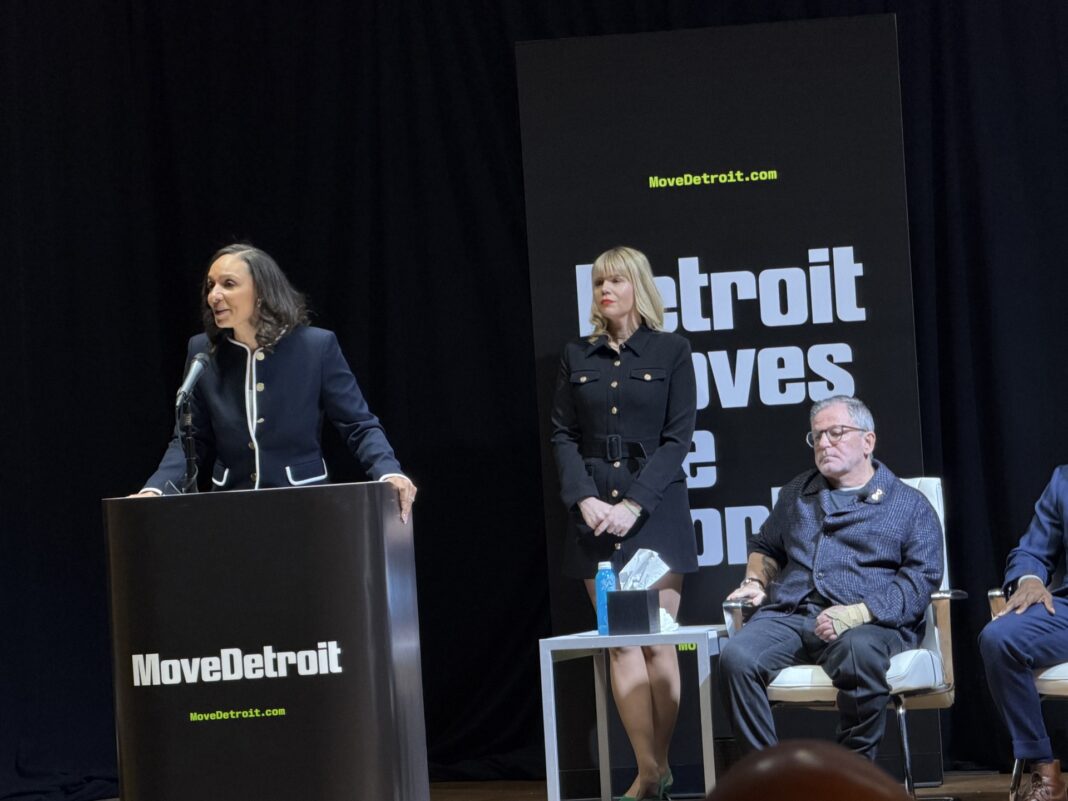

A new campaign seeking to woo newcomers to Detroit while encouraging existing residents to stay and expats to return launched this month with support across business, academic and government entities, the latest iteration of long-running efforts to market Detroit as a leading talent hub.
Billed as MoveDetroit, the campaign kicks off with a “Neighborhood Ambassador Program” that seeks to amplify the narratives of residents sharing their experiences in Detroit. Primarily supported by Rocket Mortgage CEO Dan Gilbert, who serves as chair of the new effort, the coalition has tapped Michigan Economic Development Corporation’s chief talent officer, Hilary Doe, as its president, and will work closely with Detroit Mayor Mary Sheffield in programming going forward.
“Detroit’s greatest asset is its people,” Doe said in remarks to a crowd of civic and business leaders during a press conference at Wayne State University’s Industry Innovation Center. “This program puts residents that are actively shaping Detroit’s story at the forefront to inform how we keep and attract talent, invest in neighborhoods and grow in a way that’s grounded in lived experience.”
MoveDetroit was briefly discussed by Sheffield in her March 31 State of the City address before she, Gilbert and Doe offered more details during Thursday’s conference.
More than 50 partners across different economic sectors are involved with MoveDetroit so far, including tech-focused boosters like Black Tech Saturdays, Femology and Bamboo Detroit; Wayne County Community College District, Michigan State University and Wayne State University on the academic side; retailers Shinola and Gardner White Furniture; and larger entities, including DTE, J.P. Morgan Chase and General Motors, among several others.
The Neighborhood Ambassador Program seeks to select up to 100 Detroiters to help inform MoveDetroit’s strategy, including storytelling and weighing in on growth programs and keeping initiatives in line with the wants of Detroit residents. A site, MoveDetroit.com, is live now and taking nominations for representatives.
Doe notes that the largest show of support for the coalition is involvement from the City of Detroit. Mayor Sheffield has previously announced developing similar initiatives around talent recruitment and housing availability, including expanding programs helping with down payment and implementing a new fund for relocation assistance, and is expected to work in tandem with MoveDetroit; a City spokesperson tells the Chronicle that MoveDetroit itself will not involve any public funding or administrative support from the City.
During her campaign leading to the mayor’s office and in her first 100 days after election, Sheffield has continually noted improving neighborhoods and conditions for existing residents as priorities. Stemming the city’s population losses and attracting new residents was a cornerstone for previous Mayor Mike Duggan’s administration. Both mayors and nearly all their recent predecessors have had to contend with thelongstanding issue of Detroit families leaving the city limits for the suburbs in search of lower property taxes, better education options, or both, which Sheffield briefly noted in remarks to reporters following Thursday’s announcement.
“Everyone agrees that [a lack of] property tax reform is a hindrance to businesses residents,” Sheffield said, adding to previous public remarks about working with state lawmakers to press for reevaluating how taxes are assessed in the city. “How we get there, we’re going to have to work through the details. I’m very, very encouraged that we will have some type of property tax reform done over the four years that I’m in office.”
The role of K-12 education in attracting new residents or encouraging returnees is also “at the forefront,” Sheffield says.
“No one wants to come to the city without a strong educational system. This mayor is so committed to figuring out ways we can partner with the school system,” Sheffield added, responding to a Chronicle journalist’s inquiry. “We have focused really on absenteeism, transportation, and after-school programming. If we can get kids in school, we believe that we can improve literacy, test scores…and we’re looking at better ways of transporting our kids to school through our public transportation system as well.
During Sheffield’s State of the City address, the mayor announced waiving fares for any K-12 aged students using Detroit Department of Transportation buses in the city. Sheffield said Thursday that the City is exploring other strategies centering youth, to “change the narrative that our school systems are improving, and that will signal to families are more willing to come to Detroit and put their kids in our school system.
“As a part of any growth strategy, you have to center Detroiters at the forefront – through storytelling, as well as advocating and encouraging people to come to the city,” she added. “For me, this was important because you can’t talk about growth without talking about Detroiters being a part of retaining them here in the city. Having neighborhood ambassadors will really help elevate the Detroit story coming from Detroiters….who have lived experience to help market and sell Detroit as a destination city.”
If these marketing efforts sound familiar, consider the decades-long push on every level to publicly reshape Detroit’s image and attract new residents in the process.
In 2003, then-Gov. Jennifer Granholm launched the “Cool Cities” campaign in an effort to keep recent college graduates and young adults from departing to Chicago and elsewhere. In 2011, led by then-Detroit Mayor Dave Bing, a coalition of civic and business interests came together for the “I’m a Believer” campaign, which encouraged residents outside of Detroit to get to know the city better by volunteering. Also in 2011, Midtown Inc. launched its “Live Midtown” program, which offered incentives toward housing costs for new residents moving to the area, boosted by entities like the Henry Ford Health System, among others.
Gilbert himself launched the Rock Ventures-backed “Opportunity Detroit” in the same era, an initiative that brought together civic and business interests to bring new retail and residents to the city, advertising onbillboards around the region. A brief “Move to Detroit” billboard campaign popped up exclusively in New York City in 2015, just one year after Crain Communications launched its annual Detroit Homecoming event, bringing Detroit expats back to the city for the week with the hopes of spurring investment.
A variety of neighborhood storytelling platforms have arisen in the last decade, ranging from the Detroit Free Press’ “Detroit Is…” series to the existence of Bridge Detroit itself, all of which were preceded by the City of Detroit’s own storytelling platform launched in 2017.
The ultimate push came in in 2018, when an all-hands-on-deck approach from city, county and state leaders partnering with business, philanthropic and academic interests attempted to win Amazon CEO Jeff Bezos’ favor in the widely publicized competition for the online retailer’s second headquarters, with the tagline “Detroit: Move here, move the world.”
“Yes, we went through decades where people forgot how much we were capable of,” Gilbert said in his remarks. “But now the world’s remembering, and the nation is taking notice once again. You can feel it.”