
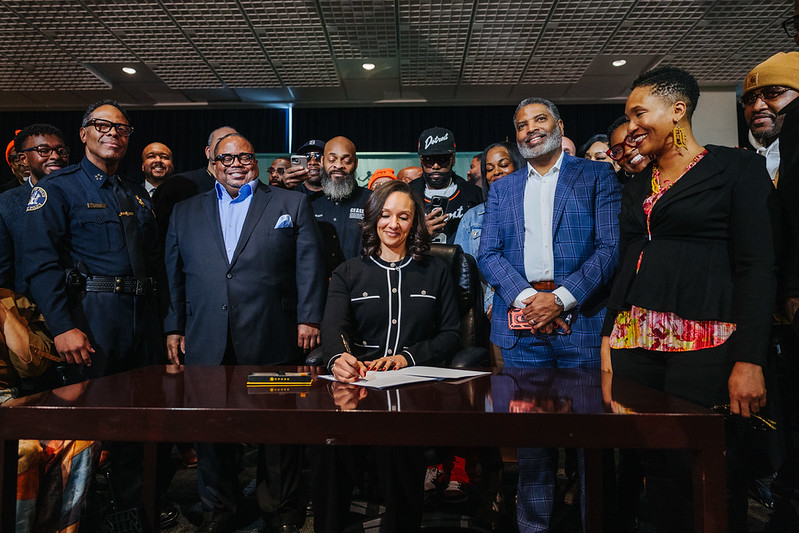

Detroit’s next phase of public safety work is moving deeper into the neighborhoods — and this time, the City is putting that strategy into a formal office built to connect the people already doing the work.
Mayor Mary Sheffield signed her second executive order creating the Mayor’s Office of Neighborhood and Community Safety, a new city office designed to strengthen Detroit’s violence prevention efforts through a public-health approach that centers prevention, intervention, trust-building, and long-term community well-being.
The order takes effect April 7.
The move comes as Detroit enters 2026 after another year of major crime reductions as Detroit’s Community Violence Intervention (CVI) groups played a major part.
City officials announced that 2025 ended with historic lows in key categories, including criminal homicides, nonfatal shootings, and carjackings. Preliminary city data shared in January showed nonfatal shootings fell to 447, down 26% from 2024, while carjackings dropped to 77, down 46% from the prior year. AP reporting also noted Detroit recorded 165 homicides in 2025, the city’s lowest total since at least the 1960s.
That context matters because this new office is not being launched as a reaction to failure. It is being built to protect gains Detroit has fought hard to make and to address the violence that still leaves families grieving in neighborhoods across the city.
“All categories of major crime in Detroit saw significant reductions in 2025, with new historic lows of criminal homicides, nonfatal shootings and carjackings,” Sheffield said. “Detroit has shown that when we work together, real progress is possible. Our comprehensive approach to public safety is working, but sustaining that progress requires continued partnership and further strengthening the bridge between government and neighborhood leaders. This office is ensuring that every neighborhood has the tools and support it needs to be safe and thrive.”
The Mayor’s Office of Neighborhood and Community Safety will be supported in part by a $200,000 grant from the Hudson-Webber Foundation to help develop a coordinated, community-driven violence prevention infrastructure. The office will house and coordinate existing CVI programs, including ShotStoppers, along with Group Violence Intervention (GVI) through Ceasefire, survivor advocacy work, reentry support, and new crime prevention efforts.
Longtime community advocate Teferi Brent will lead the office as director. Brent brings more than three decades of experience spanning community organizing, faith-based leadership, and business management.
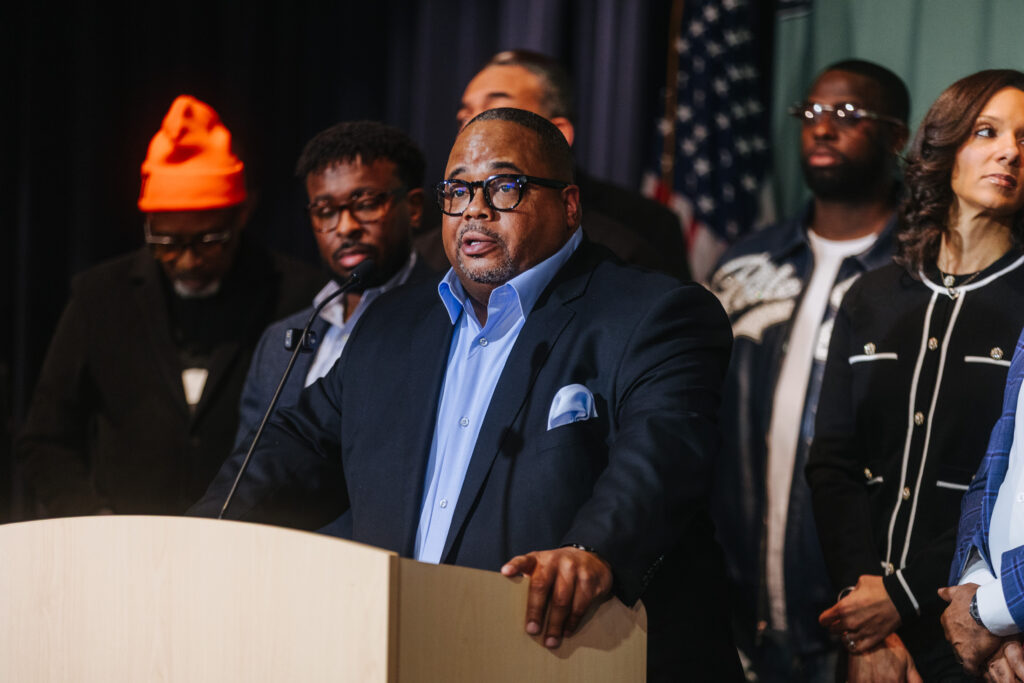
“True safety starts in our neighborhoods when people feel seen, supported and valued,” Brent said. “Our ultimate objective is to serve as a bridge between governmental resources and community-based safety organizations. We believe in a whole-of-government approach that eliminates silos and makes critical resources more accessible to our first responders and community leaders.”
Detroit residents have already seen what community-based violence intervention can do when neighborhoods are resourced and trusted.
Over the last few years, Detroit’s CVI work — especially in high-violence areas targeted through ShotStoppers — helped shift the city’s approach away from relying only on enforcement and toward prevention led by people with relationships on the block. City officials have repeatedly pointed to community violence interrupters as a major contributor to reductions in shootings and retaliatory violence in several Detroit neighborhoods, with earlier results showing steep drops in some CVI zones.
That matters for Black Detroiters, who know violence is never just a headline or a statistic. It is trauma. It is a school day interrupted by grief. It is a family trying to bury a loved one and hold itself together at the same time. It is a block carrying fear long after police tape is gone.
This new office is designed to centralize the city’s prevention strategy so that the work already happening across community organizations and city departments is not fragmented, duplicated, or undercut by silos. According to the executive order announcement, the office will serve as a hub for violence prevention and intervention efforts and will focus on strategies that are coordinated, data-driven, and responsive to community needs.
Donald Rencher, president and CEO of the Hudson-Webber Foundation, said that infrastructure is exactly what Detroit needs to sustain public safety improvements over time.
“Hudson-Webber Foundation is proud to support the City of Detroit in strengthening a coordinated, community-driven approach to violence prevention,” Rencher said. “We know that sustainable public safety is achieved when residents, community organizations and government work together. This new office represents an important step toward building the infrastructure, trust and long-term strategies necessary to ensure that every Detroit neighborhood has the opportunity to be safe, stable and thriving.”
The office will include six major service areas, each tied to a different part of the safety ecosystem Detroit residents encounter in real life:
Community Violence Intervention (CVI) through ShotStoppers, which uses evidence-informed and community-led strategies to prevent violence through relationship-building, wraparound services, violence interruption, and mediation.
Conflict resolution and restorative practice initiatives, including neighborhood-based training, mediation hubs, and centralized services designed to increase access and center equity.
Survivor advocacy and survivor services, with emotional, practical, and legal support for crime victims, while researching and considering best-practice tools such as Trauma Recovery Centers and other community-based interventions.
Domestic violence and intimate partner violence prevention and intervention, with strategies aimed at aligning and expanding existing resources, teaching healthy relationship skills, and creating proactive, victim-centered supports before abuse escalates.
Reentry support services for adults and juveniles, including a review of the current landscape to identify gaps, align resources, and address factors that contribute to recidivism.
Group Violence Intervention through Ceasefire, which will continue partnerships among community members, law enforcement, and social services to support behavior change and reduce violence among at-risk populations.
One of the most important shifts inside this office is where Detroit is turning its attention next.
Using data and lessons drawn from the city’s successful CVI work, Brent said the Office of Neighborhood and Community Safety will now work to address domestic and intimate partner violence as a major source of violence in Detroit — an area that has not received the same focused citywide prevention strategy. City officials say domestic and intimate partner violence accounted for 17% of homicides in Detroit last year. That figure is one of the clearest signs that Detroit’s next crime reduction gains will require confronting violence that happens behind closed doors, often before it becomes fatal.
“Our CVI groups have done an incredible job bringing down the number of gang-related homicides and shootings and that work will continue,” Brent said. “What their community work has shown us is that domestic and intimate partner violence is a major source of violence that needs focused attention for us to further reduce homicides in Detroit, saving more innocent lives.”
Brent said staff will be assigned to further research the issue in Detroit and develop strategies that include conflict resolution and restorative practices.
“Domestic violence really can’t be effectively addressed without these two approaches,” Brent said. “Just like CVI work, our job is to change patterns of behavior and to give people options and tool other than violence.”
Community organizations already working on this issue say the city’s decision could set a new standard.
“Detroit is the first city to devise a comprehensive strategy from the Mayor’s Office specifically designed to address DVI and IPV-related fatal and nonfatal shootings,” said Negus Vu, president of The People’s Action community organization. “That leadership matters. It sets a precedent. It sends a message that we are not waiting for solutions, we are building them.”
Dr. Keisha Allen, CEO of Black Family Development International Training Institute, emphasized that lasting peace requires neighborhood-level tools, not just crisis response after harm has already happened.
“If we truly desire sustainable, peaceful, and safe communities across Detroit, restorative conflict resolution must be a foundational strategy within our neighborhoods, not an afterthought,” Allen said. “I commend the Mayor’s Office of Neighborhood and Community Safety for recognizing that real safety is co-created with the community through restoration, engagement, and proactive conflict resolution.”
The office will work across city departments and outside partners, including public health agencies, social service providers, law enforcement and criminal justice partners, schools and hospitals, neighborhood organizations, housing and parks departments, Detroit PAL, the Wayne County Dispute Resolution Center, Center for Working Families, and the Department of Human, Homelessness and Family Services.
That list tells the real story of what Detroit is trying to do.
Public safety is no longer being framed as a single department’s job. Detroit is treating safety as a neighborhood condition — something shaped by trauma care, housing, youth support, mediation, reentry, family stability, and whether people can get help before conflict turns into gunfire.
City leaders are betting that the same community-rooted CVI model that helped lower shootings can now help Detroit go further.
For a city that has spent years proving crime can go down, this new office raises a harder and more important question: how does Detroit make safety durable?
Sheffield’s answer, at least on paper, is clear — build the infrastructure, fund the relationships, and let neighborhoods help lead what safety looks like.