
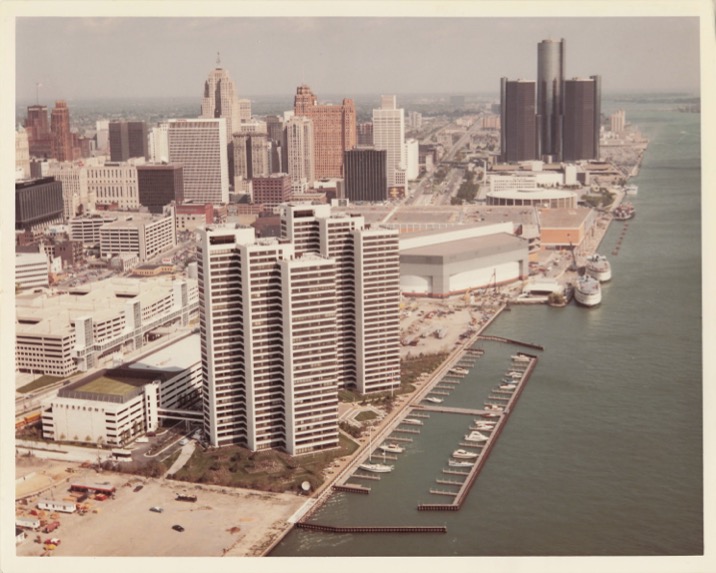

The two riverfront facing towers part of the Renaissance Center complex set to come down next year were once home to offices, businesses and a music venue.
Bedrock CEO Jared Fleisher tells Michigan Chronicle the towers won’t be demolished, but deconstructed, or dismantled piece-by-piece. That means there won’t be explosions or wrecking crews taking structures down, but workers. The buildings closest to the riverfront set to be torn down as early as next fall, he said.
“To me, we’re preserving the essence of the skyline,” Fleisher said. “I live on Brush Street, and everyday I go down Brush I stare right at the RenCen and I see three towers, the center tower and the two on the side.”
Developers General Motors and Bedrock say the deal includes historic public benefits and will jumpstart a new era for the Detroit Riverfront. Critics of the project demanded council members delay the vote, arguing the billionaire developer behind the revitalization effort shouldn’t be using public tax dollars to tear down the city’s most famous landmark.
Contracts for architecture and deconstruction packages are scheduled to be released before the end of the month, Fleisher said.
Detroit City Council voted to approve the $2.2 billion plan to deconstruct two of the Renaissance Center’s 39-story towers after more than a hundred public comments Tuesday.
City Council member Angela Whitfield Calloway said she wanted to see the buildings be saved, but voted to approve the project to continue the city’s progress on its riverfront.
The Renaissance Center was first pitched to Detroiters nearly 60 years ago as a way to kickstart the rebuilding of the city following white flight and divestment. Today, the developer who reshaped the city’s skyline with the construction of the new Hudson’s tower is set to reshape it again by taking down part of Detroit’s most famous landmark.
Billionaire Bedrock/Rock Ventures founder Gilbert is forming a 501(c)(4) nonprofit to own and operate the Renaissance Center and the East Riverfront, personally gifting it with $1 billion.
The two 39-story buildings coming down have been empty since General Motors moved its offices out of the Renaissance Center complex.
Towers 300 and 400
Ads promoting businesses that made up the buildings can be found on archives of Michigan Chronicle. The idea behind the four towers surrounding the 73-story hotel was to create a self-contained, mixed-use “city within a city.” That’s according to John Portman, an architect with similar buildings in Atlanta and Los Angeles.
There were a number of happenings inside those buildings all the way up until the 2010s worth mentioning.
On July 19, 1982, a Coldwater Daily Reporter story reported Kenneth A. Rick, a 31-year-old draftsman from Lake Orion, attempted to climb and parachute off of tower 300. He told police he planned to jump to the ground 472 feet below, but damaged his parachute on the way up.
It was Rick’s third attempt at climbing the building.
There was a First Federal Savings of Detroit bank located at the street level of the building in the 1970s. In the 80s, the Detroit Grand Prix put the box office at the street level of the building. That’s the building where drivers and their race teams would begin assembling cars and getting their race pits in order.
There were jazz nights at the second floor of the tower, what was known as “Blue Monday.” The tower hosted concerts featuring acts like the Ken Cox Quartet with Nancy Davis, and the Steve Wood Quintet with Angie Smith, billed for $6 at the door.
Seldom Blues, a jazz supper club and upscale restaurant in tower 400 operated from June 2004 until February 2010.
Images from the concerts appear in archival photography of Detroit’s 1970s–1990s jazz scene.
In tower 400 there were law offices, restaurants and shops like an av computer graphics store.