
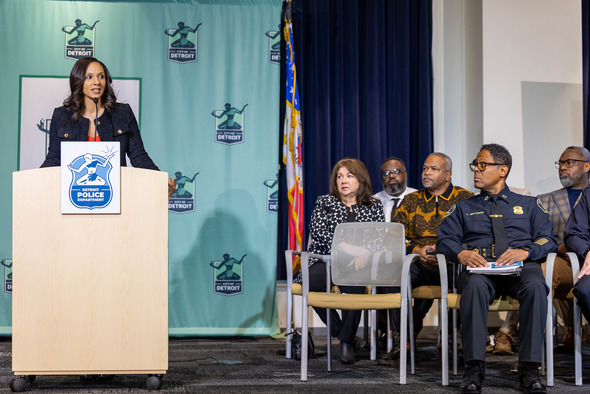

Detroit closed 2025 with 165 criminal homicides, according to preliminary year-end figures shared during a city public safety briefing led by Mayor Mary Sheffield and Police Chief Todd A. Bettison.
The city said the total is down 19 percent from 203 in 2024 and down 35 percent from 252 in 2023, continuing a multi-year decline that officials described as pushing homicides below 200 “for the first time in decades.”
Detroit is also a majority-Black city, with the U.S. Census Bureau estimating 76.8 percent of Detroit residents identify as Black alone.
That context matters because when violence drops in Detroit, it changes conditions for a city where Black families make up the bulk of the people walking to work, sending kids to school, catching the bus, running small businesses, holding down block clubs, and doing the everyday labor of keeping neighborhoods together.
“Nothing we do as a city is more important than keeping our residents safe,” Sheffield said. “Safer communities and historic reductions in crime like this don’t happen without effective strategies, great partnerships and the political will to fund these efforts. All of those things exist in Detroit and will continue to in the Sheffield Administration.”
Beyond homicides, the city reported declines across every major crime category it listed under Michigan State Police and FBI reporting standards.
The preliminary totals show 447 non-fatal shootings in 2025, a 26 percent drop from 2024. Carjackings fell to 77, a 46 percent decline from the year before. The city also reported sexual assaults decreased from 613 to 529 (-14 percent), auto theft dropped from 8,331 to 6,391 (-23 percent), and robbery declined from 1,209 to 953 (-21 percent). Officials said overall violent crime fell 10 percent and property crime fell 10 percent.
Chief Bettison framed the results as the product of collaboration across enforcement, prosecution, courts, and community prevention.
“These stats represent the commitment I promised you all when I was first sworn in as police chief, for continued dedication and constant improvement by the Detroit Police Department,” Bettison said. “As we embark on this new year, with our new Mayor, I am confident that the work done in the previous year to decrease crime will continue and be even more effective with her support and guidance. There is a saying that there is no I in team; and this collaboration is the true representation of teamwork.”
The city’s version of “team” included Wayne County officials such as Executive Warren Evans, Prosecutor Kym Worthy, and Sheriff Raphael Washington; federal partners including U.S. Attorney Jerome F. Gorgon Jr. and agencies named as the DEA, FBI, ATF, and Department of Homeland Security; state partners including the Michigan State Police and Michigan Department of Corrections; court leadership including 3rd Circuit Court Chief Judge Edward Ewell Jr., Judge Pat Fresard, and 36th District Court Chief Judge William McConico; and the Detroit Wayne Integrated Health Network.
For Black Detroiters, one of the most consequential parts of the city’s briefing was not a list of agencies. It was the city placing community violence intervention in the center of its public safety story.
The city named seven ShotStoppers community violence intervention groups: Detroit Friends & Family, Force Detroit, New Era Detroit, Detroit 300, People’s Community, Live in Peace, and Team Pursuit. The city said these groups produced reductions in homicides and non-fatal shootings that outpaced the reductions in areas without CVI coverage. It also said the city added Live in Peace and Team Pursuit in June 2025 on the northeast side, bringing the total number of CVI zones to seven.
“Force Detroit along with our partners are extremely grateful to all the individuals and community members who have been impacted by the cycle of violence,” said Zoe Kennedy. “Those who have decided not perpetuated violence, who’ve decided not to open fire around children, who’ve decided not to open fire around our elders, who have decided not open fire on homes! Who have decided to resolve conflicts before they escalated, who’ve decided to change the narrative.”
The city also said Ceasefire Detroit will implement a targeted approach focused on a specific “CVI zone,” described as a 4.5-mile area bounded by Puritan, Telegraph, Schoolcraft and the Southfield Freeway. The city said Ceasefire Detroit has provided violence prevention services since 2013.
Enforcement and prosecution were the other major pillar highlighted.
The city said U.S. Attorney Gorgon stepped up federal gun crime prosecutions in 2025 and embedded federal prosecutors in seven of the city’s precincts, while Prosecutor Worthy embedded eight county prosecutors across seven precincts.
“We know that ‘iron sharpens iron.’ And our work with the Detroit Police proves it,” Gorgon said. “We have our folks in their precincts, and they have theirs in our office. We are shoulder-to-shoulder. When one calls, the others answer.”
The city listed enforcement totals connected to its gun-violence work with federal partners: 6,235 guns recovered, 5,079 casings entered into the National Integrated Ballistics Information Network (NIBIN), 2,932 investigative leads generated by NIBIN, 593 search warrants served, 2,253 felony arrests, and 141 individuals charged federally.
“Every family in Detroit deserves to live in a community where gun violence does not dictate daily life,” said ATF Detroit Special Agent in Charge James Deir, describing ATF’s focus on targeting “prolific shooters” and “crime-gun traffickers” through Crime Gun Intelligence and NIBIN-supported investigations.
“FBI Detroit values its strong partnership with DPD to Crush Violent Crime,” said Jennifer Runyan, Special Agent in Charge of the FBI Detroit Field Office, citing intelligence sharing and joint task force operations.
On the county side, Evans pointed to the human stakes behind the percentage drops.
“We’re proud to be making even more progress than last year, because behind every reduction is a family spared heartbreak and a neighborhood that feels a little safer,” Evans said. “This doesn’t happen by accident. It’s the result of strong partnerships and a shared commitment to never give up on our neighborhoods.”
The city also highlighted the Fugitive Apprehension Service Team (FAST), a joint unit with the Wayne County Sheriff, saying FAST apprehended 1,102 individuals with outstanding felony warrants in 2025, prioritizing those wanted for gun crime.
Court processing was another theme. The city said the Wayne County 3rd Circuit Court reduced a backlog of felony gun cases by 3,000 and the 36th District Court reduced a felony gun case backlog by 1,900, restoring operations to pre-COVID levels.
“Courts typically address crime but it was my greatest honor in 2025 to join with these dedicated partners not just to address crime but to prevent it,” said Judge Patricia Fresard, describing work on alternatives to violence and support for safety.
The city tied its next steps to funding and structure. It said the state’s Public Safety Trust Fund will provide Detroit $10.6 million for law enforcement and community violence prevention, and the city said it plans to commit 25 percent of those funds ($2.6 million) to expand areas covered by CVI groups. Sheffield said she will create a new Office of Neighborhood & Community Safety within her first 100 days.
“Prevention is the key, and my office will be deeply involved in developing new strategies to build on the great work already being done,” she said.
Detroit also emphasized its partnership with the Detroit Wayne Integrated Health Network, describing a training program and a Crisis Intervention Team co-response protocol. The city said the CIT responded to 2,859 runs in 2025, aimed at de-escalation and preventing harm.
The question that follows, especially in a city where Black residents are the majority, is how those strategies are experienced on the ground: whether prevention funding keeps expanding, whether mental health co-response keeps growing, and whether “safety” continues to mean fewer funerals without creating new burdens for the same neighborhoods that have carried Detroit through its hardest years.