

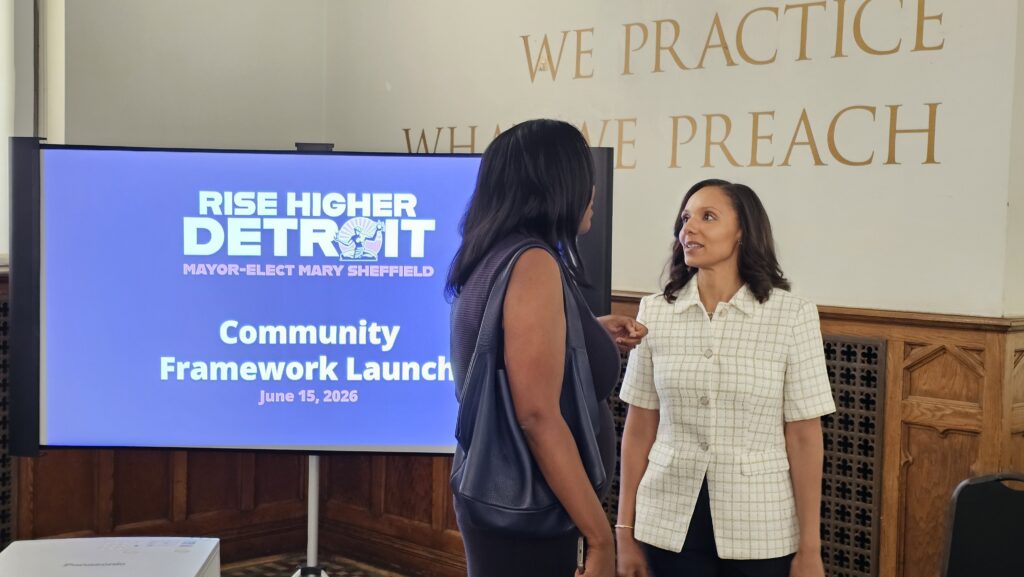
Long before the speeches began Monday, June 15, at Marygrove Conservancy, Detroiters had already spent months telling Mayor Mary Sheffield what they want their city to become.
They shared their concerns in surveys, community meetings, neighborhood gatherings, coffee shops, laundromats, grocery stores and basketball courts. They talked about the lack of grocery stores in some neighborhoods, the challenge of finding jobs that pay enough to support a family, the need for safer communities, stronger youth programs and a government that listens before making decisions.
Now, those conversations have been compiled into a 116-page document that Sheffield says will serve as a blueprint for her administration.
Standing before a crowd of residents, community leaders, and members of her transition team, Sheffield formally launched the Rise Higher Detroit Community Framework, a report built from more than 8,000 survey responses and input from over 1,200 residents who attended community conversations across the city.
“This community framework will not just sit on a shelf in our office,” Sheffield said. “It is the cornerstone this administration will return to again and again as we shape policy decisions from the people of this city.”
The framework is the culmination of what Sheffield has described as the largest community-driven mayoral transition effort in Detroit history. Supported by approximately $2 million in philanthropic funding and involving more than 300 civic, business, and community leaders, the process began immediately after Sheffield’s election victory last November.
But while the report contains dozens of recommendations across issues ranging from transportation to economic development, its broader significance may be what it reveals about Detroit itself.
The findings arrive at a moment when the city continues to attract investment, create jobs, and celebrate a decade of recovery since emerging from bankruptcy. Yet many Detroiters remain disconnected from that progress.
One out of every three city residents experienced poverty in 2024, and that number was worse (more than 50%) for youth, according to federal data. At the same time, jobs located within Detroit carry some of the highest average wages in Michigan. The challenge, residents repeatedly told city leaders, is ensuring Detroiters can access those opportunities.
Among the top priorities identified in the framework are expanding access to quality jobs, attracting more grocery stores, improving transportation, increasing neighborhood investment, reducing barriers for young people, and creating safer communities through prevention as well as enforcement.
Those themes surfaced repeatedly throughout the engagement process.
“We reached out to everybody,” said Donna Givens Davidson, president and CEO of Eastside Community Network, one of several organizations that helped conduct outreach. “We went to coffee shops. We went to grocery stores and laundromats. We went to the places that people gravitate to.”
Organizers intentionally moved beyond traditional public meetings, seeking input from residents who may never attend a city council session or government hearing. Surveys were offered in five languages, and community groups spent months knocking doors and facilitating conversations in neighborhoods across Detroit.
What emerged was a portrait of a city eager to participate in shaping its future.
“This is not a check-the-box exercise,” said Skillman Foundation President and CEO Angelique Power, a committee leader who helped oversee recommendations related to education and youth development. “Young people in Detroit are too important for that.”
The education and youth committee included high school students alongside nonprofit leaders, educators, and community advocates. Power said their message was consistent: Detroit has opportunities for young people, but navigating them can be difficult.
Residents called for expanded after-school programming, more mentorship opportunities, stronger mental health support, and better transportation options that connect youth to jobs, enrichment activities, and educational resources.
Several initiatives already launched by the Sheffield administration reflect those priorities, including the Rise to Ride transportation program, increased investment in after-school programming, and support for families through the Rx Kids initiative.
Youth advocates said residents repeatedly emphasized that transportation and mental health services should not be viewed as extras.
“They’re the baselines,” Power said. “They’re what set the conditions for whether young people can show up and participate.”
Public safety emerged as another area where residents pushed for a broader conversation.
According to Teferi Brent, Director of the Mayor’s Office of Neighborhood and Community Safety, Detroiters consistently linked neighborhood conditions and community safety. Residents argued that quality housing, youth programming, public spaces, and reliable city services all contribute to whether people feel safe in their neighborhoods.
That feedback helped shape recommendations emphasizing violence prevention, intervention and community-based solutions alongside traditional law enforcement strategies.
The administration pointed to several early actions that align with those priorities, including the creation of Detroit’s first Office of Neighborhood and Community Safety, expanded community violence intervention programs and investments in recreation and youth engagement efforts.
The framework also reflects a recurring theme heard throughout the transition process: residents want government to show up before a crisis occurs, not only after.
That philosophy has influenced some of Sheffield’s early initiatives, including partnerships between police officers, and mental health professionals, expanded neighborhood safety programming and efforts to address longstanding concerns about housing, property assessments and economic opportunity.
David Bowen, Sheffield’s chief of staff, described the framework as a guide not only for city government but for community organizations, foundations and institutions making decisions throughout Detroit.
A public dashboard accompanying the framework will allow residents to review priorities by topic, demographic group and geographic area.
“Our very next step is launching the community framework digital dashboard,” Bowen said. “It allows residents, community organizations, city staff, elected officials and other decision-makers to see what Detroiters need and what our diverse communities’ priorities are.”
The challenge now shifts from listening to implementation.
Several speakers acknowledged that not every recommendation can be accomplished immediately. Yet they argued the process created something equally important: shared ownership.
Residents were not simply asked to provide feedback, organizers said. They were invited into the process of governance itself.
Andrea Batista Schlesinger, who specializes in designs strategies that make cities more inclusive and growth more equitable, served as a key advisor in crafting the transition strategy, and has worked on mayoral transitions across the country. Batista Schlesinger called Detroit’s effort unique, citing both the scale of participation and the seriousness with which residents approached the process.
“You have offered a roadmap,” Batista Schlesinger told attendees. “The mayor said, ‘Give me my roadmap,’ and you have offered one.”
Whether the framework ultimately transforms city policy remains to be seen. But Monday’s gathering made one thing clear: thousands of Detroiters expect their voices to remain part of the conversation.
For Sheffield, whose administration is still in its early months, that may be the framework’s greatest test. The report captures what Detroiters want. The next chapter will determine whether City Hall can deliver it.
To read the entire report, visit detroitmi.gov/government/mayors-office/rise-higher-detroit-survey.