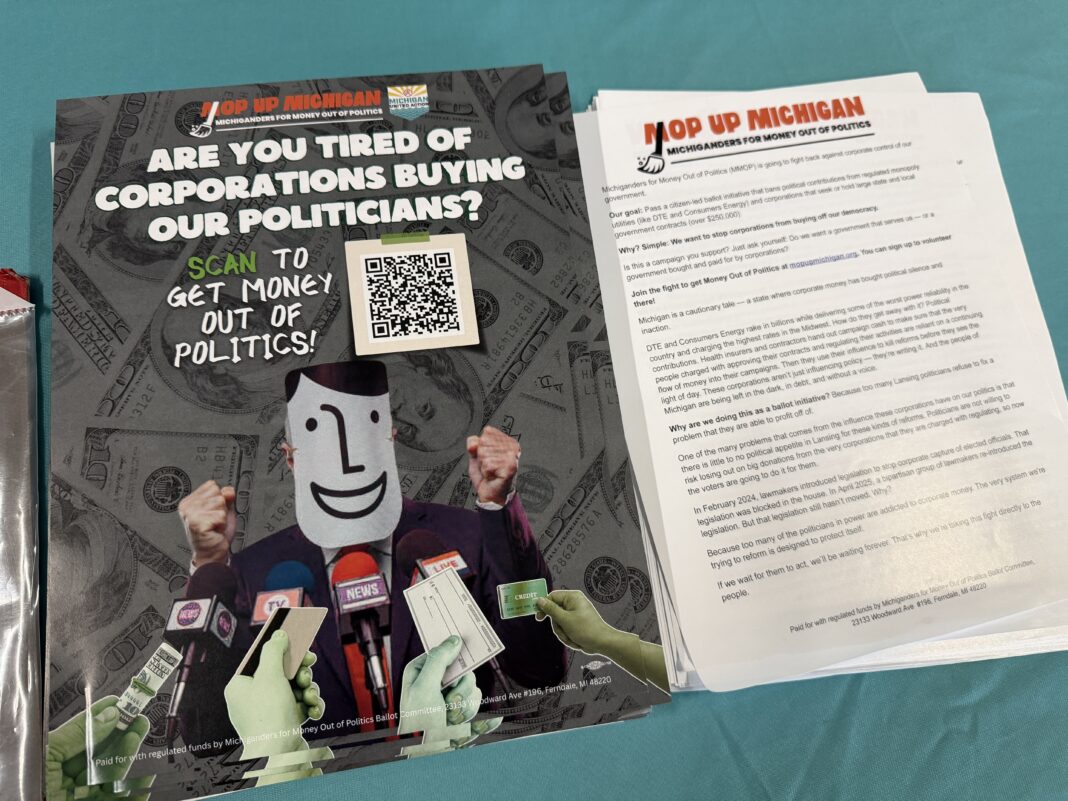

A ballot effort says it is confident voters will be able to decide whether large corporations contribute to politicians after turning in 561,468 petition signatures on Wednesday, the deadline for turn in.
Organizers and leaders with Michiganders for Money out of Politics stood in front of the Michigan Bureau of Elections Wednesday with dozens of boxes of petition sheets. Those forms are heading to the Board of State Canvassers which will decide whether there are enough valid signatures to certify the initiative to put it on the ballot.
The effort would ban DTE Energy, Consumers Energy and certain companies that do business with the state from political spending.
“People are going to care about the fact that they can stop the people who are raising prices on them from continuing to buy the lawmakers who are supposed to represent us,” said Sean McBrearty, a co-chairman for Michiganders for Money Out of Politics.
The group needs at least 356,000 valid voter signatures required to put its initiated legislation on the ballot.
The Money out of Politics group gathered signatures through a coalition of groups, including: Clean Water Action, Climate Cabinet, Detroit Action, Hip Hop Caucus Action Fund, Michigan League of Conservation Voters, Michigan United Action, MOSES Action, and Voters Not Politicians.
It’s also supported by some Republicans, like Rep. Jim DeSana, R-Carlton, who says he doesn’t believe politicians can be trusted to fix the issues caused by the influence of corporate donors.
Should the proposal make the ballot and be approved by voters in November, DTE Energy and Consumers Energy would be banned from “making direct or indirect campaign contributions to those who run for or hold offices that impact them,” the petition states.
Companies with at least $250,000 a year in state government contracts would also be barred from sending money to political campaigns through political action committees.
That includes Blue Cross Blue Shield of Michigan, a frequent contributor to political candidates and campaigns, which holds nearly $300,000 million in contracts with the state for state employee health insurance and Medicaid.
The initiative would also expand campaign finance laws to disclose donors on advertisements for candidates or ballot questions, even if they do not expressly advocate voting for or against them. Current law requires disclosure only for groups that run ads expressly suggesting how to vote.
DTE Energy, Consumers and other companies that would be barred from political spending should the effort pass are pushing back, saying it bars their free speech. Others have pointed out the effort is using dark money from out-of-state sources to bolster its effort.
McBrearty on Wednesday addressed critics of the effort in an interview with Michigan Chronicle.
“The money that we’re using in this ballot initiative, regardless of its source, we are following all the rules that we have right now, and we’re using this money to shine a light on the dark money that has been perverting our political system for way too long,” McBrearty said.
McBrearty’s confident the initiative will not only end up on the November ballot, but will also be approved by voters he says are fed up with the current campaign finance system.
“When it comes to how we’re going to win this campaign, the only thing that can beat the power of organized money is the power of organized people, and that’s what we have,” he said.
Organizers were dedicated, McBrearty said. They gathered signatures through the cold of the winter until this month. One gatherer who fell sick ended up passing out the petitions to nurses from her hospital bed, McBrearty said.